Commentary Prepared by Dr. Julia Lenaghan, Ashmolean Museum
C 045
Diomedes. Munich
Marble
Statue
1.02 m
Acquired in Paris in 1815 from the Albani collection. Thus, the statue probably came from Italy.
Germany, Munich, Glyptothek, 304
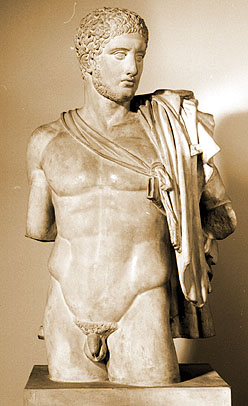
Preservation:The statue is missing, the right leg from the upper thigh downwards, the left leg from the hip downwards, and the right forearm, all of which were at one point restored; the restorations have now been removed. In addition, the statue is missing the left arm from just under the elbow downwards. The penis and testicles have broken off and were also once restored. The head, which is broken through the neck, fits perfectly on the body. On the face the nose is missing and the eyebrows and lids are slightly chipped.
The lower half of the chlamys which hung in front and in back is missing. The top and bottom ends of the scabbard are missing. They too had been restored but the restorations have been removed. Below the left shoulder at the height of the armpit there is in the drapery a raised rectangular break surface with a drill hole. At the beginning of the right thigh are two, possibly modern, drill holes with a strut to the no longer preserved right forearm. The entire front side of the statue is cleaned
Description:The statue depicts a naked male who wears a scabbard on a band of cloth and a chlamys piled on the left shoulder. The weight of the statue was on the right leg as the raised right hip indicates. The right arm is lowered and so, therefore, is the right shoulder. The upper right arm pulls back and slightly away from the body so that the right pectoral projects forward. The left shoulder, which is raised slightly, is covered by the thick heavy folds of the chlamys that is gathered on it. The chlamys falls down on both the front and the back side of the left half of the body; its falling material is attached by a strut to the left butthock. The left upper arm is pulled slightly upward and mainly backward. The forearm, which was probably parallel to the ground, projected forward. The head turns vigorously to the left. The band of cloth, on which the scabbard is held, is knotted above the left nipple. Just above the knot and in the drapery of the chlamys is a rectangular area with a drill hole that must have been connected to some attribute.
The body is wonderfully modelled which allows the skeletal and fully developed muscular structure to appear. Particularly well-defined are the abdominals, the pectorals, the bottom edge of the rib cage, the illiac furrow, the linea alba, and the lateral area of the lower back.
The skull, which has a high crown, is covered by a tight cap of hair. The hair falls in short curly locks which are arranged in rows that radiate away from the crown. Drill channels, sometimes quite deep, often differentiate the locks which feature engraved lines that delineate strands. Over the brow the hair follows an arched line. There is a small parting of the ends of the locks over the inner corner of the left eye. In general the ends of the locks on the brow are small and bend in the same direction as the adjacent locks. The ears are left uncovered by the hair. The hair of the beard is rendered similarly to the hair on the head but lacks the volume of the hair of the head; it has no deep drill channels.
The face appears to have almost “portrait” details. It has a long oval shape with thin cheeks and distinctive eyes and lips. The eyes are narrowly spaced with a drooping tear duct. The upper lid has a heavy form, arches only slightly, and has a crisp edge. The lower lid droops significantly downwards. The lips, which form a relatively small mouth, are separated by a deep groove and appear to be open. The thinner upper lip hangs sharply over the lower lip at the center of the mouth. The lower lip is much fuller. In addition, a furrow divides the upper area of the brow from the lower convex area. Also the beard, which passes only under the chin, has an individual aspect.
Discussion:The statue is a copy of a type known in possibly five statues; 1) a statue from Cumae now in Naples which is the most complete and generally considered best example of the type, 2) the Munich statue, 3) a now lost statue of which there remains a cast of the head in Dresden, 4) a statue in the Louvre considered by Vierneisel-Schlorb not to be a strict copy, 5) an unpublished statue found in Perge. In addition, there are seven heads of the type preserved. Of these heads four (Ny Carlsberg Glyptotek fragment, Boston, Rome-Conservatori, and Rome-Museo Nazionale) are true copies. The other three (Roman art gallery, Rome-Palazzo Odescalchi, the Prado) are all loose Roman variations on the type.
The Munich statue has been dated to the late Hadrianic or early Antonine period by both Lauter and Vierneisel Schlorb. They consider the rendering of the face, particularly the small mouth, the weak eyes, and the soft waxy skin, and the rendering of the hair, which has some deep drill channels, similar to portraits of the Hadrianic or early Antonine period. Vierneisel Schlorb compares the statue specifically to examples of the first portrait type of Marcus Aurelius.
In 1868 the subject of the original model was identified by Brunn as Diomedes holding the Palladion in his left hand. The general appearance and dress, the contracted left arm, and the active pose of the statue correspond to other representations of Diomedes. Moreover, a bronze statuette in Melida still preserves the Palladion held in the left hand. Coins from Argos, the fatherland of Diomedes, dating to 380-360/343 BCE and to the imperial period, show the figure and, thus, suggest that the original model was erected there.
The pose and general appearance of the original are repeatedly compared to the similar pose and appearance of “Doryphoros” of Polykleitos. The weight leg, the contrapposto position, and the fully developed torso of the Diomedes are like those of the “Doryphoros”. Unlike the “Doryphoros”, however, Diomedes turns dramatically toward the loose non-weight bearing leg, and the right arm shows some tension. The stillness of the “Doryphoros” is replaced with a sense of action. Moreover, the Diomedes is slightly slimmer than the “Doryphoros”. Nonetheless, both original models were roughly contemporary. In addition, Vierneisel-Schlorb goes to great length to point out the similarities of the model to particular figures on the metopes and frieze of the Parthenon which would also be contemporary.
Scholars have in the past tried to associate the Diomedes with a known artist. Since Lykios, the son of Myron, was known to have sculpted a dedication in Olympia which included Diomedes, V. Poulsen and G. Lippold assign the statue to him. P. Orlandini considers it to belong to the circle of Polykleitos because of its obvious similarity to Polykleitan works. Furtwangler considered it to be a work of Kresilas whom he recognized as the sculptor of the Capitoline Amazon, the Velletri Athena, the Medusa Rondanini, and the Perikles. Because there is little doubt that Kresilas was responsible for the statue of Perikles and because she considers the Perikles to resemble significantly the Diomedes (hair, beard, and eyes), Vierneisel-Schlorb has recently championed the argument for the attribution of Diomedes to Kresilas. She further argues that Kresilas probably worked on the Parthenon with Phidias. She also suggests that the statue was loosely based on a painting of Polygnotos, which stood in the north wing of the Propylon. From this painting, she believes, the images of Diomedes on Attic vases also derived.
Bibliography:H. Lauter,
Zur Chronologie romischer Kopien nach Originalen des V. Jhr. (Bonn 1968) p.113 no.7, see also pp.112-114
dates the statue to the late Hadrianic-early Antonine period, gives the replica list of the typeB. Vierneisel-Schlörb,
Katalog der Skulpturen Band II: Klassische Skulpturen des 5 und 4 Jahrhunderts v. Chr. (Munich 1979) pp.79-99 no.9
considers the copy of an early Antonine work based on an original by Kresilas-the best copy of which is the statue from Cumae.B. S. Ridgway,
Fifth Century Styles in Greek Sculpture (Princeton 1981) pp.181-184 no.2
summary description of type,
Lexicon Iconographicum Mythologiae Classicae III (Zurich 1986) p.402 no.38
brief statement about statueW. Fuchs,
Die Skulptur der Griechen (Munich 1993) pp.88-90 no.83
summary description of type, the original of which he dates to about 430