Commentary Prepared by Dr. Julia Lenaghan, Ashmolean Museum
B 145
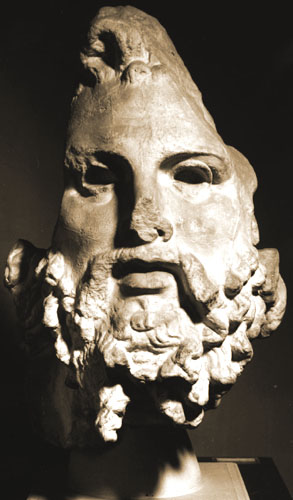
Head of Anytos from Lykosoura. Athens
Head of Anytos. From an acrolithic cult statue made by Damophon for the Temple of Despoina at Lykosoura, ca. 215-180 BC.
Marble
Head
83 cm (Kavvadias), 74 cm (Karouzou)
From the Temple of Despoina at Lykosoura. Found with many fragments (now in the National Museum at Athens or in the Lykosoura Museum) of a colossal cult group composed of four statues.
Greece, Athens, National Museum, 1736
Late third-early second century BC
Preservation:The head, hollowed out behind, is preserved with reattached fragments of the neck and neighboring bust and shoulder areas-- of these the Ashmolean Museum cast only features a fragment from the right side of the neck. The tip of the nose has broken off. Substantial sections of the upper part of both sides of the head were never wrought in marble. On the right side, the missing area runs from the cheekbone on the face vertically up through the head. It includes the ear. On the left side the missing area begins in the region of the temples and slants inward towards the center of the brow as it rises. Around the back of the head, from to ear to ear, between the neck and the hair, is a curving slot into which presumably a helmet was fitted. Below this slot fall locks of hair, as if out from under a helmet. In the mass of only roughly worked hair covering the nape of the neck there is a cylindrical hole for the insertion of some object.
Description:This colossal head depicts a bearded man whose head and beard hair are unruly and thick. It has been hollowed out behind and clearly featured a helmet that was fitted over the head and inserted into a slot running between the neck and the hair.
The hair over the forehead springs upward in two rows of tufts. This hair sprung out from under the helmet. The brow bulges, particularly over the bridge of the nose, and has two horizontal lines. The eyes were worked separately in another material and inserted. Although they are now missing, their sockets are deeply set below the eyebrows. The mouth is slightly open and the lower lip is especially full. Hanging from the face are the long corkscrew locks of the beard. Behind the groove for the insertion of the bottom edge of the helmet thick twisted locks of hair tumble downwards.
Discussion:This head of a bearded and helmetted belongs to an acrolithic colossal cult statue of the giant Anytos made by Damophon of Messene for the city of Lykosoura in the late third century or early second century BC. The cult statue belonged to a cult group composed of four statues: Demeter (cat.B 144), Despoina, Artemis (cat. B 143), and Anytos. The group rested on a large T-shaped based at the back of a hexastyle prostyle temple dedicated to Despoina. For general information on the group, see cat. B 142.
Without the aid of Pausanias, it would be impossible to identify this bearded male head. Yet fortunately Pausanias (8.37) tells us that near the seated statue of Despoina stood the Titan Anytos, a male figure in armor, who protected Despoina when she was a child. In addition to the head, which clearly wore a helmet, fragments of Anytos’ cuirass have also been identified. The coin from Megalopolis may show the figure rested its right arm on a shield placed vertically at his side. No published fragments confirm this.
The head type of Anytos is an iconographically typical representation of an older non-mortal male figure. The head is generally discussed in conjunction with the contemporary and similar head from a cult statue of Zeus at Aigeira (made by Eukleides of Athens). Both feature the stylistic tendencies-- such as thick lips, impressionistic hair, large eyes, and a bulging brow-- of the Hellenistic period.
Bibliography:P. Kavvadias,
Fouilles de Lycosoura (Athens 1893) 10-11 pl.3
brief description of excavation, first description of objectA. Daniel,
"Damophon" (JHS 24 1904) 41-57
detailed stylistic observation (to prove that the group dates to the fourth century BC)G. Dickins,
"Damophon of Messene" (BSA 12 1905) 109-136
discusses date of Damophon’s cult group at Lykosoura on basis of historic, architectural, and epigraphic details, concludes ca.180 BCG. Dickins,
"Damophon of Messene--II" (BSA 13 1906) 357-404, especially 380-383
discussion of fragments and reconstruction of all figures of cult groupG. Dickins,
"Damophon of Messene--III" (BSA 17 1910) 80-87
assessment of the bronze coin of Megalopolis featuring the group, with regard to Anytos broaches issue of shieldS. Karouzou,
National Archaeological Museum. Collection of Sculpture (Athens 1968) 172-173 no.1736
very brief catalogue entryE. Lévy and J. Marcadé,
"Au Musée de Lycosoura" (BCH 96 1972) 967-1004, especially pp.988-991
reassessment of Dickins restorations, especially regarding shoulder and himation, no comment about Anytos headA. Stewart,
Greek Sculpture. An Exploration (New Haven 1990) 94-96 and 304 figs.788-792
good summary of the group with bibliography, over emphasizes "classicism"R. R. R. Smith,
Hellenistic Sculpture. A Handbook (London 1991) 240-241fig.301. 2
brief discussion of group and Artemis, counters "neo-Classical" interpretationP. Themelis,
"Damophon" Personal Styles in Greek Sculpture (Cambridge 1996) 154-185, especially 167 and 178
dates Damophon’s work between late third and early second century on basis of Asklepeion at Messene and Messene inscription with seven decrees for him, notes technical aspects of head of AnytosE. Faulstich,
Hellenistische Kultstatuen und ihre Vorbilder (Frankfurt 1997) 167 and 207 no.12.18
discussion of statue and catalogue entry