Commentary Prepared by Dr. Julia Lenaghan, Ashmolean Museum
B 144
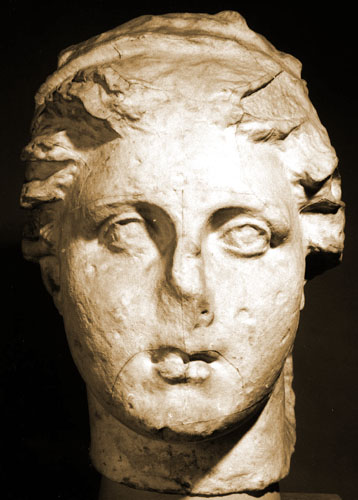
Head of Demeter from Lykosoura. Athens
Head of Demeter. From an acrolithic cult statue made by Damophon for the Temple of Despoina at Lykosoura, ca. 215-180 BC.
Marble
Head
80 cm
From the Temple of Despoina at Lykosoura. Found with many fragments (now in the National Museum at Athens or in the Lykosoura Museum) of a colossal cult group composed of four statues.
Greece, Athens, National Museum, 1734
Late third-early second century BC
Preservation:The head was worked separately from the base of the neck up. The area behind the crown of the head and a vertical area along the back right of the head have been deliberately removed The nose is chipped and there are fragments of hair and veil that are not visible on the Ashmolean cast. There are three slots on the sides of the head for additional elements. There is a vertical slot above the right ear; another with an arrowhead shape that runs horizontally through the hair over the left eye; and there is a smaller horizontal slot that runs over the left ear. There are eighteen holes, some still filled with iron, in the area between the circlet and the edge of the mantle that is pulled over the head. There were probably initially as many as 21 of these holes for a diadem of projecting rays.
Description:The colossal head depicts a female wearing two crowning items and with a mantle pulled over the top of the head. The mantle, falling from the top of the head to the shoulders, is preserved at the back of the head and in an additional fragment that joins the right side of the head. The figure has long hair that is parted in the center and pulled back, covering the tops of the ears. The hair is rendered in thick chunky “impressionistic” locks. Locks falling down the shoulders are visible on the inside of the mantle that is pulled over the head. Some features in the hair were added in wood as the slots at the sides of the head indicate.
The face has full oval shape with a prominent small round chin. The eyebrows slope downwards at their outer corners. The eyes below are wide and feature incised irises. The mouth is short from side to side and features full pouting lips that seem tucked into the cheeks.
A circlet that is round in section runs around the head. Between it and the edge of the mantle pulled over the head are holes and some iron remnants of projecting rays that formed some sort of solar crown. The upper part of the back of it has been intentionally removed as has a vertical piece on the back right side of the head. The mantle is rendered around these removed portions.
Discussion:This colossal head depicts Demeter and belongs to an acrolithic cult statue made by Damophon of Messene for the city of Lykosoura in late third century or early second century BC. The Demeter statue belonged to a cult group depicting Demeter, Despoina, Artemis (cat. B 143), and Anytos (cat. B 145). The group was on a large T-shaped based at the back of a hexastyle prostyle temple dedicated to Despoina. For general information on the group, see cat. B 142.
Demeter was the second most important figure of the cult. Raped by Poseidon who took the form of a horse, Demeter gave birth to Despoina. Angered by Poseidon, Demeter remained in a cave and caused crops to fail. Poseidon eventually convinced her to emerge from the cave and her daughter was then worshipped as a goddess of nature.
Pausanias (8.37) decribes the statue of Demeter as seated with a torch in her right hand and resting her left hand on Despoina’s shoulder. Almost the entire statue is preserved in fragments and these fragments correspond to Pausanias’ description. The statue of Demeter appears to have worn one virtually sleeveless garment belted at the waist and sat with the left leg pulled back and the right leg extended forward. The exact position of the right arm has occasioned some discussion both on the basis of the coin from Megalopolis and on the basis of new fragments. Similarly the exact position of the left hand is not clear since the palm of the hand is completely worked and, therefore, probably did not rest directly on Despoina’s shoulder.
The head is unlike the other heads preserved from the group in that it has eyes made from the same piece of marble as the head. Many scholars (eg. A. Stewart) have stressed the classical aspect of the head of Demeter, comparing it, for instance, to the head of the Athena Parthenos of Pheidias. The scholars have used the fact that Damophon was hired to repair Pheidias’ Zeus at Olympia to sustain arguments that Damophon was a deliberately neo-classical artist. However, the heads of the Lykosoura group on careful inspection show no indication of a conscious classicism.
J. Lenaghan
Bibliography:P. Kavvadias,
Fouilles de Lycosoura (Athens 1893) 9 pl.1
brief description of excavation, first description of objectA. Daniel,
"Damophon" (JHS 24 1904) 41-57
detailed stylistic observation (to prove that the group dates to the fourth century BC)G. Dickins,
"Damophon of Messene" (BSA 12 1905) 109-136
discusses date of Damophon’s cult group at Lykosoura on basis of historic, architectural, and epigraphic details, concludes ca.180 BCG. Dickins,
"Damophon of Messene--II" (BSA 13 1906) 357-404, especially pp.365-370
discussion of fragments and reconstruction of all figures, including DemeterG. Dickins,
"Damophon of Messene--III" (BSA 17 1910) 80-87
assessment of the bronze coin of Megalopolis featuring the group, with regard to Demeter discusses position of right armS. Karouzou,
National Archaeological Museum. Collection of Sculpture (Athens 1968) 172 no.1734 pl.57
very brief catalogue entryE. Lévy and J. Marcadé,
"Au Musée de Lycosoura" (BCH 96 1972) 967-1004, especially pp.967-979
reassessment of and additions to Dickins restorations on basis of more fragments, virtually no comment about head of Demeter statueA. Stewart,
Greek Sculpture. An Exploration (New Haven 1990) 94-96 and 304 figs.788-792
good summary of the group with bibliography, over emphasizes "classicism"P. Themelis,
"Damophon von Messene. Sein Werk im Lichte der neuen Ausgrabungen" (AntK 36 1993) 26 pl.3.4-6
brief stylistic discussion of group and illustrations of Demeter’s head from three sidesP. Themelis,
"Damophon" Personal Styles in Greek Sculpture (Cambridge 1996) 154-185, especially 167
dates Damophon’s work between late third and early second century on basis of Asklepeion at Messene and Messene inscription with seven decrees for himE. Faulstich,
Hellenistische Kultstatuen und ihre Vorbilder (Frankfurt 1997) 164-165 and 202 no.12.1
discussion of statue and catalogue entry for head