Commentary Prepared by Dr. Julia Lenaghan, Ashmolean Museum
B 143
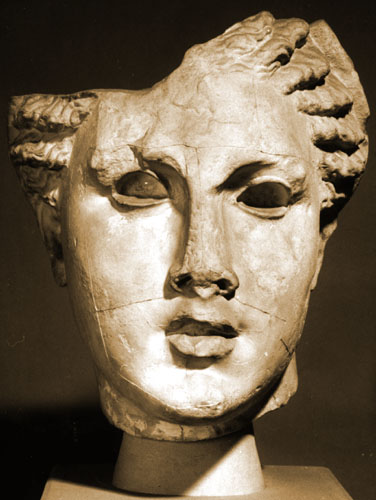
Head of Artemis from Lykosoura. Athens
Head of Artemis. From an acrolithic cult statue made by Damophon for the Temple of Despoina at Lykosoura, ca. 215-180 BC.
Marble
Head
48 cm, (total standing statue ca. 3.70 m)
From the Temple of Despoina at Lykosoura. Found with many fragments (now in the National Museum at Athens or in the Lykosoura Museum) of a colossal cult group composed of four statues.
Greece, Athens, National Museum, 1735
Late third-early second century BC
Preservation:The head was made separately from the neck up and was deliberately hollowed out at the back. It is missing a separately worked portion at the upper right side of the brow and the inserted eyes. The right eyebrow, the nose, the lips, and the rim of the left ear are broken. There are holes in the ear lobes for the insertion of earrings.
Description:The head is colossal in size and the back of it has been intentionally hollowed out and a portion of the brow over the right eye was added separately. The head depicts a young female with a "melon" hairstyle-- that is, small delineated parallel rows of short hair that run from the nape to the brow. This hairstyle leaves the ears uncovered. Small holes in the lobes (not visible on the Ashmolean cast) show that they once had earrings. Around the head is a circlet that is round in section.
The face has long oval shape with smooth full cheeks, regular features, and a small projecting round chin. The eyes were worked separately in another material and inserted. The lips are full but small from side to side.
Discussion:This head of Artemis belongs to an acrolithic colossal cult statue made by Damophon of Messene for the city of Lykosoura in late third century or early second century BC. The cult statue belonged to a cult group depicting Demeter (cat.B 144), Despoina, Artemis, and Anytos (cat. B 145). The group was on a large T-shaped based at the back of a hexastyle prostyle temple dedicated to Despoina. For general information on the group, see cat. B 142.
Pausanias (8.37) writes that the statue of Artemis is at the side of Demeter and that Artemis, accompanied by a dog, wears a fawn skin and a quiver and holds a torch and two snakes. Preserved fragments confirm all of these details except for the dog. The right hand held a torch and the left hand with snakes are unusual attributes for Artemis. The connection of Artemis to the Demeter and Despoina group is not entirely evident and may not have been clear in antiquity either. Pausanias explains that in Arcadia Artemis was recognized as a daughter of Demeter, which may or may not have been the real reason. Another potential connection between Artemis and Demeter-Despoina is their feminine character and special relationship to nature. The unusual snakes in Artemis’ hand, making her a chthonic deity, is particular to Arcadia where similar Artemises are attested.
The Lykosouran Artemis and Demeter statues, which originally stood on the proper right side of the base, are preserved in the greatest number of fragments. They seem to have been dismembered at their original location.
The Artemis head is the smallest of those preserved from the group. The statue, thus, seems to have been the smallest. This is in keeping with Artemis’ youth and secondary status in the sanctuary of Despoina. The hairstyle, the “melon frisur”, is also a detail associated with youth. The thin legs of the statue suggested to Dickins that a portion of drapery must have hung around the legs in order to give the statue extra support. He noted a statue in the Despuig collection in Majorca that featured this detail and might have been a conscious imitation of the Artemis of Lykosoura. Subsequent scholars have agreed with these observations.
J. Lenaghan
Bibliography:P. Kavvadias,
Fouilles de Lycosoura (Athens 1893) 10 pl.2
brief description of excavation, first description of object.A. Daniel,
"Damophon" (JHS 24 1904) 41-57
detailed stylistic observation (to prove that the group dates to the fourth century BC)G. Dickins,
"Damophon of Messene" (BSA 12 1905) 109-136
discusses date of Damophon’s cult group at Lykosoura on basis of historic, architectural, and epigraphic details, concludes ca.180 BCG. Dickins,
"Damophon of Messene--II" (BSA 13 1906) 357-404, especially 377-380
discussion of remains and restoration of statueG. Dickins,
"Damophon of Messene--III" (BSA 17 1910) 80-87
assessment of the bronze coin of Megalopolis featuring the group, with regard to Artemis discusses position of legs and dogS. Karouzou,
National Archaeological Museum. Collection of Sculpture (Athens 1968) 173 no.1735
very brief catalogue entryE. Lévy and J. Marcadé,
"Au Musée de Lycosoura" (BCH 96 1972) 967-1004, especially 991-996
reassessment of and additions to Dickins restorations on basis of more fragmentsA. Stewart,
Greek Sculpture. An Exploration (New Haven 1990) 94-96 and 304 figs.788-792
good summary of the group with bibliography, over emphasizes "classicism"R. R. R. Smith,
Hellenistic Sculpture. A Handbook (London 1991) 240-241 fig.301.3
brief discussion of group and Artemis, counters "neo-Classical" interpretationP. Themelis,
"Damophon von Messene. Sein Werk im Lichte der neuen Ausgrabungen" (AntK 36 1993) 26 pl.3.4-6
brief stylistic discussion of group and illustrations of Artemis’ head from three sidesP. Themelis,
"Damophon" Personal Styles in Greek Sculpture (Cambridge 1996) 154-185, especially 167
dates Damophon's works between late third and early second century on basis of Asklepeion at Messene and Messene inscription with seven decrees for him.E. Faulstich,
Hellenistische Kultstatuen und ihre Vorbilder (Frankfurt 1997) 166-167 and 205-206 no.12.12
discussion of statue and catalogue entry for head