Commentary Prepared by Dr. Julia Lenaghan, Ashmolean Museum
B 103
Sisyphos I. Delphi
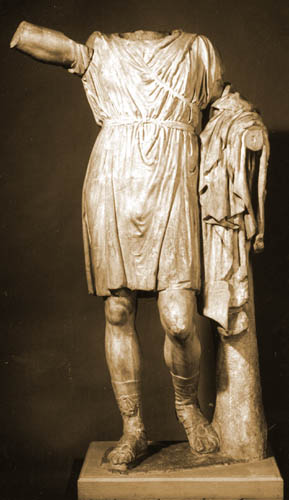
Portrait statue of Sisyphos I, a successful military man, from the Daochos monument (337-332 BC) at Delphi.
Marble (Parian)
Statue
1.795 m
From Delphi. Found northeast of the Temple of Apollo on a long limestone base.
Greece, Delphi, Museum, 1921, 1953
336/335-333/332 BC
Preservation:The head, neck, right forearm and hand, and left wrist and hand are missing. The body is recomposed of several pieces: 1) the torso, left arm, the legs until the knees, and the tree trunk support until the bottom hem, 2) the plinth, feet, shins, and lower portion of the tree trunk support (up to the corner of the hanging drapery), 3-4) the legs, 5) the right upper arm and 6-7) small pieces around the left arm. There is a hole just above the diagonal baldric and just below the neckline at the front of statue.
Description:The statue shows a man dressed in a tunic which has short sleeves and, belted at the waist, reaches the knees. Although it is of a thick material, it does not hide the physique; the shape of the strong upper right leg and of the genitals emerges through it.
The right arm is raised and extends away from the body. It may have held an upright spear or been saluting the public. The left arm is bent at approximately a 90 degree angle and rests on a tree trunk. A heavy mantle is draped over the left forearm.
The right leg bears the weight of the body. The left leg is bent and the heel of the foot is raised. The sandals are made of many straps and reach the middle of the shin.
A sword band or baldric runs diagonally across the upper body, from the right shoulder to below the left armpit. It, however, features no place to fasten the sword.
Discussion:The headless statue is identified by an inscribed epigram on its base as Sisyphos I, son of Daochos I, a man particularly favored by Athena, goddess of war. The statue was part of the nine-figured family monument erected by Daochos II (Sisyphos I’s son) between 337 and 332 BC and dismantled already by the late second BC. For a full discussion of this monument, see cat. B 102.
The statue of Sisyphos I differs from the statues of his relatives from the same monument in its manner of dress and pose. Whereas other members of the family are commemorated for athletic ability (Agias, cat. B 102, Telamachos, and Agelaos) or for having held political positions (Aknonios, Daochos I, and Daochos II), Sisyphos I is noted for his military prowess. Thus, he is shown as a general, wearing a military tunic. With his raised right arm, he either held an upright spear or more probably saluted the troops.
This Sisyphos statue is supported by a tree trunk and not by marble supports behind the back of the shins. This is unlike all of the extant statues from the Daochos monument except that of Sisyphos II. This fact, however, does not allow one to conclude that this statue was or was not copied from a bronze statue. The hole at the neckline above the baldric is a more notable detail that defies explanation.
Julia Lenaghan
Bibliography:T. Homolle,
"Lysippe et l’ex-voto de Daochos" (BCH 23 1899) 421-485, especially 428-429
first publication of the statues and monumentJ. Pouilloux,
Fouilles de Delphes II. La Région Nord du Sanctuaire (Paris 1960) 67-80
discussion of archaeological contextT. Dohrn,
"Die Marmor-Standbilder des Daochos-Weihgeschenks in Delphi" (AntP 8 1968) 39-40
physical analysis of statueJ. Pouilloux,
Fouilles de Delphes III. Épigraphie IV (Paris 1976) 134-138 no.460
latest discussion of inscription which is dated between 337/336-333/332 BC(F. Chamoux),
Guide de Delphes: Le Musee (Paris 1991) 91-98
concise discussion of object and monument to which it pertainedL. Todisco,
Scultura greca del IV secolo (Milan 1993) 114-115 no.238
presents statue and standard view of monument