Commentary Prepared by Dr. Julia Lenaghan, Ashmolean Museum
B 102
Agias. Delphi
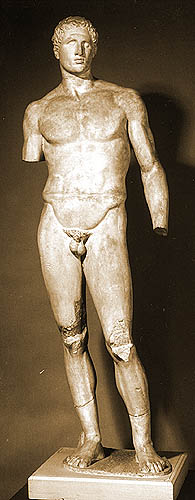
Portrait statue of Agias, a victorious boxer, from the monument of Daochos II (337-332 BC) at Delphi. Often related to a statue of Agias made by the sculptor Lysippos.
Marble (Parian)
Statue
2 m
From Delphi. Found northeast of the Temple of Apollo on a long limestone base.
Greece, Delphi, Museum, 1875
337/336-333/332 BC.
Preservation:The statue is missing the right arm (including the hand) from just above the elbow down, the left wrist and hand, the lower portion of calves, the knees, the supports behind the lower legs, the tip of the nose. There are breaks at the ankles, knees, and throat as well as in the left thigh and elbows. Parts of both lower legs above ankles and at knees are restored. The dowel holes in the break surfaces of the arms are modern.
Description:The statue depicts a nude male whose head turns toward the left shoulder. The body is athletic and has elongated proportions. The head is small and, consequently, the neck seems thick.
The face is long, slim (the widest point occurs below the eyes at the cheekbones), and unsymmetrical. The left side is narrower and not as carefully worked. The brow is tall and convex with a lower half that bulges. The eyebrows slant significantly downwards from the inner corners to the outer corners. They hood very deep-set small eyes. The nose is long and thick. The mouth is short from side to side with full lips that are slightly parted. The chin is a long smoothly shaped U without angular projections. The inner portions of the ears are swollen and are described as "cauliflower".
The hair is short, tousled, and without a part. It falls downward from the crown in short layers and is cut around the ears. Above the ears and running around the entire head, there is an indentation for a fillet.
To support the statue a block of marble was placed behind each leg. From a frontal viewpoint, this eliminates the awkward support of a tree trunk or other such item to the right or left of the statue.
Discussion:The statue is identified by an inscribed epigram on its base as Agias, son of Aknonios, a boxer who celebrated victories around 490-480 BC. The statue was part of a larger monument set up by Agias’ descendant, Daochos II, a tetrarch (ruler of the four provinces) of Thessaly, on a terrace north of the Temple of Apollo at Delphi. The monument was probably erected when Daochos II was the Thessalian representative (hieromenon) to Delphic council between 337/336 BC and 333/332 BC. One of the blocks of the base was re-used and re-inscribed with an inscription dated to 107 BC. Consequently, it seems that monument was dismantled in the late second century BC.
Daochos II’s monument, a long base surmounted by statues, was dedicated to Apollo and featured one statue of Apollo and eight statues of the men of Daochos’ family. Whereas the statue of Apollo had no corresponding inscription, each of the eight family members, who spanned six generations, was labelled with an inscription that indicated his virtues. Corresponding to his accomplishments, each was represented in a different pose or manner of dress.
Aknonios, son of Aparos, the family founder, was, like Daochos II, a tetrarch of Thessaly and was shown in a short cloak. His three sons, Agias, Telemachos, and Agelaos, were represented nude with inscriptions that cited their athletic victories. Daochos I, the son of Agias, who ruled peaceably for twenty-seven years, was depicted in a cloak with arms at his side. His son, Sisyphos I (cf. cat. B 103), singled out for military valor, was shown in a belted tunic in a gesture that may be reconstructed as saluting soldiers or leaning on a spear. The figure of Daochos II, son of Sisyphos I, the commissioner of the monument is unpreserved. His son, Sisyphos II, the family’s future, is depicted nude and resting on a herm, as if waiting for his moment of glory the exact nature of which is still unknown
The monument is extraordinary because it is a well-dated and almost fully preserved family monument. The statues, the inscribed base, and the setting allow us to reconstruct the monument as an ancient viewer would have seen it. Moreover, it is an early example of a trend, that would become ever more fashionable with time-- to erect a family monument in order to justify one’s position. This tendency corresponded to the political shift from the city (polis) to powerful individuals that began in the late fourth century BC.
The monument has received undue attention for another reason. The statue of Agias is related, at least in subject, to a statue of Agias erected at Pharsalos and made by a Lysippos. A transcription of an inscribed base at Pharsalos (IG IX,2 249) corresponds almost word for word with the inscription for Agias at Delphi. Although the two inscriptions disagree as to the number of wins Agias celebrated, the significant difference is that the inscription of the base at Pharsalos was signed “Lysipp…”. This last line has been restored as “Lysippos the Sicyonian made this.”
A hypothesis concerning these two bases is repeatedly cited as if it were fact. The hypothesis assumes that Daochos II, emulating his contemporary Philip who had erected a round temple with statues of his family at Olympia (the Philipeion), set up a family group in his home-town of Pharsalos, commissioning the famous Lysippos to make the statues. Since Lysippos, according to Pliny, worked in bronze, scholars assume the Pharsalos statues were bronze. When Daochos functioned as hieromenon at Delphi, scholars have postulated that he dedicated a marble copy of the Pharsalos monument at Delphi. In addition to being almost entirely hypothetical, the theory leaves obvious questions unanswered: for instance, how faithful might this copy have been to the original? How many statues were in the original monument? And did Lysippos make all the statues?
Ridgway has pointed out that the evidence for the Pharsalos monument is tenuous and that Delphi was a more prominent and important location. It has also emerged clearly that the hidden supports behind the legs of some of the Delphi statues (for example, Agias) occur in other contemporary works and do not prove that the marble statue was a copy of a bronze statue. Ridgway, therefore, suggests that the Pharsalos monument was a later version of the Delphi group.
The statue of Agias is generally thought to conform Lysippos’ style as understood from the written text of Pliny and the supposedly Lysippan statue of the Apoxyomenos (cat. C 113). It is said to feature characteristically Lysippan long, lean proportions and a small head. Yet the discussion has two flaws. First, we are not able to identify securely a Lysippan as opposed to general late fourth century style. Second and most importantly, even if the famous Lysippos was responsible for a bronze statue at Pharsalos that pre-dated the statue at Delphi, there is no reason to assume that the Delphi statue had to be a copy of the Pharsalos one.
It is important to understand that discussions concerning the style of the statues from the Delphi Daochos’ monument and attempts to identify some statues as copies of Lysippan works and others as works by other sculptors is not only not helpful but also misleading.
J. Lenaghan
Bibliography:T. Homolle,
"Lysippe et l’ex-voto de Daochos" (BCH 23 1899) 421-485
first publication, with development of the theory that the Delphi monument copies a monument at PharsalusH.E. Preuner,
Ein delphisches Weihgeschenk (Leipzig 1900) 17-24
first publication of Pharsalos inscriptionJ. Pouilloux,
Fouilles de Delphes II. La Région Nord du Sanctuaire (Paris 1960) 67-80
discussion of archaeological contextT. Dohrn,
"Die Marmor-Standbilder des Daochos-Weihgeschenks in Delphi" (AntP 8 1968) 34-35
physical analysis of statueA. Borbein,
"Die griechische statue des 4. Jahrhunderts v. Chr" (JdI 88 1973) 79-90
discussion of monument and its roleJ. Pouilloux,
Fouilles de Delphes III. Épigraphie IV (Paris 1976) 134-138 no.460
latest discussion of inscription which is dated between 337/336-333/332 BCA. Stewart,
"Lysippan Studies 2. Agias and Oilpourer" (AJA 82 1978) 301-313
stylistic commentary on the Agias and LysipposP. Themelis,
"Contribution à l’Étude de l’Ex-Voto Delphique de Daochos" (BCH 103 1979) 134-138
latest finds pertaining to group of Daochos: head of Sisyphos II and possibly the ApolloB. Hintzen-Bohlen,
"Die Familiegruppe- Ein Mittel zur Selbstdarstellung hellenistischer Herrscher" (JdI 105 1990) 134-137
places the Delphi monument in the context of family monuments in the Greek periodB. S. Ridgway,
Hellenistic Sculpture I: The Styles of ca. 331-200 BC (Bristol 1990) 46-50
best summary of monument in English, doubts that it copies a monument in Pharsalos(F. Chamoux),
Guide de Delphes: Le Musee (Paris 1991) 91-98
concise discussion of statue and monument to which it pertainedL. Todisco,
Scultura greca del IV secolo (Milan 1993) 114-115 no.241
presents standard view of monumentW. Fuchs,
Die Skulptur der Griechen (Munich 1993) 105-106 no.101
brief catalogue entry with bibliographyP. Moreno (ed),
Lisippo. L’Arte e la fortuna (Monza 1995) 81-82 no.4.11.1
traditional view, with attempt to distinguish hands of different masters among the different statues of the group; believes Agias to represent work of Lysippos.