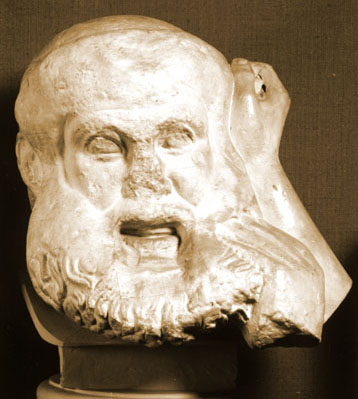
Cast Gallery catalogue number: A061a
Head of a Centaur, attacking a Lapith woman who grasps his beard and ear in defence.
See A061b for full composition.
- Plaster cast: Height: 55cm.
- Copy of the head of a marble Centaur.
- The Centaur:
- is from the west pediment of the Temple of Zeus at Olympia.
- was made about 460 BC.
- was found at Olympia and is now in Olympia Museum.
Detailed Record
Commentary Prepared by Dr. Julia Lenaghan, Ashmolean Museum
A 061 A
Centaur and Lapith Woman (N-O); Olympia West Pediment
Marble (Parian)
Pedimental Figure
H 250 cm; W 270 cm
From the west pediment of the Temple of Zeus. The various fragments were found in 1877 and 1878 scattered over a wide area to the west of the temple, some were built into later structures near the Echo-Hall and the Palaestra.
Greece, Olympia, Olympia Museum
ca. 460 BC; Early Classical
Preservation:The group consists of numerous joining fragments. The principle missing elements are: The head of the Lapith woman, parts of both of her arms, the lower part of her legs with the feet, and a section of the frontal part of her body together with a section of the centaur’s right front leg. The centaur is missing a large central section of the torso, a part of his left arm between the shoulder and the elbow, most of the right and a substantial part of the left hind leg, and a part of his tail together with the fingers of the right hand.
The entire surface is heavily weathered and worn off with large scores along the breaks. There are deep chips along the right flank of the centaur’s animal body, right hind leg, and right arm. His face is heavily abraded.
Description:The sculptural group shows a centaur trying to abduct a Lapith woman. He holds her between his raised front legs and has grabbed her around the waist with his left arm. His upper body is turned back and to the right, with the right arm stretched far behind, touching the raised tail. The centaur’s body is very powerfully built, the muscles are well defined. The ears (only the right ear is visible) are rendered in human form. He has long, unkempt hair that is reaching far down the forehead; above and on the sides it is framed by a horizontal groove. He has a long beard that touches his chest, only the ends of the locks are individually rendered. His face is wide with a flat nose and small eyes; the mouth is opened with the upper row of teeth visible.
The Lapith woman is attempting to break free from the centaur’s hold. She wears an Ionic chiton whose fine fabric is arranged in intricate folds; both her hands are stemmed against the centaur’s head.
Discussion:The considerable size of the group relates it to the central part of the west pediment, where it should be placed immediately to the right of Apollo (from the observer’s point of view), together with the figure of Theseus (A 60). Their fierce struggle has been translated into a powerful composition; the centaur’s hard, well-defined body is shown to best advantage through its frontal turn and the wide gesture of the right arm; the heavy face with the drunken smile vividly conveys the creature’s animal character. The Lapith woman is marked out through her garment: She is the only woman in the West pediment wearing an Ionic chiton. This identifies her as the nympheutria, or lady of honour.
Bibliography:G. Treu,
Die Bildwerke in Stein und Thon (= Olympia III) (Berlin 1895) 77-79; 110-111 figs. 121-122 pls. 26.2; 27.3
This is the thorough original publication providing details on findspot, preservation etc.B. Ashmole and N. Yalouris,
Olympia. The Sculptures of the Temple of Zeus (London 1967) 18; 178 pls. 92; 98-101; 105
A valuable and richly illustrated discussion including new fragments.