Cast Gallery catalogue number: A021
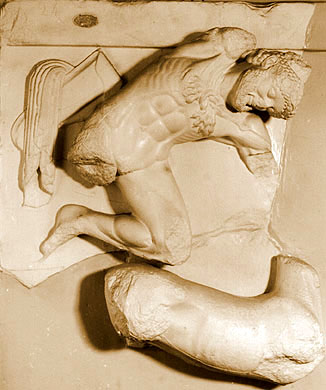
Herakles fights the Keryneian Stag.
See A023.
- Plaster cast: Height: 69cm.
- Copy of a marble metope.
- The metope:
Detailed Record
Commentary Prepared by Dr. Julia Lenaghan, Ashmolean Museum
A 021
Herakles and the Stag (Metope 19); Athenian Treasury, Delphi
Marble (Parian)
Metope
H 67 cm
From the Athenian Treasury at Delphi. The various fragments were found in 1893 scattered widely around the treasury.
Greece, Delphi, Museum, 67+86d+2027+405a
Late Archaic, after 490 BC
Preservation:Most of the left and the entire right arm, and the right leg of Heracles are missing. His left knee is scored, the face partly abraded. Only the torso of the stag is preserved. Most of the relief ground below Heracles and a large section around the lower right corner of the metope have broken off. (Not all preserved fragments are included in the cast).
Description:The scene depicts a bearded man, clad only with a lion skin draped around his shoulders, forcing down a stag. He has pressed his left leg on the stag’s back, and with his arms must have pulled back the antlers. The stag has broken down on his knees with its front legs, with the hind legs it tries to resist the pressure on its back. The male figure carries a quiver and mantle next to him. His muscles are well defined.
Discussion:The metope shows one of the labours of Heracles, the encounter with the Kerynitian stag. Heracles body is represented in a bold pose, extending well beyond the upper frame of the metope. The composition is familiar from contemporary vase-paintings, the way Heracles’ right leg does not touch the ground, however, is unusual. Like A 20, this metope belonged to a cycle depicting adventures of Heracles. See also A 20; 22-23.
Bibliography:J. Audiat,
"Le Tresor des Atheniens" (FdD II 1933)
Gives a full account of the architecture and reconstruction of the treasury.P. de la Coste-Messeliere,
"Sculptures du Tresor des Atheniens" (FdD IV 4 1957) 117-125 pls. 50-57
The thorough original publication of the sculptures. The Theseus metopes are reconstructed on the south and east sides, the Heracles metopes on the west and north. Following Pausanias a date after 490 BC is proposed.K. Hoffelner,
"Die Metopen des Athener-Schatzhauses. Ein neuer Rekonstruktionsversuch" (AM 103 1988) 77-117 foldout 5 (esp. 95 fig. 19)
Provides a detailed description of the metopes. H. argues for a date before 490 BC and offers a different reconstruction (Theseus metopes on south and north, Heracles metopes on the east and west sides; some 'Heraclesmetopes' are ascribed to Theseus.H. Knell,
Mythos und Polis (Darmstadt 1990) 52-63
Is a comprehensive account of the sculptural decoration and the chronological arguments.