Commentary Prepared by Dr. Julia Lenaghan, Ashmolean Museum
H 016
Epicurus (Group B). Aphrodisias
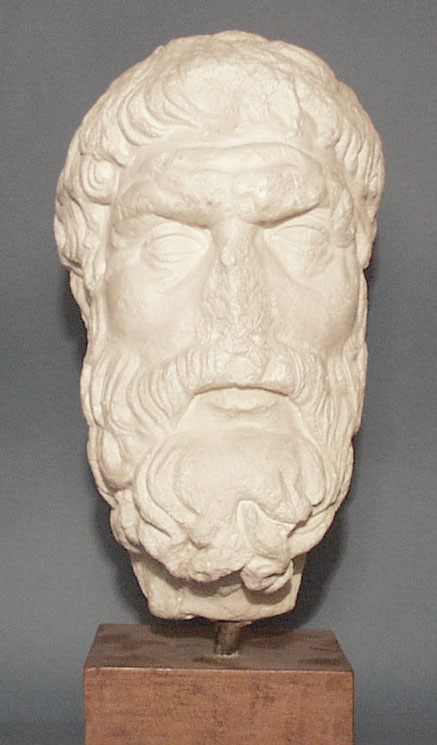
Roman period portrait of the philospher Epicurus (ca. 342-270 BC). Following a late Hellenistic or early Roman variation of an original model made ca. 270 BC.
Marble
Head
H: 31 cm., W: 16 cm., D: 22 cm.
From Aphrodisias. Stray find.
Turkey, Geyre, Aphrodisias Museum, excavation inv. 71-161
Early second century version of an original dating to ca. 270 BC
Preservation:The nose has been battered off. The locks of hair over the brow are battered. The back of the head is cursorily rendered and oddly shaped. The area behind the left ear is especially sunken and irregular in shape.
Description: The head is broken at the base of the neck. The back of the head is not carefully worked and is very irregularly shaped; it seems pressed inwards. The head depicts a bearded old man with cropped hair, a long face, and a striking brow.
The hair is cut around the ears and across the brow. The hair comes forward to the brow and temples. The locks are of medium length and are wavy around the brow and ears. Over the outer corner of the right eye successive locks turn to the left; adjacent to these locks, beginning over the inner corner of the right eye, are traces of locks, the ends of which twisted to the right. .At the back of the head the hair is cursorily rendered. Behind the right ear the hair is rendered schematically in parallel waves and behind the left ear it is rendered in sketched straight lines. The ears themselves are oddly placed and not symmetrical with one another.
The hair of the full beard is rendered, like the hair of the brow, in full wavy locks. Under the chin the beard hair acquires greatest volume. The beard parts slightly below the chin.
The face is long and narrow. The brow, framed by the medium-length full locks, is not especially tall but is markedly modelled. It features two furrows of which the upper one is longer; the furrows do not run parallel to each other but converge at the outer corners. The lower portion of the brow bulges in various sections. Vertical creases rises above the base of the nose and more significantly, the brow reflects the shape and movement of the remarkable eyebrows. The eyebrows contract forcefully, following a sharp downward path, at the root of the nose. Above the outer corners of the eyes, however, they arch highly. The arched section of the eyebrow bulges. The hair of the eyebrow seems to be rendered on the right side; it appears bushy. Beneath these eyebrows, the eyes are deep-set. At the outer corners of the eyes are wrinkles and just below that the cheekbones noticeably protrude. The bulge of the eye continues below the lower lid. Loose skin or “bags” are carefully delineated below the eyes. Across the base of the nose is a deep undulating fold. The mouth is broad with full, slightly parted lips. The moustache covers all but the center of the upper lip. The lower lip protrudes and below it is an emphatic indentation before the beard begins. The chin is entirely concealed.
Discussion:The Aphrodisias head, depicting a long-faced bearded older man with flaring eyebrows, represents the Athenian philosopher Epicurus (ca. 342- 270 BC). The portrait of Epicurus was reproduced in great number in the Roman period and probably derives from a portrait statue erected in the early part of the second quarter of the third century BC. The portrait statue of Epicurus is discussed in detail in cat. no. C 214. The Aphrodisias example has been dated to the early second century AD by Kruse-Berdoldt and von den Hoff for stylistic reasons.
The Epicurus portrait type is known in approximately 43 heads which fall into two groups that differ slightly from each other (see cat. no. C 214). Most of these heads have been grouped by Schmalz into ‘Group A’, and these probably faithfully reproduce the original. Not only are they more numerous but also the Capitoline head, which assuredly reproduces the folds of drapery around the neck with accuracy, falls into this category. It would be unlikely that a bust that depicts the folds rigorously would not depict the head type accurately.
The Aphrodisias head and three others (Copenhagen, Vatican, and Terme) constitute Schmalz’s group B. These versions differ from the others primarily in that they do not show a symmetrical arrangement of locks over the brow. The sickle-shaped locks over the right eye that turn to the left do not continue to a point at the center of the brow over the nose; they are confined to the right third of the brow. Several other locks are also altered, a small lock under the right moustache in the Group A versions is omitted, and the face is longer.
Schmalz attempted to show that the Group B portraits depended on a high Hellenistic rendition of an early Hellenistic portrait and that the Group A portraits depended on an adaptation of the high Hellenistic rendition. This difficult argument has, however, been properly dismissed by von den Hoff who returns to the simpler hypothesis that both groups depend on one early Hellenistic portrait. He points out that some of the B elements occur on some Group A portraits, that among the Group A portraits there are a series of other small variations, and that all of the portraits show the same arrangement of hair on the left side. Finally, contrary to Schmalz’s assertions, the Group B portraits were set up within a long chronological period (early to late Empire) and span large geographic areas. He concludes that group B may well represent a late Hellenistic or early imperial variation of that model.
J. Lenaghan
Bibliography:S. Dillon,
forthcoming article by S. Dillon (0)
G.M.A. Richter,
Portraits of the Greeks II (London 1965) 194-200
general discussion of the portraits of Epicurus, prior to the excavation of the Aphrodisias headV. Kruse-Berdoldt,
Kopienkritische Untersuchungen zu den Porträts des Epikur, Metrodor, und Hermarch (Göttingen 1975) Nachtrag
B. Schmalz,
"Das Bildnis des Epikur und die Überlieferung griechischer Portäts" (MarbWPr 1985) 20, 25, pls. 6-7
dates head to early imperial period, notes it belongs to the’ Type B’ version of the Epicurus portraitR. von den Hoff,
Philosophenporträts des Früh-und Hochhellenismus (Munich 1994) 69, no. 2, 71
lists Aphrodisias head and dates it in the fullest most recent discussion of the Epicurus portrait typeP. Zanker,
The Mask of Socrates (Berkeley 1995) 113-127
discussion of portraiture of the Epicureans