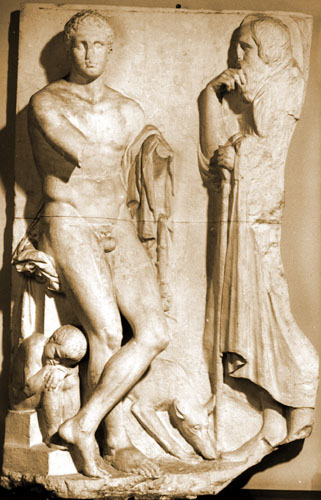
Old man with youth, boy, and dog.
Commentary Prepared by Dr. Julia Lenaghan, Ashmolean Museum
D 076
Illissos Relief; Athens
Marble (Pentelic)
Grave Stele
H 168 cm; W (pres.) 107 cm
The relief was found on December 12th, 1874 in the bed of the Ilissos river, Athens.
Greece, Athens, National Museum, 869
Late Classical, ca. 340-330 BC
Preservation:The right edge of the stele and a large section of the plinth from the left figure’s feet to the right corner have broken off. The right figure is severely damaged: A large part of the body closest to the viewer, including the left shoulder and arm, hip and thigh are missing. Also broken off are the figure’s nose and left foot. The left figure is missing the lower left arm and the right arm from the biceps, his nose and member have broken off. The surface of the relief is slightly scored in places but otherwise in good condition. The architectural frame of the stele is not preserved.
Description:The relief depicts three figures, two adults and a small boy. To the left, leaning against a pillar on a two-stepped base, is a muscular young man shown in three-quarter profile from the right, his head turned to face outwards. He is completely nude except for a long garment (probably a himation) draped over his left arm and the top of the pillar against which he rests. His legs are crossed; the left arm was bent in the elbow with the lower arm raised, the right arm held in front of the body. Below the left arm are the remains of a club. Crouching next to this figure on the base of the pillar is a small, naked boy. His head rests on his hands, which in turn are crossed over his knees. On the other side, behind the young man, is a dog.
The right side of the relief is filled by an old, bearded man with long hair. He is depicted in left profile, gazing towards the youth on the left. This man wears boots and is tightly wrapped in a himation. His left hand holds a long staff, the right is raised and touches his chin.
There are a number of small dowel holes next to the heads of both men for the attachment of metal wreaths (there is a small groove in the young man’s hair for the same purpose), and a larger dowel hole on the upper left rim of the stele for the attachment of a frame (these have been filled in on the cast).
Discussion:The Ilissos stele figures prominently in discussions of Classical Attic tombstones, both because of its high quality and the particular way the deceased is represented. Originally a naiskos stele with a distinct architectural frame, it would have been further enhanced by paint and metal attributes.
The focus of attention is on the athletic young man to the left. It is possible that he originally held a bronze spear in his hands, whose position is otherwise difficult to explain. He is completely nude, yet his club (a lagobolon) and dog characterise him as a hunter. At his feet crouches his pais, or slave boy, his head buried in his arms and seemingly overcome by grief. The old man on the right, normally identified as the young man’s father, has his hand on his chin in a pensive gesture: He is a distant onlooker, gazing intently at his prematurely deceased son. It is the relationship between these figures that is particularly interesting, with the complete lack of any sign of close contact between the dead and the living. On the contrary, the deceased is strongly marked out by his nudity and looks out of the intimate, confined space defined by the three figures. This nudity, acceptable for athletes in the gymnasium but highly unusual for a hunter, stresses the young man’s heroic qualities. As N. Himmelmann has pointed out, the relief thus refers back to an earlier tradition that had depicted the deceased isolated, and it shows a marked departure from the iconography of other family groups that stress the closeness and harmony between the living and the dead through eye contact and handshake (dexiosis) to an extent that the two groups cannot be distinguished.
The sculptor who created the Ilissos relief possessed great skill. The three figures are united in an almost pictorial composition of powerful plasticity; at the same time, on a more abstract level, they represent the three ages of man. The youth is clearly influenced by heroic figures of such great masters as Lysippus and Skopas, and some scholars have seen statues like the Herakles Landsdowne (C 107) as an inspiration for it. It was thought that because of this striking effect, the stele was imitated several times (cf. esp. Clairmont no. 2.954), but characteristically only in form, not content: The other reliefs change the youth’s gaze into a more modest, confined expression, and they show palaestra equipment, thus transforming his nudity from the heroic back into the athletic. N. Himmelmann, however, has now proposed that these reliefs quote the image of a hero, probably Orestes, from a well-known statue or painting rather than alluding directly to the youth from the Ilissos stele.
In its radical characterisation of the deceased as heroised individual, the Ilissos stele foreshadows a Hellenistic concept still at odds with the democratic conventions of Classical Athenian iconography.
Bibliography:A. Conze,
Die attischen Grabreliefs (Berlin 1893) II 226 no. 1055 pl. 211
This is the Classic corpus of Attic grave reliefs. Partly outdated, but still useful.N. Himmelmann-Wildschütz,
Studien zum Ilissos-Relief (Munich 1956)
Mainly concerned with the way the dead youth is represented here in heroized form, set apart from the living; the relief is put within the wider context of Attic stelae and the change in iconography leading to the Ilissos stele is assessed.N. Himmelmann-Wildschütz,
Ideale Nacktheit in der griechischen Kunst [= 26. Erg. H. JdI] (Berlin 1990) 106-114
Explores the significance of the deceased’s nudity and interprets it as heroic quality.A. Stewart,
Greek Sculpture. An Exploration (New Haven 1990) 92-94 pls. 517-519
Tries to define the particular way the 'Ilissos Sculptor' characterised the deceased as heroic individual, and how he was stylistically influenced by Lysippan and Skopaic figures.C. W. Clairmont,
Classical Attic Tombstones (Kilchberg 1993) II 821-824 no. 2.950
Meant to replace Conze’s corpus; gives a full bibliography of the stele and a summary of the discussion.