Commentary Prepared by Dr. Julia Lenaghan, Ashmolean Museum
D 067
Grave Stele of Dexileos; Athens
Marble (Pentelic)
Grave Stele
H 175 cm; W 135 cm
The relief was found in 1863 in the grave precinct of the family of Dexileos in the Kerameikos cemetery, Athens.
Greece, Athens, Kerameikos Museum, P 1130
Late Classical, 394/93 BC
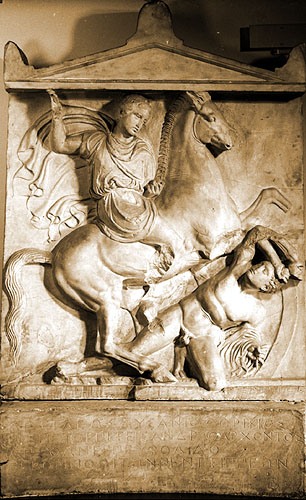
Preservation:When found, the stele was broken into two parts. The break is still visible running in a diagonal line from the lower left corner upwards to the right below the horse’s body. The surface of the relief is otherwise in good condition. The lower right leg of Dexileos and the right foreleg of the horse have partly broken away. Also missing are the frontal part of the horse’s head and its left fore-hoof; the horseman’s right hand is damaged. The left section of the plinth has broken off.
Description:The monument consists of a wide, slightly concave stele crowned by a pediment with three akroteria, resting on a slightly deeper block with an inscription cut in front. There are no framing pilasters.
The scene depicted shows a young cavalryman charging to the right. He is clad in a short, belted chiton and a chlamys that flows behind his back. With his left he holds the reigns of the horse, while his right is raised and brandished a weapon. His mount has reared up over another warrior. This man has broken to his knee; he is shown frontally and is completely nude except for a garment wrapped around his left arm. With his left he holds a round hoplite shield, his right is raised over his head and held a weapon. He looks up towards his attacker whose head in turn is lowered, so that their gaze meets.
There are numerous dowel holes on the horseman’s left hand and the horse’s head for the attachment of metal reigns, and on the horseman’s head for a metal wreath or helmet. Both warriors originally held metal weapons in their hands.
Discussion:One of the few firmly dated monuments, the Dexileos stele is remarkable for the insights it allows into the stylistic development of Attic grave stelae and the attitude towards death expressed by it. This is mostly due to the unusually lengthy inscription carved on its base. The text (IG II2 6217) reads thus:
DEXILEWS LUSANIOU QORIKIOS
EGENETO EPI TEISANDRO ARCONTOS
APEQANE EP’ EUBOLIDO
EG’ KORINQWI TWN PENTE IPPEWN
Transl.: “Dexileos, son of Lysanios, from Thorikos, born under the archon Teisandros [414/13 BC], fell under the archon Euboulides [394/93 BC] before Corinth among the five knights.”
Thus we learn that Dexileos died as a young knight only twenty years of age in military action near Corinth. The war dead of democratic Athens were buried in state tombs, and by a lucky coincidence a fragmented filial of the stele of the state tomb for the dead Athenian soldiers of the year 394/93 BC with the name Dexileos inscribed on it has survived (Conze no. 1158). The stele for Dexileos himself must therefore belong to a cenotaph erected by his relatives in their family precinct. Significantly, the young Dexileos is depicted victorious.
The iconography of the relief itself is conventional and has many parallels. Horse and horseman are clearly influenced by the Parthenon frieze; similar depictions can for example be found on the Albani relief (a large stele from the late fifth century BC that may have belonged to a public burial – Clairmont 2.131) and, even closer to the Dexileos stele, on a fragmentary relief from Chalandri in Attica (D 66).
The precinct of Dexileos’ family was situated on a crossroads of the Kerameikos cemetery. His stele crowned the semicircular back wall of the plot; the wall itself was flanked by spinxes. Two stelae for relatives of Dexileos stood on the terrace in front of the wall, close to the road. Among the pottery found in the precinct are fragments of Panathenaic amphorae and small choes, one of them with a depiction of the Tyrant Slayers. It is usually assumed that these were offerings for Dexileos, symbols of the Athenian democracy that fitted a young soldier who gave his life for the state.
Bibliography:A. Conze,
Die attischen Grabreliefs (Berlin 1893) II 254-255 no. 1158 pl. 248
This is the Classic corpus of Attic grave reliefs. Partly outdated, but still useful.S. Ensoli,
L' heroon di Dexileos nel Ceramico di Atene [= Atti della Accad. Naz. Dei Lincei, Memorie, ser. 8, vol. 29] (Rome 1987)
Mainly concerned with a new reconstruction of the burial precinct and typological comparisons. The detailed study of the relief contains among other things the reconstruction of a Boeotian helmet for Dexileos.U. Knigge,
Der Kerameikos von Athen (Athens 1988) 111-113 fig. 117
Gives a description of the family precinct within the context of the Kerameikos cemetery.C. W. Clairmont,
Classical Attic Tombstones (Kilchberg 1993) II 143-145 no. 2.209
Meant to replace Conze’s corpus; gives a full bibliography of the stele and a summary of the discussion.R. Stupperich,
"The Iconography of Athenian State Burials in the Classical Period", in: W. Coulson et al. (eds.), The Archaeology of Athens under the Democracy (Oxford 1994) 93-103, esp. 92-93 fig. 1
Stupperich discusses the development of the state burial and its influence on the iconography of private grave monuments. Good bibliography on the topic of public burials.R. Osborne,
Archaic and Classical Greek Art (Oxford 1998) 13-16 fig. 3
Gives a short summary on the stele and the ideology behind it.