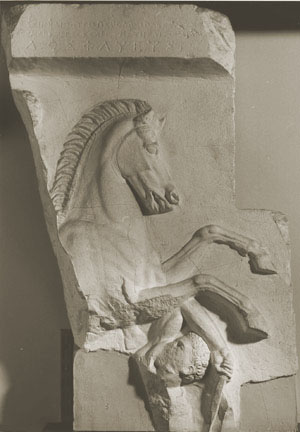
Fragment of tombstone.
Commentary Prepared by Dr. Julia Lenaghan, Ashmolean Museum
D 066
Grave Stele from Chalandri; Berlin
Marble (Pentelic)
Grave Stele
H 86 cm; W 61 cm
From Chalandri, north of Athens. The relief was found in the first half of the 19th century and given to the Berlin Museum by L. Ross in 1845.
Germany, Berlin, Staatliche Museen, Antikesammlung, K 30 (inv. no. 742)
Late Classical, ca. 400 BC
Preservation:The relief is very fragmentary, it is broken on all sides except for the top. The regular cut on the upper right corner stems from later reuse. Of the figures only the front part of a horse, the crown of the horseman’s head and his left foot, and a small part of a second man survive. The horse’s right foreleg and the second man’s face have partly broken off.
Description:The stele shows the remains of a horseman charging to the right. His mount has reared up over the fragmentary figure of his enemy. The victim appears to be naked and must have fallen on his knees. Traces of a round hoplite shield are visible behind his left shoulder; in his raised right he holds a sword or dagger. The horseman’s head was lowered, so that his gaze meets his defeated enemy’s.
The relief is crowned by an architrave with the remains of an inscription in three lines, and dowel holes on top. There is also a dowel hole in the horse’s mouth for the attachment of metal reins.
Discussion:The stele with its depiction of a victorious cavalryman closely resembles the grave relief of Dexileos (D 69), and must have been carved at around the same period, perhaps slightly earlier. The powerfully depicted mount is very similar to the horses on the Parthenon frieze; here, the heads of the horse and victim are given in strict profile, whereas on the Dexileos stele they are slightly turned to the front.
As in the case of the Dexileos relief, it seems quite possible that this tombstone was erected as a cenotaph for an Athenian soldier who fell in battle. The inscription (IG II2 7716) on the lintel contains an epigram of two very fragmentary elegiac couplets of which only the pentameters survive:
[< + + < + + < + + < + + < + +]sasin
kai; patriv
, wJ pollo;
w[lesa dusmen[evwn].|
[< + + < + + < + + < + + < + + <]sqe
mavrture, o{ss’ ajreth`
(s)th`sa trovpaia mav[ch].|
]ULOS FLUEUS
Transl.: “…and my country (knows) how many enemies I have destroyed…[bear] witness how many trophies of my prowess in battle I set up.”
The name of the soldier unfortunately is not preserved, but we know that he belonged to the deme of Phlya (… ulo
is more likely to be part of the deceased’s patronymic than of his name). C. W. Clairmont has argued that the close similarity between this relief and the Dexileos stele is caused by the fact that they both copy the same official monument in Athens. Although this is a possibility, their iconography might be more generally connected to public burials, where those who had given their lives for the state were shown in heroized form. In borrowing this iconography for a private monument, the family could achieve the same heroic overtones for their relative, which would otherwise not have been permissible in the restricted repertoire for stelae set up in a private context. The epigram thus complements the message of the relief in marking out the deceased as someone special.Bibliography:A. Conze,
Die attischen Grabreliefs (Berlin 1893) II 256 no. 1160 pl. 249
This is the Classic corpus of Attic grave reliefs. Partly outdated, but still useful.C. Blümel,
Die klassischen Skulpturen der Staatlichen Museen zu Berlin (Berlin 1966) 28 pl. 26
A short description of the stele and its context.C. W. Clairmont,
Gravestone and Epigram (Mainz 1970) 100-102 pl. 14
Discusses the stele and its relationship to the Albani relief and Dexileos stele. Translation of the epigram.S. Ensoli,
L' heroon di Dexileos nel Ceramico di Atene [= Atti della Accad. Naz. Dei Lincei, Memorie, ser. 8, vol. 29] (Rome 1987)
Briefly mentions the stele in connection with the tombstone of Dexileos and their shared iconography.C. W. Clairmont,
Classical Attic Tombstones (Kilchberg 1993) II 88-89 no. 2.130
Meant to replace Conze’s corpus; gives a full bibliography of the stele and a summary of the discussion.R. Stupperich,
"The Iconography of Athenian State Burials in the Classical Period", in: W. Coulson et al. (eds.), The Archaeology of Athens under the Democracy (Oxford 1994) 95 n. 34
Stupperich discusses the development of the state burial and its influence on the iconography of private grave monuments. Good bibliography on the topic of public burials.