Commentary Prepared by Dr. Julia Lenaghan, Ashmolean Museum
D 043
Great Eleusinian Relief. Athens
Marble
Relief
h 2.40 m, w 1.52 m, thick 0.16 m; h of female figures 1.98 m, h of boy 1.60 m
From Eleusis (near Athens|). Found in 1859 during the construction of a school next to the chapel of St. Zacharias in Eleusis; this is about 100 m east of the boundary of the ancient sanctuary at Eleusis. Below St. Zacharias are the ruins of a tenth century Byzantine church below which are Roman period domestic structures. The relief seems to have been reused as a paving block in the tenth century church.
Greece, Athens, National Museum, 126
ca. 440-430 BC
Preservation:The relief has been reconstructed from four perfectly joining fragments. Some missing areas have been filled with plaster. Other missing details have not been restored. The female figure in front of the boy is missing the index finger of right hand; the outline of the finger is still visible on the relief’s background. This figure also lacks the edge, which continues to form the pinky finger, of the heel of the right hand as well as the tips of the ring and middle fingers. The central figure of the youth is missing the pinky and index fingers of the right hand; the outline of the whole index finger is still visible on the background. The ring and middle fingers as well as the thumb of the youth’s right hand are preserved to the first knuckle. The female figure behind the boy is missing the thumb of her right hand and the tips of the other fingers are worn away. This figure also lacks a small piece of the left heel. On this figure, there are uniform small holes for the attachment of metal ornaments. There is one hole in the ear lobe for an earring, three holes around throat for necklace, one on the left sleeve for an arm band , and two on each forearm for bracelets. Likewise, in front of the youthful central figure at the level of the hair line there is a large hole for the attachment of an object.
The back of the relief is only roughly worked out. There are no (and never were) framing elements on either of the sides of the relief. At the bottom there is a wide flat ledge in the front surface of which old photographs show two rectangular cuttings near both sides. Newer photographs and casts show larger irregular cut out areas in place of the regular cuttings. This is perhaps due to accidental damage. All gaps in the bottom surface have been filled with plaster.
The top ledge projects over the relief and was wider than the relief. On the proper left edge of the monument the ledge is preserved extending beyond the relief. An arching profile connects the ledge to the background of the relief. Because none of the front surface of the ledge is preserved it is impossible to say whether it was flat or had moulding. The upper side of top ledge shows the same working as the sides of the relief. It has three holes which served to fasten the relief to some other feature.
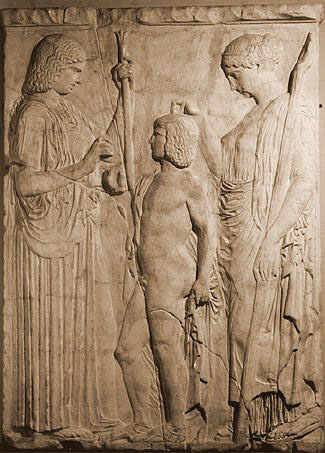
Description:The large relief, which is framed on top and bottom by mouldings, depicts three figures in exceptionally flat relief. At its deepest the relief is 5 cm. The three figures, from the viewer’s left to right, are a standing woman with short hair, a boy, and a standing woman whose hair is tied up.
The head of the standing woman on the viewer’s left is seen in profile whereas the body turns slightly to the viewer. Her back is in line with the left (viewer’s) edge of the relief and she faces toward the viewer’s right. The figure wears an “Argive” peplos. This garment is one large piece of material the upper edge of which is folded downwards. It is then wrapped around the body so that the two lateral edges of the material meet, in this case, at the left side of the body. The crease of the fold forms the upper border and at both shoulders it is pulled up from the front and back and fastened together. A belt is worn about the waist but it is mainly covered by the folded panel of material which hangs down to about the waist. Below the waist the material hangs straight down as if it were a heavy pleated skirt. The figure also wears sandals which have a thin sole and a strap that runs from the base of the small toe up and back toward the heel.
The figure’s weight rests over the straight right leg. The left leg, visible in the background, is bent; the knee projects forward towards the central figure of the boy. Around the weight-bearing right leg, the folds of the peplos are vertical and deep; the bent left leg pushes through these folds.
The right arm of the figure is bent at a ca. 70 degree angle. The upper arm, alongside the body, falls straight downwards from the shoulder and the forearm extends forwards and slightly upwards. This arm emerges from the material of the wide peplos which, bunched together and fastened at the shoulders, hangs in a generous loop at the side. The right hand is raised in front of the right breast and the back of the hand faces outwards towards the viewer. The index finger is raised above the other three fingers and bends so that the end of the finger falls downwards. The middle, ring, and pinky fingers hang together in a position more or less parallel to that of the index finger. The thumb is not visible to the viewer who sees the hand in profile.
The left arm is visible in shallow relief. The upper arm falls downward and forward and the forearm reaches upwards. The hand, at eye level, wraps around a scepter in such a way that the viewer sees a little portion of the inner palm and mainly the outer side of the fingers. The scepter features a lotus bud at the end and which continues downward behind the right arm and side of the figure of the youth.
The head of the figure looks downward toward the adjacent boy. It features centrally parted hair which ends in a horizontal cut that is even with the chin line. At the ends the locks of hair curl into themselves. The locks are delineated by parallel engraved lines. The brow appears short and forms an unbroken profile with the straight nose. The eyebrows have a low arch and the eyes are narrow with an upper lid that continues beyond the intersection with the lower lid. The lips are large and the corner of the mouth is down-turned. Below the lower lip is an indention and the chin comes forward. The chin is strong but on a plane that is set back from the nose.
The figure of the boy at the center of the relief is seen in profile and faces the figure of the woman with the short hair. His head reaches the level of her breasts. The figure is nude except for a chlamys which is slung over the right (inner) shoulder and is pulled diagonally across the back so that its upper border reappears at the level of the buttocks on the left (outer) side of the figure. The bottom border of the chlamys hangs between the ankles behind the figure.
The boy stands with his body weight over the straight left leg. The thigh of the right leg projects forward from the body and then the lower leg extends vertically downwards. Both feet rest on the ground and wear unusual sandals which have a network of grid-like straps. The torso of the boy is robust and has an emphasized arch at the small of the back which makes it seem almost to lean backwards. The left arm is drawn slightly back from the body but hangs downward. The hand below the buttocks grasps a section of the chlamys. Only the forearm of the right arm is visible and it rises upwards from the rib cage toward the hand of the short haired figure in front of the boy. The palm faces the viewer. The index finger was straight and points diagonally upwards toward the facing figure. The thumb appears to have bent towards the index finger. The middle, ring, and pinky fingers appear to have been closed.
The head of the boy looks straight forward. The contour line of the brow and nose projects outwards. The chin and cheeks appear round and full. The hair is composed of two different sections. A front portion has been separated by a part that runs from the temple diagonally backward and upward to the crown. This front section may either be read as combed forward or slicked backwards; the hair is defined by gently arching lines. The rest of the hair falls downwards in long wavy locks that end just above the shoulders. These locks are defined by undulating lines.
The rightmost (viewer’s) figure of the relief is an elaborately dressed female who faces the other female figure. Her back is in line with the rightmost (viewer’s) side of the relief. Her head is seen entirely in profile but her body is turned slightly to the viewer.
The figure wears a fine inner garment (chiton), a heavier over garment (himation), and sandals. The himation covers the front of the body from the waist to the shins and the entire back of the body. It leaves exposed the area above its downward arching crossing at the waist. Thus, the chiton is visible near the feet and from the waist to the shoulders. At both points it is shown with numerous fine crinkly folds. The chiton is fastened together by buttons visible on the upper right arm but presumably also on the upper left arm and both shoulders.
One end of the himation is visible on the left side of the body. From this point the other side of the himation is pulled upward over the left shoulder. It then spills down the back of the figure and is brought forward to the front of the body at waist level. With its upper portion folded downwards, the himation is pulled across the front of the body and tucked between the left arm and the body. The folded panel of the himation hangs down from the bunched roll at the waist and falls downward like a triangular apron. The apron extends from the right hip to the right knee and then back up to the left hip.
The right leg is the weight leg and is put forward. The left leg is bent and the foot is raised; only the front part of the sandal touches the ground. The sandal has a sole and two straps; one of which runs from below the outside of the heel across the foot to the instep and the other runs from above the outer heel to below the outside of the small toe.
The left upper arm remains close to the body and extends downwards. The left forearm comes forward. A torch, which reaches from the ground in front of the forward right foot to above the left shoulder, is cradled in this bent arm and the hand rests on it loosely. The torch is composed of a cylindrical shaft with evenly spaced vertical lines and a top portion that slants backward.
Only the forearm of the right arm is visible and it rises upwards from the breast toward the head of boy in front of the figure. The hand with its palm facing the viewer borders the top of the boy’s head. The index, middle, ring, and pinky fingers bend inwards at the second knuckle. The thumb seems to have reached across the inside of the hand and to have joined the other fingers.
The head looks downward and towards the boy in front of the figure. The hair falls from the crown naturally to all sides. At the front it is brushed away from the face and pulled back over itself to a point behind the ears. This hair and the hair at the nape which is rolled over itself is somehow knotted together in a chignon behind the head. The face of the figure is not significantly different from that of the short haired woman on the left (viewer’s) side of the relief. The nose and brow make an uninterrupted profile. The eyes are narrow and the eyebrows have a low arch. The cheeks appear full and the chin is rounded but stepped back from the rest of the face.
Discussion:The Sanctuary at Eleusis was the site of cult known as the Eleusinian Mysteries which, revolving around the rape of Kore by Hades and her subsequent return to Demeter, promised some reward after death to its initiates. Because it was a mystery cult, any record that recounted what occurred there was strictly forbidden. The mythological basis for the cult, however, is presumed to be that told in the Homeric Hymn to Demeter. In the hymn Demeter searches tirelessy without food for her daughter, Kore, whom Hades has stolen. In the guise of an old woman she stops at Eleusis where she becomes the nurse for the son (Demophon) of the royal couple (Keleos and Metaneira). To thank them she tries to give the son immortality by fire. She is, however, stopped in the act and must reveal her true self. The awed Eleusinians then dedicate a temple to her. She causes a plague until her daughter is finally returned with the compromise that she will spend half the year with Hades and half the year with her mother. Demeter then teaches various kings of the Eleusinians (Eumolpos and Triptolemos) the mysteries which allow for happiness after death.
Because the relief was found near the boundaries of the Eleusinian sanctuary, there has never been any doubt that the two women depicted represent Demeter and Kore. The iconography of the figures, moreover, established these identifications securely. The figure on the viewer’s left has short cut hair which is plausible for Demeter who cut her hair in mourning for her daughter and she holds a scepter with a bud, another plausible attribute for the goddess of grain. The figure on the viewer’s right holds a torch, an attribute often held by both Demeter and Kore, which alluded to the long search and the underworld.
Almost equally well-established is the date of the relief which is generally given as 440-430 BC. The date is based both on the technical manufacture which has parallels in eastern Greek works and significantly in the Parthenon frieze (cf. the maidens of the East Frieze, slabs VII and VIII) and on the types of the figures represented. The female figures of the frieze correspond basically, though not exactly, to types known to us in Roman period copies seemingly of fifth century originals. These types are known as the “Cherchel Demeter” (cat. C 70) which is dated ca. 450 BC and the “Kore Albani” type which is also dated to the third quarter of the fifth century BC. Even the figure of the boy on the relief follows types used on grave stele in the fifth century (cf. Athens National Museum, funerary stele from Thespia).
A third fact about the relief is that it is known in at least four copies. A full scale fragmentary marble copy is now in the Metropolitan Museum of Art (14.130.9), a marble fragment of the head of a Demeter exists in Corinth, and two fragmentary reduced scale terracotta copies from the villa of A. Voconius Pollio near Marino are now in the National Museum in Rome. In addition, a fragment of a foot in the Met may belong to yet another copy. Thus, it should be concluded that the relief was well-known, highly visible, and was not sacred to the Mysteries.
Two fundamental and important questions concerning the relief remain unsatisfactorily answered. The identity of the boy and the action depicted are unclear as is the function of the large relief. The various identities proposed for the central figure of the youth include an initiate, “the child from the hearth”, Nisos, Iachkos, Ploutos, and Triptolemos. The initiate can be excluded because of the childish nature of the figure, his sandals, and the lack of the myrtle staff or piglet; Nisos can be excluded because he is an obscure figure without relevance at Eleusis; and Iachkos because the figure is nude and lacks the signficant attribute of Iachkos, the torch. . Of these only “the child from the hearth” (a boy who served an official function), Ploutos (the offspring of Demeter who symbolized Wealth), and Triptolemos (the Eleusinian noble man who was entrusted by Demeter to spread agricultural knowledge) should be considered seriously.
The relief is traditionally read as Demeter handing stalks of grain to Triptolemos who is being crowned by Kore. The missing stalks or bundle of grain would, it is argued, have been painted on to the relief. The theory is attractive for several reasons. Triptolemos had a shrine at Eleusis (Pausanias 1.38.6), the moment in which Triptolemos received the grain from Demeter is often depicted in vase painting, and finally also in vase painting Triptolemos appears frequently making a libation between the two goddesses. Those, who are opposed to the Triptolemos reading, point out one or all of the following problems. Nowhere else does Triptolemos appear without an attribute (generally a winged chariot, a scepter, or a hoe), nowhere else does he appear completely naked, and nowhere else does he appear as a child. Moreover, the position of the hands of Demeter and Triptolemos do not appear to show an exchange of grain stalks and Kore may not crown the figure. Moreover, the grain stalks could not have been painted into the three dimensional fist of the youth without appearing very odd.
For this reason Clinton, reassuming an old proposition of Stephani and tentatively supported by Metzger, proposes to identify the figure as Ploutos who represented the agrarian wealth which the happy Demeter might bestow. Clinton points out that in red-figure vase painting Ploutos appears as a boy of various ages and always nude and sometimes with a himation over his shoulder. Frequently the boy appears with a cornucopia but not always. A red-figure chous in Berlin shows a nude boy with a himation without an attribute and is inscribed “
?????s”. Clinton, however, does insist that for the reading of Ploutos, to make sense the figure would have been wearing crown and would have been holding stalks of grain toward Demeter. He suggests that the stalks were glued into the boy’s fist.
Ridgway has re-proposed another old theory, that of Bötticher, which identifies the youth as the “
???s?????????????????s”. The “Child from the Hearth” or “Hearth Initiate” is the name of an official which appears on inscriptions as early as 460 BC. These officials were apparently boys from the wealthiest families selected by the archon basileus. Ridgway points out that the hairstyle of boy, which is knotted over the forehead, is that of an adolescent and that this hairstyle is worn by a boy leading a horse on the West Frieze of the Parthenon (slab XII). Because the boy in the relief is nude, Ridgway suggests that the relief commemorates the office rather than an actual individual. She believes that the Demeter figure shows the grain to the Initiate and that Kore places a fillet on his head.
None of the theories, however, has managed to define convincingly the action of the hands or the odd hairstyle of the boy. Both Demeter and the boy appear to hold whatever object it is between the thumb and index finger. This suggests a relatively small object. Moreover, although a long forelock of hair is typical of a boy, here it is oddly represented and the hole in front of the head seems ill suited for a crown of which there is no other trace since Schneider appears to be correct in pointing out that the small hole behind his head actually is the hole for the bracelet of the Kore’s right wrist.
In addition to the identification of the scene, the use of the relief has presented some problems because of its size. It is thought to have been too big to be simply a personal votive which, in any case, would not have been an obvious choice for copying. Thus, Simon thought that it might have served a function like that of a cult statue within the Telesterion. Yet, we not only have no precedents for a cult relief but we also have no notion that there were size limitations on votives.
Bibliography:M. Ruhland,
Die eleusinischen Gottinen (Strassbourg 1901) pp.11-12
uses Relief as starting point for discussion of the Demeter and Kore since their identification in the relief cannot be disputedJ. Svronos,
Das Athener Nationalmuseum (Athens 1908) pp.106-120 no.126 pls.24-25
objects to the identification of the male figure of the relief as Triptolemos, suggests NisosR. Ross Holloway,
"The Date of the Eleusis Relief" (AJA 62 1958) pp.403-408 pls.110-111
detailed stylistic assessment which compares the relief to the Parthenon frieze and thus, dates it contemporaneouslyH. Metzger,
"Le Triptolème du relief d’Eleusis" (RA 1968) pp.113-118
reconsiders the Triptolemos identification and revaluates the actions of the handsA. Peschlow-Bindokat,
"Demeter und Persephone in der attischen Kunst" (JdI 87 1972) pp.110-111
presents traditional reading of the reliefL. Schneider,
"Das Grosse eleusinische Relief und seine Kopien" (AntPl 12 1973) pp.103-122 pl.31
discusses fully technical details of the relief and its copies, also critiques copiesB. S. Ridgway,
Fifth Century Styles in Greek Sculpture (Princeton 1981) pp.138-141
suggests that the relief depicts the institution of the office of the Hearth InitiatesI. and A. Raubitschek,
"The Mission of Triptolemos" Studies in Athenian Architecture, Sculpture, and Topography Presented to Homer A. Thompson: Hesperia Supplement 20 (Princeton 1982) pp.109-117
discusses correlation of the story of Triptolemos with Athenian politicsE. Simon,
Die Götter der Griechen (Munich 1985) pp.113-114 fig.111
considers the relief to have served as cult statue of the Telesterion, depicts Demeter giving grain to TriptolemosG. Schwarz,
Triptolemos: Ikonographie einer Agrar-und Mysteriengottheit (Horn 1987) pp.192-196 no.R1
adamantly defends the Triptolemos identification(L. Beschi),
"Demeter" Lexicon Iconographicum Mythologiae Classicae IV (Zurich 1988) p.875 no.375
most likely a representation of Triptolemos, Demeter, and Kore, ca.430 BC, admits that the consignment of grain to Triptolemos is uncommonK. Clinton,
Myth and Cult. The Iconography of the Eleusinian Mysteries (Stockholm 1992) pp.39-55 figs.1-2
full discussion of the relief, identifies the boy depicted in it as PloutosW. Fuchs,
Die Skulptur der Griechen (Munich 1993) pp.515-516 no.603
presents traditional view, that it dates ca.440-430 BC and depicts Demeter, Kore, and TriptolemosE. Simon,
"Eleusis in Athenian Vase-Painting: New Literature and Some Suggestions" Athenian Potters and Painters (Oxford 1997) pp.97-108
rejects some of Clinton's ideas especially his identification of Euboulos and Eumolpos