Commentary Prepared by Dr. Julia Lenaghan, Ashmolean Museum
C 253
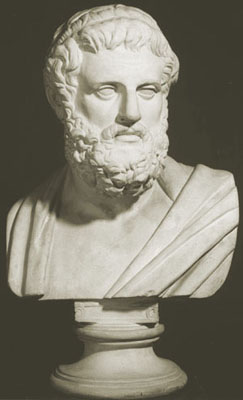
Bust of the Lateran Sophocles. Vatican
Portrait head and bust from an early Augustan marble statue of the Athenian tragedian Sophocles (496-406 BC). Possibly based on a bronze statue of Sophocles set up ca. 330 BC in the theatre of Dionysos at Athens.
Marble
Head from a statue
32 cm
From Terracina. Said to have been found at the Temple of Jupiter Anxur but more likely to have come from a Roman house. In 1839 the statue was given by the Antonelli family to Pope Gregory XVI who had it restored by P. Tenerani. It was then displayed in the Museo Lateranense Profano until 1963. During the reorganization of the Vatican collections, it became part of the new Museo Gregoriano Profano.
Italy, Vatican, Museo Gregoriano Profano, 9973
Late Republican-Augustan version of an original possibly created ca. 330 BC
Preservation:The nose, small areas in the forehead and right eyebrow, as well as locks of head and beard hair have been restored in plaster. The surface is especially porous. The Ashmolean cast depicts only the bust and head of the entire statue
Description:The bust and head are taken from life-size statue that depicts a bearded man wearing a thin circlet in his hair and a traditional Greek cloak (himation). His head turns to the left.
The upper border of the cloak is visible. It is draped around the left side of the body; wraps tightly around the back and the right side; and moves across the front of the body in an upward diagonal path with the excess material of the cloak is thrown over the left shoulder.
The leftward looking head has short tousled locks girded by a thin circlet and a beard that is especially thick under the chin. The hair falls naturally to the sides of the head from the crown and is cut around the ears which have large detached lobes. The circlet runs around the head at a level just above the ears. The hair behind the circlet is rendered in flat locks that end in a turning spit; each lock has four or five thick strands delineated by engraved grooves. The locks in front of the circlet, especially at the temples and above the ears, are more voluminous; they do not lay flatly on top of each other but are separated by deep drill channels. The beard and moustache hair is rendered like the hair on the front part of the head. It attains its greatest volume and curl around the jowls and chin.
The face has a broad oval shape. The tall forehead, fringed with a horizontal series of locks that turn in random directions, has two parallel furrows. There is indication of slight contraction of the brow over the nose. The ends of the eyebrows drop downwards. The eyes are deep set and directly under the eyebrows. Both the upper and lower lids are heavy and carefully delineated. The cheekbones are widely spaced and the cheeks are smooth. The lips are parted. The moustache covers all of the upper lip except for its central downward dip and the lower lip is rendered as a projecting horizontal band. There is a small area of skin exposed under the lower lip before the beard begins.
Discussion:This bust and head represent Sophocles, the fifth century (496-406 BC) Athenian tragedian. The entire statue and the securely identified portrait type are discussed fully under cat. no. C 141. The Vatican marble portrait depends on a fourth century BC original, perhaps that set up at the instigation of Lycurgus in the Theater of Dionysos with statues of Aeschylus and Euripides. It itself is generally (though not unanimously) thought to have been made at the end of the first century BC. Found at Terracina, south of Rome, the statue probably decorated a sea-side villa.
J. Lenaghan
Bibliography:G.M.A. Richter,
Portraits of the Greeks I (London 1965) 124-125, 129, no. 2, 132-133, no. 11, figs. 680-688
catalogue entry and discussion of Sophocles’ Lateran typeL. Giuliani,
Bildnis und Botschaft. Hermeneutische Untersuchungen zur Bildniskunst der römischen Republik (Frankfurt a. M. 1986) 138-139
brief discussion and interpretation of differences among Lycurgan portraits of poetsC. Gasparri,
"Una officina di copisti in età medio-imperiale" The Greek Rennaissance in the Roman Empire (1989) 96-101, especially 97, fig. 1
considers the statue to belong to a workshop producing for the area south of Rome in the late first century ADC. Vorster,
Vatikanische Museen. Museo Gregoriano Profano ex Lateranense. Römische Skulpturen des später Hellenismus der Kaiserzeit I. Werke nach Vorlagen und Bildformeln des 5. und 4. Jahrhunderts v. Chr. (Mainz 1993) 154-159, no. 67, figs. 297-308
full catalogue entry with excellent photographic documentationP. Zanker,
The Mask of Socrates (Berkeley 1995) 43-50, fig. 25
Augustuan representation of the presumed Lycurgan model that showed Sophocles as good citizen