Commentary Prepared by Dr. Julia Lenaghan, Ashmolean Museum
C 211
Aeschines from Herculaneum. Naples
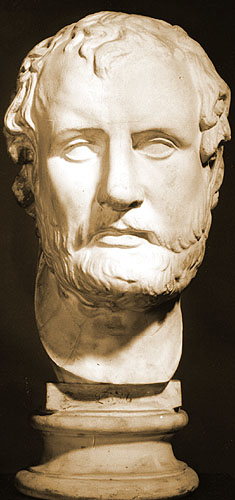
Portrait head from an early imperial period statue of the orator Aeschines (ca. 390-314 BC), found at the Villa of the Papyri in Herculaneum. Based on an original model of the late fourth century BC.
Marble
Staue
H of statue without modern plinth 1.99 m
From the Villa of the Papyri at Herculaneum. Found in 1753 in the portico of the great peristyle. It lay between the second intercolumnation to the northeast of the main entrance of the peristyle.
Italy, Naples, Museo Archeologico Nazionale, 6018
Early imperial version of a late fourth century BC statue
Preservation:The head was broken from the body which is preserved, (though restored from several pieces). On the head the left eyebrow, the upper lip, and half of the lower lip are restorations.
Description:The head belongs to a statue. The statue wears a chiton and a himation and stands with it weight over the left leg. The right arm is folded across the body held in a sling of material formed by the himation. The left arm rests akimbo with the hand behind the left hip.
The head itself turns to the right. It depicts a middle-aged man with a rectangular-shaped face, a receding hairline, and a short beard. The brow is tall and straight with a slight horizontal crease and minor indication of a contracting movement that stems from above the nose. The eyebrows do not arch; they are mainly horizontal and fall downwards at the outer corner of the eyes. The eyes are set directly below the eyebrow. The nose is broad and has a horizontal crease across its base. The naso-labial folds are indicated but are not especially deep. The cheeks are solid and the skin hangs slightly loosely. The upper lip, concealed by the moustache, and the lower lip are both mainly restored. The chin is strong and projecting. The beard grows low and on the sides of the face. Although it is flatly rendered and in front of the ears not full, some of the locks are long and the hair continues to grow on the neck and under the chin.
The hair is unruly. At the top of the head it is combed forward so as to cover the balding pate. This hair comes further forward at the center than at the sides of the brow. Directly over the center of the brow is a long curling lock, the end of which points downward and just barely to the left. Above, in front of, and behind the ears, which are mainly uncovered, the hair has more volume and curl. This is especially true at the right side of the head where locks brushed forward, backward, and falling straight down converge.
Discussion:The portrait statue found at the Villa of the Papyri represents Aeschines the fourth century (ca. 390-314 BC) Athenian orator and politician. Known as man of elegance and style, he favored the Macedonian cause and was the political opponent of Demosthenes.
The portrait type, showing a middle-aged man with a receding hairline, is known in under ten extant copies (not mentioned by Richter are a head in Frankfurt and one in Malibu). It is securely identified as Aischines by two inscribed herms, one found in 1780 at Hadrian’s Villa in Tivoli and now in the Vatican and another found in the early 1800s in Macedonia and now in the British Museum. The Herculaneum portrait is the only one that preserves the statue body in addition to the head. The pose of the statue, surely that of an orator, gives proof that the Aischines represented was indeed Aischines the Athenian orator. The portrait herm in Malibu which bears the portrait type with an ancient inscription Periander cannot offset the other evidence and must be viewed as an ancient mistake or desire to have a herm of Periander.
The body type of the Herculaneum statue resembles that of the Lateran Sophocles (cat. no. C 141). The main difference between the two statues is the weight leg. From the works of Aeschines himself we learn that restrained posture and especially the right arm held motionless by the wrap of the cloak were considered desirable qualities in a speaker. The posture appears to have been a highly correct and socially acceptable manner of self-presentation. In regard to the manner of dress, Zanker suggests that the chiton (inner garment), which was not traditionally worn, was an effeminate and foppish aspect.
The statue is entirely different from the statue of Aeschines’ rival Demosthenes (dicussed in cat. no. C 212-213). In comparison to Demosthenes, Aeschines’ total appearance, the sum of body and portrait, is perfect, elegant, restrained, and unstrained.
The original model for the statue of Aeschines has been dated to ca. 320. It resembles inarguably that of Sophocles which very probably dates between 340 and 325 BC and it wears a chiton which was first portrayed on male figures in the late fourth century BC. The Herculaneum version appears for contextual and stylistic reasons to be Augustan in date.
The Villa of the Papyri is, of course, well known for its statuary and its academic pretentions. The Aischines statue was found on the short and entrance side of the great rectangular portico of the Villa. Found on the same side of the portico, just across the entrance way, were two statues that were probably related thematically to the statue of Aeschines. One shows a clean-shaven short-haired speaker dressed in a himation without a chiton and the other depicts an old philosopher or poet, leaning on a stick.
J. Lenaghan
Bibliography:G.M.A. Richter,
Portraits of the Greeks II (London 1965) 212-215, especially 213, no.6, figs. 1369-1371
catalogue entry and discussion of the portraits of AeschinesD. Pandermalis,
"Statuenausstattung in der Villa dei Papiri" (AM 86 1971) 182, 204-205, no. 38
catalogue entry, discussion of location and theme of the statuary programM. Wojcik,
La Villa dei Papiri ad Ercolano: Contributo alla ricostruzione dell'ideologia della "nobilitas" tardo republicana (Rome 1986) 43-45, no. A3, pl.27
catalogue entry, discussion of excavation and original location,
Le Collezioni del Museo Nazionale di Napoli I,2 (Rome 1989) 130-131, no. 171
brief catalogue entry with photographP. Zanker,
The Mask of Socrates (Berkeley 1995) 45-49, 88-89, fig. 26
portrait statue discussed in conjunction with statue of Sophocles and statue of Demosthenes