Commentary Prepared by Dr. Julia Lenaghan, Ashmolean Museum
C 209
Menander. Philadelphia
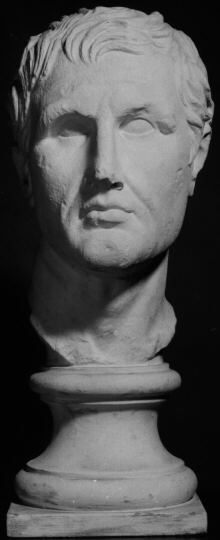
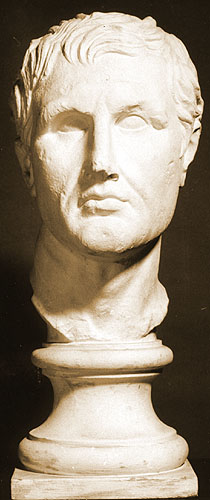
Portrait head of the poet Menander (ca. 340-290 BC). Roman period work based on an early third century statue in Athens by Kephisodotos and Timarchos, sons of Praxiteles.
Marble
Head
40 cm
From Montecelio (Lazio). Formerly in the Edward Warren collection at Lewes House, Sussex.
United States, Philadelphia, University Museum
Roman period head based on an original of the early third century
Preservation:The head was made for insertion. There is a chip at the neck’s right edge and the front edge of the neck is abraded. The rims of both ears are missing. The left eyebrow and the tip of the nose are chipped.
Description:The head, created for insertion into a statue, bust, or herm, depicts a clean-shaven man with long receding hair who turns to his right. He appears to be in his 40s or 50s.
The face has a long oval shape. The brow is tall. The upper portion of it features two parallel creases and the lower portion of it protrudes. At the juncture of brow and nose there are vertical lines of contraction. The eyebrows are heavy and hood small, deep-set eyes. There are crow’s feet (wrinkles) at the outer corners of the eyes. The nose is long and slightly aquiline in profile. The naso-labial folds are pronounced. The mouth has shapely, lightly parted lips. The upper lip has a central dip. The lower lip is full and projects which creates a recession below it. The chin is strong and almost has a cleft. The neck has a pronounced Adam’s apple and features creases, denoting tendons and wrinkles that result from a slim physique and the turn of the head.
The hair is rendered in long gently waving locks. On the right side of the head the locks are combed forward from the crown and the back of the head. On the left side of the head, the locks drop down from the crown or are brushed from the front backwards. Over the brow, there is a long S shaped lock that begins at the behind the left corner of the brow and continues forward, ending just to the right of center (at which point it twists slightly back to the left). At both corners of the brow the hair recedes.
Discussion:This portrait head, found in a Roman villa in Lazio with other fragmentary decorative sculpture, represents Menander (342/1-293/2 BC), the most famous New Comedy poet. Menander was extremely popular throughout the Roman period. At least seventy-one copies of his portrait have been recorded. (A head on the art market, see cat. 00-57, would bring the total to seventy-two). Although the portrait type was once thought to depict Vergil, several inscribed representations decisively associate the type with Menander.
Pausanias (I.21.1) notes that at the theatre in Athens there were portrait statues of poets. Among these statues of poets he adds that there is only one of any distinction, Menander. In 1862 a statue base was found in the theatre of Dionysos in Athens. The base bore an inscription for Menander and was signed by Timarchos and Kephisodotos, sons of Praxiteles. These sons of Praxiteles are said by Pliny (NH 34.5) to have flourished between the years of 296-293 BC. This date coincides approximately with Menander’s death. It is generally assumed that this prominent original statue in the theatre in Athens, probably created shortly after Menander’s death, was the basis for the Roman period copies of the playwright.
The size of the statue base suggested that the statue itself was a seated figure. In 1935 Crome hypothesized that a seated body type (referred to as the Naples-Capitoline type), known in at least seven headless examples, represented the body portion of the statue. This conclusion was based on the resemblance of the neckline of a Menander bust in Venice (possibly from Athens) to that of the body type and on the right turn of the neck of that body type. Fittschen recently confirmed this connection by introducing corroborating evidence. For instance, the manner of dress around the neckline of the Venice version repeats in a bronze bust of Menander in Malibu and in a mosaic of Menander from Mytilene. Moreover, Fittschen showed that a cast of the Venice bust fit perfectly into a cast of the Naples statue. Thus, the full monument (head, body, and base) has been plausibly recovered.
There are so many preserved heads (some of which may well be Renaissance) that one wonders if the sculptors always relied on the original model itself. Fittschen has pointed out that the Philadelphia head and the examples in Leipzig, Paestum (from Velia), and Mississippi (from Taranto) represent a particular variation from the original model. These heads all feature a broader lower face and larger eyes, details that he believes to be more in keeping with a late, rather than early, third century date. He believes that they rely not on the original statue but on a high Hellenistic reworking of the original statue.
In any case, all of the copies do present a clean-shaven handsome man. This corresponds to Menander’s reputation as an urbane, cosmopolitan man concerned with his appearance.
Julia Lenaghan