Commentary Prepared by Dr. Julia Lenaghan, Ashmolean Museum
C 178
Leconfield or Petworth Aphrodite. Petworth
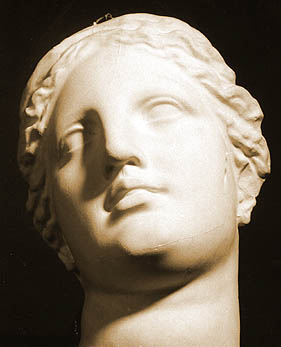
Marble head of Aphrodite, made to be inserted into a statue. The head reflects the style of the late fourth century BC and may be related to a work of Praxiteles.
Marble
Head
26 cm
Acquired in Rome by Gavin Hamilton or Matthew Brettingham for the Earl of Egremont. Brettingham notes that he bought an antique head of Venus from the Italian restorer Cavaceppi in 1753 and the accounts of the Earl of Egremont show that Gavin Hamilton was paid for a bust of Venus in 1755.
United Kingdom, Petworth, Petworth, Leconfield Collection
An original dated ca.300 BC, or a Roman version of an original dated ca.300 BC
Preservation:The head, which was formed separately from the body, is made in two pieces. The back of the head, from behind the band of the fillet to the hair knot, is worked separately and is not included in the Ashmolean cast. The nose and the upper lip are restorations. They have apparently been restored twice, once in the eighteenth century and once in the nineteenth century (perhaps 1870).
Description:The head, turning to its right, depicts a female with long thick wavy hair that is brushed back. The face is full and broad with a tall triangular forehead. The eyebrows slope downwards at the outer corners. The bridge of the nose features no indentation. The mouth is small with a thick lower lip. The chin is short and rounded. The surface of the neck bulges outwards. The hair, parted in the center, is pulled backwards, covering the upper portions of the ears. It is gathered in a bun at the back of the head; a large lock escapes from this bun. Around the face the hair is rendered loosely in bulky crinkly locks. At the back of the head, it is rendered impressionistically by irregularly undulating surfaces.
Discussion:The Leconfield/Petworth head of Aphrodite is considered either an original head of the late fourth century, possibly a work by Praxiteles or one of his immediate successors, or a copy of such an original masterpiece. It appears to have been worked separately and inserted into a statue. Because of the smallness of the area around the neck, the statue may have been draped.
At the end of the nineteenth century the German scholar Adolf Furtwängler praised the beauty of the head and labelled it a late work of Praxiteles. The facial structure and the rendering of the hair strongly resemble those of the Hermes of Olympia (cat.no.C 113) which was in Furtwängler’s time taken to be an original work by Praxiteles. Even though it now seems that the Hermes is a later copy of the work of Praxiteles, the Leconfield/Petworth head is still generally cited as an original. It, however, cannot be associated with any secure statue or context.
Julia Lenaghan
Bibliography:A. Furtwängler,
Masterpieces of Greek Sculpture (Lodon 1895) 343-346
a late original of PraxitelesM. Wyndham,
Catalogue of the Collection of Greek and Roman Antiquities in the Possession of Lord Leconfield (London 1915) 118-123 no.73 pls.73-73a
entry which quotes FurtwänglerG. Rizzo,
Prassitele (Milan 1932) 73-74 pls.108-110
original of PraxitelesM. Bieber,
Sculpture of the Hellenistic Age (New York 1961) 19
original late work of PraxitelesA. Stewart,
Skopas of Paros (Park Ridge, NJ 1977) 111 and 114
an Aphrodite in the late style of PraxitelesA. Stewart,
"A Cast of the Leconfield head in Paris" (RA 1977) 195-202
discusses the head as known from an early cast, considers it possible that the head demonstrates the style of PraxitelesB. Vierneisel-Schlörb,
Katalog der Skulpturen Band II: Klassische Skulpturen des 5 und 4 Jahrhunderts v. Chr. (Munich 1979) 329-330 footnote 33
explores the possibility that the head represents some work of PraxitelesA. Delivorrias,
"Aphrodite" Lexicon Iconographicum Mythologiae Classicae II (Zurich 1984) 107 no.1060
catalogue entry(C. Picon),
The Treasure Houses of Britain (Washington DC 1985) 302 no.226
catalogue entry with discussion of acquisitionB. S. Ridgway,
Hellenistic Sculpture I: The Styles of ca. 331-200 BC (Bristol 1990) 90
believes the head expresses the style of Praxiteles but doubts that it is a fourth century originalL. Todisco,
Scultura greca del IV secolo (Milan 1993) no.297
considers the head an original dated ca.320-300 BC