Commentary Prepared by Dr. Julia Lenaghan, Ashmolean Museum
C 149
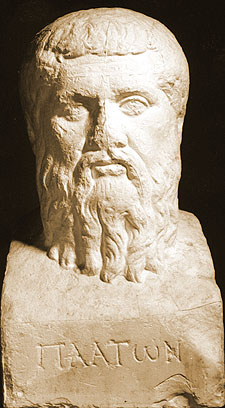
Herm of Plato. Berlin
Inscribed portrait herm of the Athenian thinker Plato (428/7 - 348/7 BC). Possibly based on a statue set up in Athens by a Persian named Mithradates and made by the sculptor Silanion in the early fourth century BC.
Marble
Herm
H 1.42 m, head 33.8 cm
Probably from Italy. Acquired by Count Tyszkiewicz in 1884 from the Castellani collection in Rome. Subsequently donated by the Count to the Berlin Museum
Germany, Berlin, Staatliche Museen, Antikesammlung, 300
Late second century version of an original probably created ca. 350 BC
Preservation:The nose, the right eyebrow with the upper lid and eyeball, the moustache, the lower lip, and edges of the herm shaft are badly battered. In addition, the ears and parts of the beard are heavily damaged. The back of the head and the shaft, with the exception of the front side, are encrusted.
Description:The fully preserved herm features a shaft, just over a meter in height. At the top of the shaft the name Plato is inscribed in Greek. Above the inscription is a bare-chested portrait bust of a middle-aged man with a long beard. The portrait head is block-like; the top of the head is especially flat and the face is square and impressively broad.
The hair on the head is short but full. Most of it is badly damaged or has not been fully worked out. It is cut around the ears and trimmed in a horizontal line at the nape of the massive neck. Across the brow the locks are all brushed to the right. At the left corner of the brow the hairline recedes slightly; at the right corner, the locks form a right-angle.
Two deep horizontal creases traverse the flat brow. Over the base of the nose there is an indication of a vertical crease and across the nose there seems to be a horizontal line. The eyebrows arch only slightly. The eyes seem closely set and small in the broad face. The upper lid is heavy; an engraved line denotes the irises and a drill hole the pupil. The nose is broad and deep naso-labial folds originate at the corners of the nostrils. The mouth is short from side to side. The upper lip is covered, except for a small triangular area, by a long moustache that begins below the septum of the nose. The lower lip is full and protrudes. On the cheeks, just above the jaw line, a long beard grows; the initial growth from the cheek is rendered by thin engraved lines. The beard grows in a series of full vertical sections of twisted locks. These locks entirely cover the chin and reach down to the chest.
Discussion:The Berlin herm depicts a square-faced, mature, bearded male. An inscription in Greek on the herm identifies this portrait as that of Plato, the Athenian philosopher (428/7 – 348/7 BC).
The portrait type is known in about twenty other Roman period versions. The Berlin herm provides the secure identification for the type. This identification is seemingly confirmed by a double herm in the Vatican which pairs a version type with that of Socrates, Plato’s mentor.
Although there is evidence for numerous statues and images of Plato in antiquity, including one owned by Cicero, scholarly discussion on Plato’s portrait type focuses on the notice of a statue of Plato that potentially dates to the fourth century. According to Diogenes Laertius III.25 Mithradates, the Persian, son of Rhodobatos, dedicated a statue of Plato made by Silanion to the Muses. Thus, it has been inferred that this statue of a Plato was located in the Shrine of the Muses in the Academy at Athens. It remains, however, impossible to date this statue precisely. The name Mithradates was common and cannot be attached with security to any particular man; there are at least thirty-six possible Mithradates. The sculptor Silanion is mentioned elsewhere but again no fixed dates can be associated with him. According to Pliny (NH 34.51), Silanion’s floruit was the 113th Olympiad, 328/7-325/4 BC.
Thus, other grounds for dating the statue set up by Mithrades must be considered. Many scholars (Giuliani, Vierneisel) believe that a just over life-size statue of the philosopher would have most probably been erected shortly after his death in 348/47 BC. Zanker, however, sees no reason to believe that it could not have been made during his lifetime and comments that style and characterization are compatible with a date in the first half of the fourth century. Richter places the portrait type stylistically between that of Thucycides (cat. no. C 144) and the Socrates by Lysippus (cat. no. C 146 and H 14). It should be pointed out that it cannot be entirely excluded that the statue of Plato, of which some twenty Roman period versions are preserved, was not that statue set up by Mithradates and mentioned by Diogenes Laertius.
Zanker goes to great length to emphasize that this portrait type does not present a manner of self representation that was particular to an intellectual or a philosopher but rather that the portrait type was a typical representation of the proper Athenian citizen. Giuliani notes the portrait’s contracted brow as indication of a man who thinks. The two points are, however, not mutually exclusive. It is to be expected that a contemporary or immediately posthumous portrait of Plato would portray him as a model Athenian citizen and that a characteristic of a model Athenian citizen of a certain age was thoughtfulness.
The Berlin herm was probably erected in the second half of the second century AD for technical reasons. For instance, the irises of the eyes are engraved and the pupils are indicated with drill holes; this technique certainly places the work after 130 AD. In addition, the lettering of the inscription points to a date in the second century AD.
J. Lenaghan
Bibliography:R. Boehringer,
Platon. Bildnisse und Nachweise (Breslau 1935) 14-15, pls. 1-5
catalogue entry and fine illustrationsC. Blümel,
Staatliche Museen zu Berlin. Katalog der Sammlung antiker Skulpturen V: Römischen Kopien griechischer Skulpturen des IV Jahrhunderts vor Chr. (Berlin 1938) 1-2, pl. 4
catalogue entryG.M.A. Richter,
Portraits of the Greeks II (London 1965) 166, no. 10, figs.903-905, 908
catalogue entry and discussion of the portraits of PlatoL. Giuliani,
Bildnis und Botschaft. Hermeneutische Untersuchungen zur Bildniskunst der römischen Republik (Frankfurt a. M. 1986) 138, n. 139
notes on portrait of Plato in discussion of the contracted browK. Vierneisel,
Ein Platon-Bildnis für die Glyptothek (Munich 1987) 11-20
summary of the discussion on Plato’s portraitK. Fittschen,
Griechische Porträts (Darmstadt 1988) 22, pl. 47
points out the difficulty with the dating of the type.P. Zanker,
The Mask of Socrates (Berkeley 1995) 40-41, 67-77
interpretation of Plato’s portrait type, understands the type as a depiction of an ordinary citizen