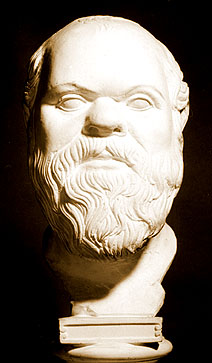
Portrait head of Sokrates.
Commentary Prepared by Dr. Julia Lenaghan, Ashmolean Museum
C 145
Socrates in Type A. Munich
Post antique bronze version of an ancient head of Socrates (following the Type A model). Seemingly made from a cast of a no-longer extant double herm featuring a portrait of Socrates.
Marble
Head
40 cm
Germany, Munich, Glyptothek, 448
Post antique made from a cast of a Roman period copy of a 4th century BC model
Preservation:The head is preserved with a crudely worked, asymmetrical bust. The surface is dark and cleaned. It shows traces of corrections on the left brow and in the beard. On the sides of the neck, just under the period, two holes have been filled with resin. The back side is unworked.
Description:The head, attached to a small oddly shaped bust area, shows an elderly, full-faced bearded man. The head, as set on the bust, turns slightly to the left.
The large face is both broad and tall. In addition, it is asymmetrical. The left side of the face is less wide, flatter, and the left eye is set further back than the right one.
The high brow is rounded and bald. The eyebrows arch evenly into the brow. The eyes are wide and framed by sharply defined upper and lower lids. The cheekbones are high, broadly spaced, and rounded. The bridge of the nose is a deep horizontal crease. Below the crease begins a short nose with flaring nostrils and a bulbous tip. The naso-labial folds are rendered by indented grooves. Between the cheekbones and the naso-labial folds the cheeks puff outwards. The broad mouth has full lips. The moustache reveals a central triangular area of the upper lip. The lower lip is flat and horizontal. The moustache is heavy and composed of slightly wavy, mainly parallel locks of hair. The beard is similar. It begins in front of the ears; there is noticeably large lock in front of the right ear that moves out toward the face and then curves back in. The beard continues well below the chin; it forms a solid tapering U shape that is attached to the neck. The portion of the beard under the chin and on both sides of the face where the face begins to slope back is not rendered.
The pate of the head is bald except for a lock flat curving lock that comes forward from the back. Its end turns toward the right. On the sides of the head, the hair is composed of long, flat, loosely twisting locks. The locks at both temples are pushed back behind the ears which are uncovered. The right ear is incorrectly rendered. At the back of the head the hair is not rendered at all.
The right side of the neck is shorter and the left side more powerfully delineated. Viewed from the back the head would seem to turn to the right. On the left side of the bust, a rounded area flares out.
Discussion:The bronze head in Munich represents Socrates (b. 469 BC, d. 399 BC). There are two principal ancient portrait models known to represent Socrates and one later variation; these are known as Type A, B, and C. The Munich head follows Type A.
Both Types A and B are securely identified with Socrates because two portraits (cf. cat. C 146) of the Type B variety bear inscriptions naming Socrates and because Socrates is described in several literary accounts as looking like a satyr, a detail that corresponds to the portrait types. The Type A Socrates, which shows Socrates with more satyr-like features, is known in about ten replicas as opposed to the thirty copies of the Type B, which tones down the satyr features. Type A is generally accepted to be the older of the two types, probably created in the first half of the fourth century. The dating is hypothetical and hinges upon a passage in Diogenes Laertius (2.43) in which it is said that the rueful Athenians after Socrates’ death erected a statue of him made by Lysippos in the Pompeion in Athens. The question remains how soon after Socrates death in 399 BC was the statue by Lysippos (whose working period begins at earliest in the 370s) erected and which of the two types, A or B, should be associated with the statue of Lysippos. Type B, the later of the two types and the obviously better known type, is usually connected with the Lysippan statue in Athens; for more discussion on Type B, see cat. no. H 14. Type A is usually dated either during the lifetime of Socrates or in the two decades following his death. No secure evidence, only common sense and probability, however, connect the passage in Diogenes Laertius with either type. It is also, on the extant evidence, virtually impossible to judge what type of statue bore the Type A head.
The most recently proposed theory regarding the Type A Socrates portrait belongs to P. Zanker. Zanker points out that the silen traits of the portrait represent the positive qualities of those extraordinary creatures. A silen was wise, good, and super-human; thus, the connection had many positive connotations. Zanker postulates that the unconventional portrait head could not have originally belonged on a conventional body type; he supposes that the body was fat, ugly, and malformed as a caricature of Socrates found at Pompeii shows. The entire image he believes may have been set up in the Museion of Plato’s Academy and may have been a deliberate statement full of philosophical discourse about appearance versus reality, a statement that challenged the superficial values of Athenian society. Zanker’s theory is, however, entirely conjecture.
The authenticity of the Munich Type A Socrates head has been a source scholarly debate. The bronze casting is of poor quality, the base oddly shaped, the back and the beard unfinished, the right ear mis-shaped, and the lock over the left ear brushed in the direction opposite to that in the other copies. In the nineteenth century Brunn and Bernoulli doubted that it was ancient; in contrast, Furtwängler asserted that it was. Richter in the twentieth century suggested that it was a Renaissance or post-Renaissance version of the Farnese head in Naples 6129. It should be noted that the Munich bronze was certainly recorded and illustrated in the inventory of the Veronese Bevilacqua collection in 1753. It, in addition, may appear in the inventory list of 1589. That list (published by Franzoni) records a "Silenus" and a "Bacchus" under the title "Bronze heads with chest." Thus, the head may have been made before 1589 and certainly before 1753.
In 1989 Scheibler examined all of the extant Socrates Type A copies and presented a new theory about the original nature of the Munich bronze. Her theory has gained widespread acceptance. She showed that the head displayed tendencies of an ancient copy that would have been impossible or unlikely for a modern copyist to have created, particularly a copyist working from the Farnese head. Thus, she concluded that the Munich head was a post-classical (actually late antique) cast from a Trajanic period double herm that is no longer extant.
The particular details that enabled this conclusion were that 1) the neck and asymmetrical forms of the head clearly betrayed an original turn to the right; this turn is visible in the best preserved copies in Naples and Toulouse and would probably not have been repeated in a copy that was not carefully based on an ancient model: 2) the moustache reveals a portion of the upper lip; this occurs only and in exactly the same fashion in the Toulouse copy which was discovered after 1753: 3) the lock in front of the right ear of the Munich head again repeats that of the Toulouse head and not that of the Naples head. The fact that the back of the Munich head is not worked at all makes the head look as if it were copied from a double herm. The right ear was clearly damaged in the cast and had to be reworked free-hand.
It is worth noting that several bronze heads from Venice have been shown to have been made in the Renaissance or shortly thereafter from ancient marbles. There is a bronze copy of a Hadrianic portrait bust now in the Hispanic Society in NY, a bronze head of the Ephesos Apoxyomenos (cat.no. 00-22) sold in 2000 at Sothebys, and a portrait bust of again Hadrianic male which was thought to be a completely Renaissance creation until a copy of the head of the head was excavated at Hadrian’s Villa at Tivoli in 1956 and another copy of the head was located in the Prado in the 1990s.
Julia Lenaghan
Bibliography:G.M.A. Richter,
Portraits of the Greeks I (London 1965) 111-112, figs. 467-468
believes head to be modern copy of the Naples Farnese Type A Socrates portraitL. Franzoni,
Per una storia del collezionismo. La Galleria Bevilacqua (Milan 1970) 53, fig. 33
accepts Richter, provides inventory lists of collectionI. Scheibler,
"Zum ältesten Bildnis des Sokrates" (MüJb 40 1989) 15-17 no. 4, figs. 11, 13, and 19
full discussion of Type A and careful entry on the Munich bust which proves it is based on an ancient originalP. Zanker,
The Mask of Socrates (Berkeley 1995) 12 and 32-39, fig. 6
accepts Scheibler regarding Munich bust, philosophical theory on Type A