Commentary Prepared by Dr. Julia Lenaghan, Ashmolean Museum
C 144
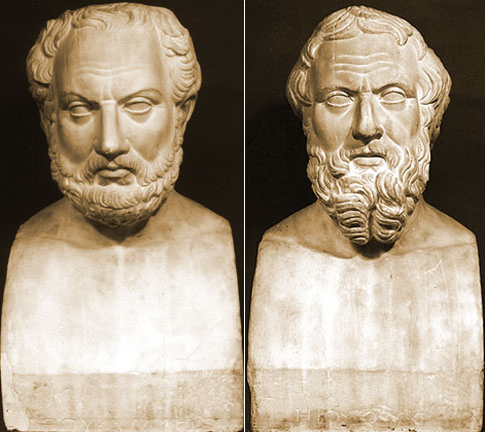
Double herm of Herodotus and Thucydides. Naples
Inscribed double herm depicting the historians Herodotus (ca. 484-424 BC) and Thucydides (ca. 460-400 BC) back to back. Roman version based on original models of the fourth century BC.
Marble
Herm
58 cm, heads 32 cm (H) and 28 cm (T)
From Italy. Perhaps from near Tivoli. In the sixteenth century the herm stood in the gardens of Julius III (now Villa Giulia); eleven of the eighteen herms there came from Tivoli. Although this herm was not cited with provenance, Michaelis suggested that it resembled others of the herms that did come from Tivoli and therefore may also have. After the death of Julius III, the Cesi family acquired the herm which eventually came into the possession of Fulvio Orsini. He bequeathed it to his patrons, the Farnese family. In 1787 it was transferred to Naples with much of the rest of the Farnese collection.
Italy, Naples, Museo Archeologico Nazionale, 6239
Roman version of original models created ca.400-350 BC
Preservation:The nose of Herodotus has been restored and the Herodotus inscription may have been altered. The end of the nose of Thucydides has been restored. The herm was sawed into two pieces by the Farnese; the fracture runs vertically between the backs of the head.
Description:The herm presents two life-size portrait heads mounted on nude busts. The portraits, placed back to back, are joined behind the ears.
On one side the herm is inscribed Herodotus in Greek at its lower edge. The portrait on this side shows a middle-aged man with a high forehead and a long beard that continues well below the chin. The forehead and beard make the face appear long. Across the brow are three horizontal creases. They are supplemented by two pronounced vertical lines between the eyebrows, above the base of the nose. On the indented base of the nose itself there are two further horizontal furrows. The eyebrows are arched and the eyes are set directly under them. The upper eyelid is sharply defined; its upper line is deeply engraved. The cheekbones protrude and the cheeks below them sink slightly. The mouth is of average size with defined naso-labial folds. The upper lip is entirely covered by the moustache and the lower lip is a full horizontal band. The beard is well groomed along the sides of the face. Below the chin it divides into two vertical twisting sections.
The hair of the beard and the hair of the head are delineated in thick locks without individual strands. The hair on the head has greater volume around the temples and ears, which it does not cover, than at the top of the head. Over the center of the brow, the hair parts. The long locks on either side of the part are brushed in opposite directions, covering most of the extent of the brow; their ends turn slightly back inwards near the corners of the brow.
The other side of the herm is inscribed, Thucydides, in Greek. The inscription is written just above the lower edge of the herm. The portrait shows a middle-aged man with a receding hair line and a markedly short lower face. The brow is tall, sloping, and balding. There are three light creases across the brow, two vertical ones above the base of the nose, and one sharp horizontal crease across the base of the nose. The eyebrows arch sharply over the outer corner of the eyes, leaving ample space between the eyebrow and the eyelid. The upper lid is separated from the space below the eyebrow by a broad deep channel. The tear ducts at the inner corners of the eye are finely shaped and at the outer corners of the eyes are small wrinkles. The cheekbones are pronounced and rounded. The naso-labial folds are pronounced and flank the outer side of the moustache. The mouth, positioned directly under the nose, is short from side to side with full lips. The upper lip, mainly covered by the moustache, has a triangular dip at the center and the lower lip is full and protruding. Directly under the right and left portions of the lower lip are two tufts of hair that reach the beard. The beard is full. It is trimmed towards the back of the sides of the face and grows under the chin. On the sides of the face it grows in two to three layers of short, basically straight locks; under the chin the hair is fuller and curlier.
The hair of the beard and head are rendered in the same manner as that used in the portrait of Herodotus; locks without strands are delineated by flat grooves. The hair of the head is cut short and does not cover the ears. It is combed forward from the back toward the brow where there is a significant recession of hair. On the side of the head above the left temple, the hair is combed backwards around the ear; on the right side of the head one layer of locks comes forward and another goes backward.
Discussion:The double herm in Naples features portraits of the fifth century historians, Herodotus (ca. 484-424 BC) and Thucydides (ca. 460-400 BC). Across the lower edge of both busts are inscriptions in Greek that label the two historians. Both portrait types are known in several other Roman period replicas.
The Herodotus portrait type is known in a total of about eight marble copies. In addition to the Naples double herm, the portrait type appears identified by an inscription as Herodotus in another herm portrait in Naples as well as one in New York. Roman period coins from Herodotus’ birthplace, Halicarnassus, also bear portraits that reproduce the same model. This original model for the portrait type is generally dated for stylistic reasons to the first half of the fourth century BC. It, above all, resembles the similarly dated portraits of Plato (see cat. no. C 1..) and Thucydides.
The Thucydides portrait type is known in about five copies, the finest of which is a bust in Holkham Hall. The Naples double herm, however, is of great significance because it alone identifies the portrait as Thucydides. Just as the original model for the Herodotus is dated to the early fourth century BC, so too is that of Thucydides.
No particular fourth century monuments can be associated with either portrait, although there is epigraphic evidence for statues dedicated to both men and a Christodorus, a late antique writer, mentions a bronze statue of Thucydides with his right arm raised. That statue was located in Constantinople and was assuredly a stolen treasure of the classical era. The Roman period copies demonstrate the popular Roman habit of decorating porticos and gardens with educational images of the past.
The existence of the Naples double herm can be traced back into the early part of the sixteenth century. Its provenance is unknown and the suggestion (repeated by Richter) that it came from Tivoli is based purely on the conjecture of Michaelis. Michaelis notes that Hadrian’s Villa below the pleasure palace of Ippolito D’Este was the source of many herms with portraits of Greek intellectuals and that the lettering of the inscription of this double herm was not terribly different from some of the herms with a secure provenance of Tivoli.
J. Lenaghan
Bibliography:G.M.A. Richter,
Portraits of the Greeks I (London 1965) 146, no. 2, 148, no. 1, figs. 810-812 and 825-827
catalogue entries with succinct discussion of both Herodotus and Thucydides typesK. Fittschen,
Katalog der antiken Skulpturen in Schloss Erbach (Berlin 1977) 16-18
discussion of portrait type of Herodotus which he places in first half of fourth centuryA. Michaelis,
"Die Bildnisse des Thukydides: Ein Beitrag zur griechischen Ikonographie" (Strassburg 1877) in K. Fittschen, Griechische Porträts (Darmstadt 1988) 39-57, pls. 41-42
nineteenth century assessment of Thucydides portrait with full history of Naples piece and comparison to Holkham Hall version,
Le Collezioni del Museo Nazionale di Napoli I,2 (Rome 1989) 168-169, no. 102
figs. 102- 102b extremely short catalogue entryP. Zanker,
The Mask of Socrates (Berkeley 1995) 65
refers to Thucydides’ portrait as being a a generation before Lycurgus’ tragedians