Commentary Prepared by Dr. Julia Lenaghan, Ashmolean Museum
C 121
"Ilioneus (youngest son of Niobe)". Munich
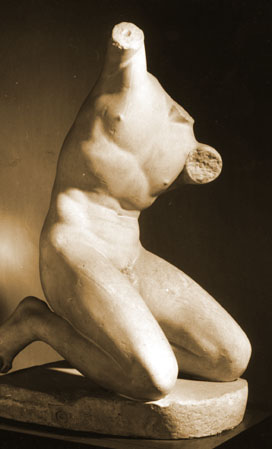
Statue of a kneeling nude boy who twists and tilts at the waist. Once thought to have represented the youngest son of Niobe.
Marble
Statue
.886 m, .98 m with plinth
Probably from Rome or its environs. Known since 1402 and used by Ghiberti as a model for Isaac for the scene of Isaac and Abraham for the Baptistry Doors in Florence.
Germany, Munich, Glyptothek, 270
Hellenistic or a Roman version of either an early or late Hellenistic work
Preservation:The statue is missing its head and both arms from the upper biceps down (including the hands). It is also missing the toes of the right foot, part of the smallest toe of the left foot, and the genitals. The holes in the break surfaces at the arms and neck are the result of a restoration in plaster carried out at the end of the 1700s or beginning of the 1800s.
Description:The statue depicts a nude boy who kneels on both knees. The lower legs do not rest on the ground; the thighs press against the backs of the lower legs. The ankles are also raised and only the toes touch the ground. The upper body of the figure bends significantly to the left at the waist so that the right shoulder is higher than the left. The right arm is raised, seemingly over the head. The left arm also slightly raised may have crossed the body. The head seems to have turned to the right.
The plinth is uneven. It reaches its lowest point under the left knee and its highest point under the right knee and left foot. The edge is smooth and slants inward on the right, long, side
Discussion:This statue of an intimidated boy has both an interesting and long modern history as well as a difficult and unclear ancient history. Its original context, subject, and date remain open to interpretation.
In 1402 the statue was in Florence and used by the sculptor Lorenzo Ghiberti as a model for Isaac in the Abraham and Isaac scene that Ghiberti submitted for the competition to decorate the Baptistry Doors of the Duomo in Florence. It seems likely that the statue came from Rome or its environs. In the sixteenth century, the statue passed from the Ghiberti family to a certain Gaddi at whose death the statue went Rome into the collection of Cardinal da Carpi in Rome. It was recorded in inventory lists there in 1562. In 1571 it was acquired by the D’Este family who took it from Ferrara to Modena and finally gave it to Rudolf II in Prague. There it remained from 1674 to 1782/84. At that point it was acquired by a sculptor named Malinisky and then for a ducate by a doctor Barth who brought it to Vienna in ca.1799 and who had the arms and head restored in plaster. In Vienna Rauch saw it and on his advice Prince Ludwig purchased it from Barth for 6000 ducates in 1814.
The original subject of the statue is unknown. Scholarly suggestions have included Ganymede, Troilos, and Ilioneus, the youngest son of Niobe. This latter identification was in part suggested by a comparison to a statue from Subiaco, now in the Terme collection (MNR I,1), judged to be similar and to represent a Niobid. Although they may have similarities, neither is assuredly a Niobid. According to Vierneisel-Schlörb the cringing posture of the statue suggests that the attacker may have been closer at hand and may have been bearing down more forcefully than Apollo or Artemis, the opponents of the Niobids, who shoot arrows.
The date of the statue relies on stylistic and technical details and, therefore, varies from scholar to scholar. Among the technical details, the uneven plinth has been used as grounds to declare it a non-Greek work. Scholars have held opinions as widely different as an original statue of the fourth century BC and an Antonine copy of a high Hellenistic work. Among the most recent opinions Vierneisel-Schlörb considers it a rendition of a late fourth century (early Hellenistic) work created by a follower of Praxiteles and Geominy believes it to be date to the late second century BC (late Hellenistic).
J. Lenaghan
Bibliography:B. Vierneisel-Schlörb,
Katalog der Skulpturen Band II: Klassische Skulpturen des 5 und 4 Jahrhunderts v. Chr. (Munich 1979) 431-434 no.39 with figures
full discussion and bibliographyW. Geominy,
Die Florentiner Niobiden (Bonn 1984) 196-201
stylistic discussion of statue, which he excludes from Florentine Niobid group, dates the statue to the late second century BCW. Geominy,
"Niobidae" Lexicon Iconographicum Mythologiae Classicae VI (Zurich 1992) 923 no.59
brief entry under category uncertainly identified as Niobids, notes that it has been considered either early or late Hellenistic work