Commentary Prepared by Dr. Julia Lenaghan, Ashmolean Museum
C 115
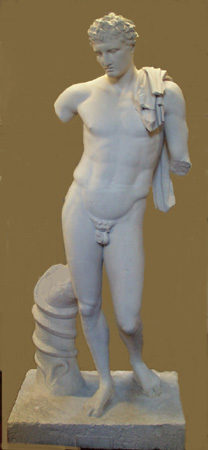
Hermes of Andros, in the "Andros-Farnese Hermes" Type. Andros
First century BC statue of Hermes Pyschopompos, based on a statue of the fourth century BC.
Marble (Parian)
Statue
1.96 m
From Andros. Found in Palaiopolis in 1832 in a funerary setting with a headless female statue in the Large Herculaneum type.
Greece, Andros, Archaeological Museum, 245
First half of the first century BC, based on an original dated ca. 350 BC
Preservation:The statue is restored from the knees down. It is missing its right arm from the upper bicep, the left arm from just above the elbow, and the end of the mantle behind the left arm. There is a roughly worked oval area on the right hip where the hand joined the body and traces of a strut on the outer side of the left thigh.
Description:The statue depicts a youthful nude male with a mantle draped over his left shoulder. Alongside the right leg is a tree trunk support with a snake wrapped around it.
The head of the young man turns downward and to the right. The right leg bears the weight of the body and the right hip projects outward. The lower part of the left leg trails behind. The left foot is close to the right one and its heel is raised. The right arm extends downward and away from the body and the left arm falls down by the left side. The legs, hips, torso, and shoulders create a sinuous line of motion for the viewer who observes the statue from the front.
The head of the statue has an almost rectangular shape. The lower brow bulges. The eyebrows are long and slope downward at their outer corners. They form a hood over small eyes which are deeply set well below them. The bridge of the nose is broad. The mouth is small with down-turned corners and parted lips. There is a deep recess below the lower lip. The chin is broad and projects.
The hair, in unruly locks, begins high on the forehead and leaves the ears uncovered. Over the left eye the locks fork. Around the temples and a few centimetres back from the brow the hair gains in volume. Some of the locks near the top of the head are rendered only roughly as large tufts.
Discussion:The Hermes of Andros, found in a funerary context and dating probably to the first century BC, follows a statue type known in about twenty seven other copies. The original statue type seems to have been conceived in the fourth century, perhaps in the milieu of Praxiteles, and may have represented Hermes Pyschopompos.
Among the twenty seven other copies, which consist of 16 torsos and 11 heads, the best preserved is in the British Museum and was formerly part of the Farnese collection. The statue type obviously derives its name, the Hermes Andros-Farnese type, from the statue in question here and that in the British Museum. The British Museum statue shows that Hermes held a caduceus in his left hand. At least one of the copies of the body bears an early imperial portrait, rather than the original ideal head. In comparison with other Hermes statue types, it is not, however, frequently used for portait statues.
The type has been identified as Hermes Pyschopompos or guide of the souls for several reasons. It carries a caduceus. On the Andros statue a snake, which had associations with the underworld, appears on the support. And, the Andros statue was found in a funerary context where such a meaning would have been appropriate.
The Andros statue itself has for various stylistic reasons been dated to the first century BC. The original model of the statue seems to belong to the fourth century. The S curve and proportions of the body as well as the closely spaced feet recall works usually assigned to Praxiteles. Thus, many scholars date the original about 350 BC and suggest that it is a work of the school of Praxiteles. It should be noted that it is most often compared to the Hermes of the Hermes and Dionysos Group at Olympia (C 113), the date and authorship of which is controversial.
Julia Lenaghan
Bibliography:A. Hundt and K. Peters (E. Boehringer),
Greifswalder Antiken (Berlin 1961) 117-128
provides replica list of the type, dates the type to the end of the fourth century BCW. Helbig (H. von Steuben),
Führer durch die öffentlichen Sammlungen klassischer Altertumer in Rom II (4th edition) (Tübingen 1966) 190-191 no.246
identifies the original type as a late classical depiction of Hermes PsychopomposS. Karouzou,
National Archaeological Museum. Collection of Sculpture (Athens 1968) 88-89 no.218
catalogue entryS. Karusu,
"Der Hermes von Andros und seine Gefährtin" (AM 84 1969) 143-157
full discussion of the context, funerary, and date, first century BC, of the Andros statueJ. Inan,
Roman Sculpture in Side (Ankara 1975) 98
adds another head to Boehringer’s list, supports Boehringer’s conclusionsC. Maderna,
Iuppiter, Diomedes, und Merkur als Vorbilder für römische Bildnisstatuen (Heidelberg 1988) 84-85 94-95
full presentation of the type with bibliography, discusses two examples that use the type for Roman portrait statues, dates the type ca.350-340 BCG. Siebert,
"Hermes" Lexicon Iconographicum Mythologiae Classicae (Zurich 1990) 367 no.950 a
summary entry with bibliography, date, and other other copiesL. Todisco,
Scultura greca del IV secolo (Milan 1993) 133 no.285
statue of the second half of the first c BC deriving from an original attic work produced by the school of Praxiteles, ca.340 BCB. S. Ridgway,
Fourth-Century Styles in Greek Sculpture (London 1997) 337 pl.8
variation of the Hermes of Olympia type