Commentary Prepared by Dr. Julia Lenaghan, Ashmolean Museum
C 113
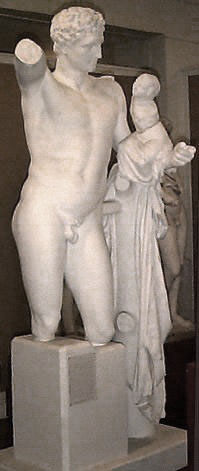
Hermes and Dionysos from Olympia, based on a work by Praxiteles?. Olympia
Hellenistic statue of a youthful Hermes holding the baby Dionysos in one arm and with the other presumably dangling grapes in front of the baby. Generally considered to be a Hellenistic or Roman copy of a statue made by Praxiteles around 340 BC.
Marble
Statue
2.13 m
From Olympia. Found in the cella of the Temple of Hera in 1877.
Greece, Olympia, Olympia Museum
Hellenistic or Roman statue based on an original dated ca. 340 BC
Preservation:The statue was found in seven separate pieces which have now been joined. These are the 1) main section of the statue, 2) a piece from the lower end of the tree trunk, 3) a small piece of the right upper arm, 4) the right foot and a piece of the plinth, 5) the lower corner of the mantle draped over the tree trunk, 6) the upper body of the baby, and 7) the head of the baby. Missing are the right arm from the bicep downward (including the hand and fingers), the index finger of the left hand which was dowelled on separately in antiquity, both legs from the knees downward, and the left foot as well as both arms of the baby and a knot of his hair over the center of the brow. Of these missing parts Hermes’ left leg and foot, Hermes’ right lower leg, and the lower part of the tree trunk have been restored in plaster. The right side of the face of the baby is damaged. The shins and left foot of the main figure and the lower part of the tree trunk support have been restored in plaster.
The back of the statue shows rasp marks, especially in the middle of the back. These marks have been removed and replaced with chisel strokes at the small of the back and on the buttocks. There are also two holes, one at the base of the spine and another at the back of the tree trunk, both filled with lead. At the front of the head there are cuttings and holes drilled through the hair over the forehead for the addition of an element such as a fillet or a wreath. When it was first excavated there were traces of color, now no longer visible, on the sandal, lips, and hair of the main figure.
Description:The statue depicts a youthful nude male who holds a baby in the crook of the left arm. The head of the young man turns to the left toward the baby that he holds in his bent left arm. The left arm rests on a tree trunk which bears part of the baby’s weight. The right arm is raised and held toward the right side. The baby looks towards it. The weight of the body rests over the left leg and the left hip projects outward. Consequently, the torso of the youth bends sinuously. From the protruding right hip, the torso initially leans to the left toward the tree trunk, but its direction is changed by the raised and outstretched right arm. A strut attaches the left hip to the tree trunk. Over the tree trunk is a long mantle which features thin hem line and a small garment weight.
The youth has an oval face with modelled flesh. The brow bulges at the center and features a horizontal crease over the bulge. The nose is broad. The eyebrows slope slightly downward and directly under them are deep set eyes, the upper lid of which follows a path parallel to the eyebrow. The mouth is small and has down-turned corners. The upper lip has a pronounced central lift which is echoed in the lower lip. Under the lower lip there is an indentation above the chin. The broad chin is stepped back from the plan of the face.
The hair, rendered in short unruly locks, begins high on the forehead. The hair around the brow is more carefully defined than that elsewhere. Towards the crown the hair increases in volume and the locks are rendered only roughly as large tufts. At the back of the head a groove or a fillet is clearly delineated running between the ears.
The baby, resting on the left arm and the tree trunk support, is in a seated position and wears a small mantle draped around his hips. His hair is long and held in place by a fillet. Over the center of the brow is indication that there once would have been a hair knot there.
Discussion:From the time of its discovery in 1877 until 1927 the marble statue of Hermes, holding the infant Dionysos, was thought to be an original work by the fourth century sculptor Praxiteles. It was found in the cella of the Temple of Hera at Olympia where in the second century AD Pausanias (5.17.7) wrote that he saw a marble statue made by Praxiteles of Hermes with the infant Dionysos.
In 1927 C. Blümel declared that for reasons of technical handling the statue could not belong to the fourth century BC but must be Roman or Hellenistic. Since that time others scholars have added yet further arguments and virtually no one any longer (pace Yalouris) believes that the statue is an original work of the fourth century. Blümel’s initial points included the odd unfinished surface of the back side which differed from that of the front side, the use of the round drill, the modelling of the drapery, the rendering of the hair, the style of the base, and the seemingly unnecessary strut from the right thigh to the tree trunk. Other scholars have further noted features of the drapery, the sandals, and even the elongated proportions and sfumato features, which they deem to be impossible for a fourth century date..
Yalouris’ argument that the statue is fourth century addresses mainly Blümel’s points. Yalouris claims that the molded portion of the base is made of a different marble than the base itself and, thus, was a revision. Also he believes that the odd tool marks on the back of the statue actually cut into a finished surface and thus, are later additions. The holes filled with lead he attributes to a re-positioning of the statue against a wall in the Temple of Hera.
Whatever the original date it does seem likely that this is the statue that Pausanias saw. Thus, three possibilities exist. Pausanias was misinformed; Pausanias intended another, later, sculptor named Praxiteles; or Pausanias saw this, a marble copy, of a great work by Praxiteles. Although most scholars prefer the lattermost solution, each argument has its supporters. Ridgway, for instance, does not believe that the statue has any connection whatsoever to the fourth century BC. Two facts should be noted: No other sculptor by the name of Praxiteles is known and that Kephisodotos, a relative of Praxiteles, possibly his father, is known to have made a similar group of Hermes and Dionysos. Moreover, it would also a great a coincidence that two other statues, which have been associated with Praxiteles on account of the imprecise but strikingly close descriptions of ancient authors, the Pouring Satyr (C 110 and 251) and the Apollo Sauroktonos (C 111 and 112) show the same interest in curves formed by projecting hips, leaning torsos, and a raised arm.
Hermes is generally thought to have been dangling grapes in front of Dionysos with his right arm. This restoration is based on a Pompeian wall painting that shows a satyr in the same pose. Interestingly there are no known copies of the statue, although there are several related works. These include a few fragments of statues that show Hermes resting on a pillar and a statue of Hermes with Dionysos with a tree trunk support on the other side of the body. The general motif, however, of a non-mortal carrying the infant Dionysos is popular in all types of media.
Julia Lenaghan
Bibliography:G. Treu,
Die Bildwerke in Stein und Thon (= Olympia III) (Berlin 1895) 194-206 pls.49-53
full publication of the statue and find locationC. Blümel,
Griechische Bildhauerarbeit (Berlin 1927) 37-48
presents an eight point technical argument to illustrate that the statue cannot be an original of the fourth century BC,
AJA 35 (1935)
varous scholars persent reactions to Blümel’s assessmentN. Yalouris,
Olympia: The Museum and the Sanctuary (Athens 1987) 155-157
argues that the statue is a fourth century originalA. Corso,
Prassitele: Fonti epigrafiche e letterarie. Vita e opera I (Rome 1988) 157-162
speculation about the original commission, considers the statue to be an original of the fourth centuryG. Siebert,
"Hermes" Lexicon Iconographicum Mythologiae Classicae (Zurich 1990) 321 no.394
uninformative entry with some bibliographyL. Todisco,
Scultura greca del IV secolo (Milan 1993) 75-76 no.129
considers the statue to be a Hellenistic copy of a work by Praxiteles dated ca.340-330 BCA. Ajootian,
"Praxiteles", Personal Styles in Greek Sculpture (Cambridge 1998) 103-110 figs.55-56
summarizes the state of the research, concludes with the question, even though the statue is not 4th century in date, is it a copy of a work by Praxiteles