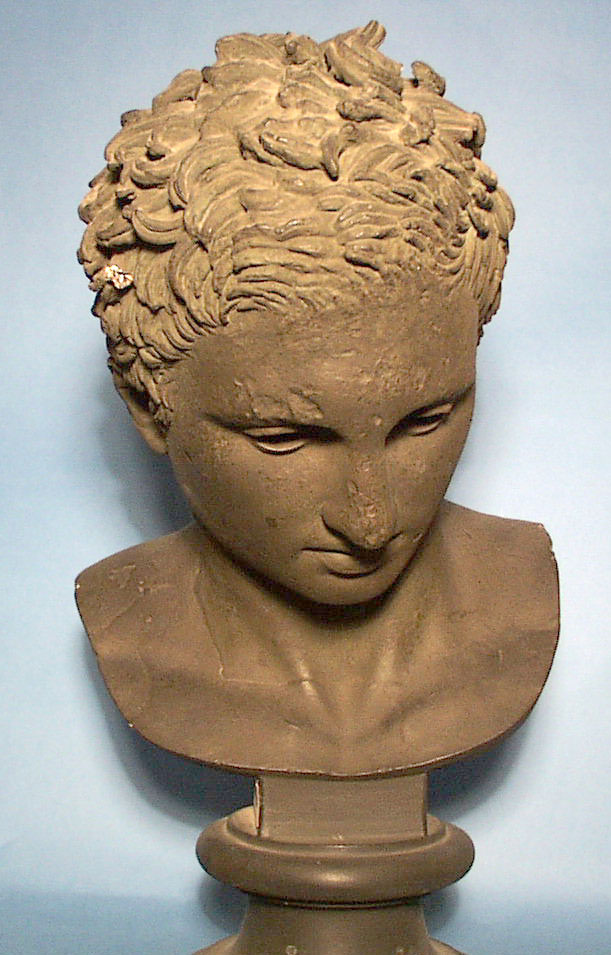
Commentary Prepared by Dr. Julia Lenaghan, Ashmolean Museum
C 102
Head of the Ephesos Scraper. Vienna
Head from a bronze statue of an athlete using a strigil after exercise. The statue is a version of a famous late fourth century original or less possibly even the late fourth century original.
Bronze
Statue
1.91 m
From Ephesos. Found in the Gymnasion near the port in 1896. It stood in an aedicula expressly made for it. The aedicula was located against the back wall of a room and faced the palestra. The base of the statue, recording the dedicators and the gymnasiarchs, was also found.
Austria, Vienna, Kunsthistorisches Museum, 3168
A Flavian or Trajanic Copy of an Early Hellenistic Work or an Early Hellenistic work
Preservation:The statue was found in 234 pieces. Many of these pieces were seriously damaged by fire. They were recomposed with the aid of a cast of the Uffizi version of the statue. The head, which is reproduced in the Ashmolean Cast, the right hand, and the right foot were all found unbroken.
Description:The head, lowered and turned slightly to the left, depicts a young man with short thick hair. The face has a squarish shape. It is widest between the cheekbones and relatively short between the eyebrows and chin. The forehead is tall and the lower portion of it protrudes. The eyes are deep set and unremarkable in form; this is true also of the nose. The corners of the nostrils are tucked into the full cheeks. The mouth is small. The upper lip has a pronounced central dip. The lower lip is full and projects. There is a significant indentation under the lower lip and above the chin. The chin is broad but not protruding. The outer area of the ears appears flattened.
The hair begins high on the forehead. Over the outer corner of the left eye, the locks fork. The locks to the right of the fork spring upwards and to the right; those to the left fall downward and lie plastered against the forehead. The locks around the forehead are short, straight, and thick. Around the crown of the head the locks are arranged in a starfish pattern. These locks have greater curl than those around the brow and they jump away from the head, unlike those around the brow.
Discussion:The statue of the Ephesos scraper shows a young athlete, probably a boxer since he has a heavily developed upper body and cauliflower ears. He stands with his weight on his right foot and his left leg slightly forward, holding a scraper near his left thigh. Since neither the head nor the body is idealized, the statue gives the impression of a specific individual. Significantly it was found in a fully preserved context and is known in possibly as many as seven other ancient versions.
The original context of the statue was an aedicula that faced a courtyard in a gymnasion complex of the Flavian period at Ephesos. The base of the statue, although fragmentary, records that it was a donation by a private individual to the city and the name of the gymnasiarch mentioned in the inscription dates the base (and the setting up of the statue) to the end of the first or beginning of the second century AD. The inscription reads in Greek:
Gra[mmateuontoV.....
M. A]ntwvioV Dros[oV
sun ......kai Paulh ka[i
Dros....toiV t]ek[n]oiV ton
a]ndria[nta ek twn i]diwn [th] glu
kutath pa[t]rid[i an]eqhken
gumnasiarcountoV L. Kl. Fro[ug]ianou
During the year when M. Antonius Drusus and … were secretaries….and Paula and …their children set this statue for their most fatherland. Lucius Claudius Phrugianus was the gymnasiarch.
Most scholars believe that the statue’s manufacture coincides with the date when it was set up in the gymnasium; that is, it was commissioned for this particular location in the late first century or early second century. The other possibility is that it was made in the Hellenistic period and dedicated several centuries later by a wealthy Ephesian who has somehow procured it. This scenario is less probable and the scholars who propose it rely on technical and stylistic details to support the argument.
The existence of other copies, even bronze ones, of the same model makes it yet more likely that this is a Roman rendition. The extant copies include 1) a marble statue in the Uffizi (from the Medici collection and known already in the Renaissance), 2) a bronze statue found in ca.1997 in the sea off Croatia, 3) a body made of black schist from Castelgandolfo found in 1930-31, 4) a worked over head in the Torlonia collection, 5) a head in the Hermitage of unknown provenance, 6) a bronze head sold at Sothebys NY in 2000, mentioned already in 1716 (possibly a Renaissance copy) (see cat.no. 00-22), and 7) a statuette in Boston found at Villa Mondragone in 1896. In addition, the general schema of the statue is reproduced on gems, in a Campana relief, and in various statuettes. The Boston version and the Campana relief shows the athlete cleaning the scraper as opposed to cleaning himself and this seems to reflect the original motif.
The original model of the Ephesos Scraper (or less probably, the Ephesos Scraper itself) was certainly famous in antiquity. Most scholars agree on stylistic grounds that the original statue ought to date to about 300 BC.
Pliny the Elder mentions three sculptors, Polykleitos (NH 34.55), Lysippos (NH 34.62), and Daidalos (NH 34.76), who created statues of the nude youths scraping themselves. On the basis of Pliny, some modern scholars have proposed Daidalos as the sculptor of the original model, mainly by process of elimination. Polykleitos, who flourished in the mid fifth century BC, could not be the sculptor since the style of the statue seems later. An attribution to Lysippos has also been excluded by many scholars since they have assigned the Vatican Apoxyomenos (cat.no. C 133) to him. The Vatican statue seems to correspond to what Pliny says about Lysippos’ tendency for elongated proportions.
Two points are worth noting about the attribution attempts. First, Pliny notes that Lysippos made real looking figures. Thus, one has as much grounds to identify this scraper with Lysipppos as one has for the Vatican Apoxyomenos. Second, one of the arguments against Daidalos is not valid. That is, it is frequently pointed out that the Ephesos scraper may not actually be cleaning himself but rather the strigil and thus, does not correspond to Pliny’s statement that Daidalos’ statues of scrapers were cleaning themselves (destringentes se). This is an overly literal reading of Pliny who might easily have referred to this genre of statue as destringens se. In any case, it is clear that we do not have enough information to judge who the original sculptor was and if Pliny actually had this statue in mind.
Julia Lenaghan
Bibliography:O. Benndorf,
Forschungen in Ephesos I (Vienna 1906) 181-204 figs.127-135 frontispiece, pls.6-7
first publication, thorough discussionF. Eichler,
"Die Bronzestatue aus Ephesos" (JbKuHistSamml 50 1953) 15-22
discusses the restoration of the right armS. Lattimore,
"The Bronze Apoxyomenos from Ephesos" (AJA 76 1972) 13-16 pls.7-8
discusses action of hand, places the original of the type in the third century BCA. Stewart,
"Lysippan Studies 3. Not by Daidalos" (AJA 82 1978) 473-482
suggests that the Ephesos scraper is an original statue by a follower of Lysippos, compares it to the Conservatori girlR. R. R. Smith,
Hellenistic Sculpture. A Handbook (London 1991) 278
notes the statue as contemporary with the Apoxyomenos generally attributed to LysipposK. Gschwantler,
"Der Athlet von Ephesos. Ein Projekt zur Restaurierung und Konservierung der Bronzestatue" (JbKuHistSamml 91 1995) 287-293
full discussion of preservation and restorationM. Sanader,
"Der Meergeborene. Die Entdeckung einer Bronzestatue in Kroatien" (AW 30 1999) 357-359
discovery of a new bronze example of the "Ephesos Scraper" Type