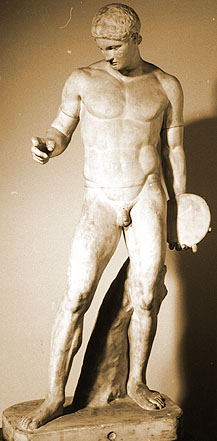
Discus-thrower.
Commentary Prepared by Dr. Julia Lenaghan, Ashmolean Museum
C 097
‘Diskobolos by Naukydes’ with non-pertinent head. Vatican
Early imperial statue (with an ancient but non-pertinent head) depicting an athlete about to throw a discus. Based on a statue probably created ca. 400 BC and attributed to Naukydes.
Marble
Statue
1.665 m
From Rome. Found on the Via Appia between the 8th and 9th milestones, in Frattocchie at the so-called Villa of Gallienus (Tenuta Tor Colombaro) by G. Hamilton in 1771. Bought by the Vatican in 1772. Under Napoleon the statue was in Paris.
Vatican, Vatican City, Sala della Biga, 2349
Roman statue (Early Imperial) based on an original dated ca. 400 BC.
Preservation:The head does not belong to the statue. It is ancient but has been set on the statue in the modern era. On the statue, the following portions are modern restorations: the right elbow with a portion of the upper arm; the thumb, second, and third fingers of the right hand; a large part of the strut that connects the right arm to the body; part of the fingers of the left hand, a piece at the upper left edge of the discus, random areas on the back of the tree trunk support, and the parts of the outer plinth. There are many breaks on the statue. These are: at the middle of the right forearm; on the left forearm at the height of the strut; separating the left hand with discus from the body; on the right leg on the front part of the knee; on the strut that extends from the tree trunk to the right lower leg; above the right ankle; in the area of the left knee where the tree trunk ends; on the left foot near the ankle; and through the penis. (The Ashmolean cast has removed all three of the statue’s ancient struts).
Description:The statue depicts a naked young man. He is a lean, well-muscled athlete, and holds a discus.
The figure stands, facing forwards, with its weight on the left leg. The left leg bends slightly at the knee and the lower leg is set back. The foot is pressed into the ground; the pressure falls more heavily on the inside of the foot. The right leg steps forward and opens outward. The foot, slanting diagonally towards the figure’s right, is planted fully on the ground. Beginning between the legs and ending behind the left knee and thigh is a tree trunk support. A strut runs from the tree trunk to the back of the right calf. The legs are long, slender, and fit but lack heavy musculature.
The torso does not face totally forwards. Whereas the left hip is fixed in a frontal position, the right hip pulls backward as a result of the outward position of the right leg. The linea alba, in contrast, reflects the position of the arms and bends to the left. The left arm is lowered and straight. A strut connects the forearm to the left hip. The left hand holds a discus, the front face of which extends from behind the left buttock diagonally outward. The right shoulder is raised slightly and the arm is pulled back and away from the body. It bends at a 90 degree angle and stands at 45 degree angle away from the body. A strut extends from the right wrist to the right hip. Unlike the legs, the torso is heavily and sharply muscled; the anatomy is fully defined and gives the impression of hardness.
Discussion:The Vatican statue is the best-known example of a type that shows a young man getting ready to throw a discus. Holding the discus in his left hand, readying to pass it to his right hand, and bending at both knees, he steps outward with his right leg and looks downward. In the early nineteenth century Visconti identified the type as the discus-holder (‘diskobolos’ or ‘diskophoros’) made by the sculptor Naukydes around 400 BC, and this identification is still mainly upheld.
The type is known in ten replicas. In addition to the Vatican statue, these are 1) a statue body with an unoriginal head in Liebieghaus in Frankfurt which, found in Rome in 1569, was well known and admired in the Renaissance; 2) a head and body fragments found in Rome in 1910 (cat.no. C 98), now in the Capitoline; 3) a heavily restored torso to which a copy of the Vatican head was added in London; 4) a headless statue, found before 1644 in Italy and now in the Louvre, to which a copy of the Capitoline head has been added; 5) head and body found in 1979 in Perge and now in the Antalya museum; 6) a head fragment found in the Baths of Caracalla, now in the Museo Nazionale Romano; 7) a head purchased in Rome and now in Liebieghaus in Frankfurt; 8) a head in Copenhagen, again purchased in Rome; and 9) a left hand and part of the discus in Budapest. The number of replicas and their geographic range which extends to Asia Minor attests that the type copied a model that was well-known in antiquity.
Most authors date the Vatican version of the type to the early imperial period, possibly late Augustan era. The head that is attached to the Vatican statue (see cat.no. C 99) does not follow the head type that was found with the Capitoline statue and that is known in other replicas. Most scholars have, therefore, assumed that the head on the Vatican statue never belonged to the statue. Yet the Vatican statue and head seem to have been found together since the earliest reports speak of the finding of a complete statue. If they were truly found together, it need not be entirely excluded that in antiquity a head type, similar to the original, was mounted on the body, either as a restoration or as an adaptation of the original model.
The model of the type is generally dated around 400 BC on stylistic grounds. The upper body and the contraposto pose recall Polykleitan models and works ascribed to the “School of Polykleitos” as does the fundamental structure of the head. The statue does differ from the mid-fifth century strictly Polykleitan models in that the leg proportions are leaner, the face and head rounder and fuller, and the hair less organized. These details are generally associated with works of the fourth century date, rather than the fifth century. The pose of the statue has often been compared to that of the “Ares Borghese” (see cat.no. C 56) which is usually dated to the last quarter of the fifth century. Although the discus-holder and the “Ares Borghese” are clearly similar, the Ares is less complicated and less dynamic; its weight bearing leg, for instance, does not bend. Thus, scholars conclude that the statue of the discus-thrower must post-date that of the Ares.
Because of its numerous copies, most scholars accept that the type was a famous work in antiquity and that the original model was made in commemoration of a victorious athlete. Scholars, combing the written sources for clues about the original model, have arrived at two possible passages, both from Pliny the Elder. One passage (NH 34.72) speaks of a bronze statue of a pentathlete made by Alkamenes. This passage was once associated with the statue because Alkamenes has been thought most likely to be the creator of the seemingly similar “Ares Borghese”. Yet, the Ares and the discus-holder do not necessarily appear to be made by the same hand, and Bol asserts the Polykleitan and non-Phidian, non-Attic workmanship of the discus-holder.
Thus, most scholars prefer to associate the discus-holder type with another passage in Pliny (NH 34.80), a passage that was first connected to the type by Visconti. In that passage Pliny speaks of three famous statues by Naukydes: a discobolus, a Hermes (perhaps the Hermes Ludovisi or the Hermes Pitti-Lansdowne), and a man sacrificing a ram. Because Pliny (NH 34.50) gives the floruit for Naukydes as 400-396 BC, the association is generally accepted, though it cannot be proven.
The name Naukydes in reference to a sculptor is attested in the epigraphic record (at Olympia and Athens), by Pausanias (on five separate occasions), and by Tatianus (on one occasion). There is some confusion about how many sculptors were named Naukydes and what was Naukydes’ relationship to Polykleitos. The inscriptions from Olympia and Athens appear to date to the early fourth century and refer to Naukydes from Argos and Naukydes son of Patrokles. A cult statue of Hebe in a temple, which burned in 423 BC, is also ascribed to Naukydes and must date around 400 BC. Another statue in Argos is ascribed by Pausanias to Polykleitos’ brother, Naukydes, the son of Mothon. Pausanias then tells of other statues of athletes in Olympia made by Alypos and Polykleitos students of Naukydes from Argos and a statue of another victorious athlete of 400 BC by Naukydes. Thus, there seem to have been two sculptors, both from Argos, one the son of Patrokles and the other the son of Mothon, who worked between the second half of the fifth century BC and the first half of the fourth century BC. It is not possible to distinguish clearly between the two or to ascribe to one or the other the statue of the discus-holder mentioned by Pliny, which, in turn, cannot even be securely associated with the Vatican statue type.
Julia Lenaghan
Bibliography:G. Lippold,
Die Skulpturen des vaticanischen Museums III, 2 (Berlin 1956) 79-83, no. 615, pls. 41-42
complete catalogue entry, considers statue to be early imperial version of an original by NaukydesW. Helbig (W. Fuchs),
Führer durch die öffentlichen Sammlungen klassicher Altertumer in Rom I(4th ed) (Tübingen 1963) 397-398, no. 501
brief summary of LippoldK. Moser van Filseck,
"Wirklichkeitsraum und Wirkungsraum. Zum antretenden Diskobol des Naukydes" (Boreas 12 1989) 47-61
discussion of stylistic details of stance, proportions, hairstyleA. Linfert,
"Die Schule des Polyklet" in Polyklet: Der Bildhauer der griechischen Klassik (Mainz am Rhein 1990) 266-269
in context of Naukydes and his worksL. Todisco,
Scultura greca del IV secolo (Milan 1993) 53, cf. no. 47
traditional assessment of the statue with bibliography under no. 47P.C. Bol,
Der antredende Diskobol (Mainz am Rhein 1996) 54, 60-72, 114, no. 2, figs. 39-41
most recent catalogue entry with bibliography, full discussion of NaukydesB. S. Ridgway,
Fourth-Century Styles in Greek Sculpture (London 1997) 243-244
without knowledge of Bol, considers the type to be an impessive work of the first quarter of the fourth century BC and there to be only one Naukydes