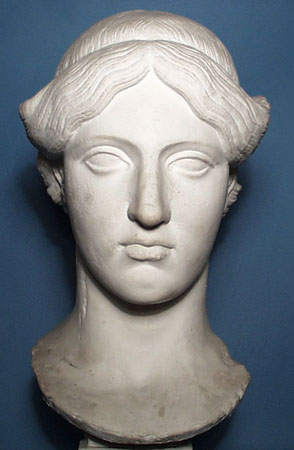
Female head ('Candia' type).
Commentary Prepared by Dr. Julia Lenaghan, Ashmolean Museum
C 060
Copy of the Head of the "Ludovisi Peplophoros" (also known as the "Candia") Type. Copenhagen
Marble
Head
37 cm, height of the head 23.4 cm
Bought in Florence and said to have been found in Syracuse.
Denmark, Copenhagen, Ny Carlsberg Glyptotek, 293
Preservation:The insert head is preserved intact from its bottom plug below the area of the clavicle to the top of the head. The tip of the nose has broken off. A large vertical piece of marble which depicted the back of the right side of the neck and some of the back of the neck has broken off and is missing. On the bottom left edge of the neck-chest are a piece has broken off (and seemingly been reattached?). The cheeks and temple hair on the right side are abraded. The entire surface has root marks.
Description:The head depicts a long haired clean shaven youthful face. The face has a roughly oval which begins to taper inwards at the lower cheeks. The brow is tall; the cheekbones are widely spaced; the cheeks are smooth and end in a “U” shaped chin. The eyebrows are slightly arched. The eyes are long and narrow. The slightly arched upper eyelid continues beyond the intersection with the lower lid. The lower lid does not mirror the shape of the upper lid but dips down further into the cheek near the outer corner of the eye. The nose is regular and has a flat bridge. The lips are of an expected size and are full and shapely. The upper lip moves from the corners, which are upturned, upwards and then has a central dip. The lower lip follows an almost horizontal line.
The hair, which originates at the crown, falls to all sides in long wavy strands which are delineated by engraved lines. These strands appear to be held tightly to the head by a band which is not depicted but runs around the head at a level just above the ears. Below this undepicted band the hair has a different aspect. At the back of the head from ear to ear below the band the long hair is rolled and tucked under the band. At the front of the head, the hair as a central part over the brow. From this part it is pulled towards both sides, passes over the tops of the ears and over the band, and then is tucked under the band. The foremost strands of hair move from the brow to the temples and, thus, create a triangular form. Just in front of the ears where the hair turns upwards toward the band, it bunches together and has greater volume.
Discussion:A statue found in Kisamos, Crete preserves this head type together with a peplos-wearing or peplophoros statue. This peplophoros statue is also known in a fine example formerly in the Ludovisi collection (now in the Museo Nazionale Romano inv.8577). Thus, the statue type is known as either the “Ludovisi Peplophoros” or the “Candia” or less frequently as the “Kisamos”. Because the statue does wear a peplos, we can identify the Copenhagen head as female.
The original of the “Ludovisi Peplophoros” is one of the two most copied Early Classical female statues; the other is the “Aspasia/Sosandra” type (see cat.no.C 63). There are about eighteen strict copies and three accepted variants of the type; only one preserves the head and the body, six preserve the body, and fourteen preserve only the head.
Mainly because the statue body epitomizes the “Severe Style” with it simple forms but also because of the features of the face, scholars are in agreement that the original statue dated to the second quarter of the fifth century BCE. Moreover, it is generally agreed that the original was probably a bronze statue. That the statue bears similarities, again stylistic, to the peplophoroi on the metopes and pediments of the Temple of Zeus at Olympia as well as to the “Hestia Giustiniani” and “Aspasia/Sosandra” types, supports the dating.
Tolle-Kastenbein is unique in that she attempts to identify the subject of the original statue. She notes that on the example from Crete there are struts under the right hip and that, since the right forearm projected horizontally in front of the body, these struts must have been for a large attribute. She points out also that a torso in the Conservatori collection has a trace of a strut on the left leg. She, therefore, suggests that the original attributes were a bow in the right hand and a torch in the left hand. A relief in Berlin (Tolle-Kastenbein fig.29) as well as a figure on a black-ground lekythos in Zurich (Tolle-Kastenbein fig.30) show a similarly dressed Artemis with these attributes. She then postulates that the original model of the “Ludovisi Peplosphoros” was the cult statue of Artemis Agrotera, whose temple was located on the Ilissos river (Pausanias 1.19.7).
The Copenhagen head is not considered by Tolle-Kastenbein to be among the best copies of the type. She groups it with several other heads which show a classicizing influence. Contributing to this impression is the narrowness of the lower face and the non-symmetrical shape of the long eyes.
Bibliography:W-H. Schuchhardt,
"Kopfe des strengen Stils" Festschrift fur Carl Weickert (Berlin 1955) pp.66-67, 72-73
assigns the original of the head type to a Corinthian artistW. Helbig (H. von Steuben),
Führer durch die öffentlichen Sammlungen klassischer Altertumer in Rom III (4th edition) (Tübingen 1969) pp.243-244 no.2324
original of the type made by a Corinthian or Sikyonian artist ca.456 BC, that is, contemporary with the sculpture of the Temple of Zeus at OlympiaB. S. Ridgway,
The Severe Style in Greek Sculpture (Princeton 1970) p.73 no.1
considers the statue type to be the epitome of a Severe Style peplophorosR. Tölle-Kastenbein,
"Fruhklassische Peplosfiguren. Typen und Repliken" (AntPl 20 1986) p.17 no.50n, pp.25-26, 31-32 pls.27-28
replica list, considers the original to date to the early 5th century and to have represented Artemis, perhaps to have been the cult statue of Artemis Agrotera which was on the IllisosW. Fuchs,
Die Skulptur der Griechen (Munich 1993) p.187 no.199
dates the type between 470 and 460 BC