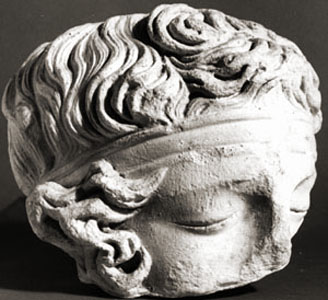
Cast Gallery catalogue number: C058
Head of a youth with closed eyes (Thamyris?)
- Plaster cast: Height: 18 cm.
- Copy of a head of a marble statue.
- The statue:
- is a 2nd century AD version of a work of the late 5th century BC.
- is from Rome.
- is now in Budapest, Szepmuveszeti Muzeum, 18.
Detailed Record
Commentary Prepared by Dr. Julia Lenaghan, Ashmolean Museum
C 058
Head Based Loosely on Polykleitos’ Diadoumenos. With Eyes Closed. Budapest
Marble
Head
18 cm
From Rome
Hungary, Budapest, Szepmuveszeti Muzeum, 4723
Preservation:The lower part of the face, the back of the head, and a separately worked piece of the top of the head are missing. The surface is chipped in many places.
Description:The fragmentary head depicts a young male with closed eyes. Little remains of the face but the eyes, the arcing eyebrows, and the bridge of the nose. The brow is not tall and is mainly covered by the fillet which runs around the head at a level above the ears. The fillet features two engraved lines (deocration?) which run parallel to its upper and lower borders.
Above and below the fillet are unruly locks of hair. The locks over the center of the brow appear in two layers. The lower layer of locks clings closely to the head; the upper layer, which has greater volume, features a central part. Behind the locks which form the central part are short locks that curl toward the front of the head. Below the fillet, around the temple and in front of the ear, long thick curly locks emerge and conceal some of the fillet. Above the fillet and behind the variously directed frontal locks, the hair follows a more organized pattern. It falls down from the crown in long gently waving strands which are pressed to the skull by the fillet. Individual locks here are not as distinctly articulated as they are at the front.
Discussion:The head generally follows the format of Polykleitos’ Diadoumenos; it does not, however, copy it but rather uses it to create a new work. The head is grouped by modern scholars with several other Roman periods heads that are inspired by Polykleitos’ work. Other such heads include one in the Bunnemann collection in Munich, in the British Museum, and in the Louvre. In addition, there is a series of four related heads (see cat.no.57) which are also based on the “Diadoumenos.”
The Budapest head is considered particularly interesting of its subject which features closed eyes. Hekler initially proposed Endymion, who would have been depicted sleeping, or Thamyras, the Thracian bard who challenged the Muses, and was then blinded for his hubris. Thamyras appears on vase paintings with his eyes closed. Moreover, he is known to have appeared in wall painting and Pausanias (9.30.3) mentions a statue of him in Thespiae by a relatively unknown artist. Zanker more recently and Maderna-Lauter, following him, re-propose Endymion, who was popular in the Roman period and suggest a “pretty Gorgon” since a gorgon might also be shown sleeping.
All scholars have dated the Budapest head to the Hadrianic or early Antonine period because of the rendering of the hair. Zanker and Maderna-Lauter, following him, place it more specifically in the Hadrianic period and compare the technical details to those of portraits of the empress Sabina.
Bibliography:A. Hekler,
Museum der bildenden Kunste in Budapest: Die Sammlung antiker Skulpturen (Vienna 1929) p.28 no.18
considers to be Hadrianic-Antonine, possibly representing Endymion or Thamyras.E. Schmidt,
"Der Kassel Apollon und seine Repliken" (AntPl 5 1966) pp.286-290 figs.37-39
attributes head to same artist as PlatoP. Zanker,
Klassizistische Statuen (Mainz 1974) p.17
considers Hadrianic, suggests that represented Endymion or a pretty GorgoD. Kreikenbom,
Bildwerke nach Polyklet (Berlin 1990) pp.138, 202-203 V 58 pl.347
Hadrianic or early Antonine on account of drill work in hair, probably Endymion, better considered a new creation than an adaptation of "Diadoumenos"(C. Maderna-Lauter),
Polyklet: Der Bildhauer der griechischen Klassik (Mainz am Main 1990) pp.634-635 no.164
repeats Zanker’s dating and discussion of subject