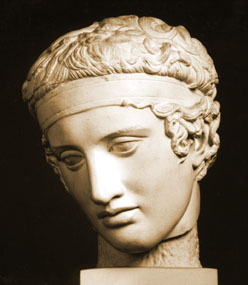
Cast Gallery catalogue number: C038
Head of an athlete.
For other versions of the same original see
C036, C037 and C039.
- Plaster cast: Height: 46cm.
- Copy of the head of a marble statue.
- The head:
- is a version of the head of the original bronze Diadoumenos made by Polykleitos about 430 BC.
- was acquired by Kassel in 1815 from Paris.
- is now in Kassel, Staatliche Kunstsammlungen, 6.
Detailed Record
Commentary Prepared by Dr. Julia Lenaghan, Ashmolean Museum
C 038
Copy of the Head of Polykleitos’ Diadumenos. Kassel
Marble
Head
29 cm, face 21 cm
Acquired in Paris in 1815. The provenance is unknown.
Germany, Kassel, Staatliche Kunstsammlungen, 6
Preservation:The head is broken diagonally through the throat; the break descends from the right side to the left side. The end of the nose and the back part of the right ear with some touching locks are missing. The ends of the fillet are broken. The outer part of the right eyebrow and the right side of the lower lip are abraded.
Description:The head has a flat wide cranium with a face that is broad between the temples but tapers to the chin. The brow appears as a short rectangular area because it is traversed horizontally by the broad fillet which encircles the head. In addition, the eyebrows are virtually horizontal. The eyes have a heavy upper lid which is sharply defined and a tear duct that, extending toward the nose, breaks the harmonious shape of the eye. The cheeks are round and merge at a solid short chin. The nose has a broad ridge and the lips, especially the lower one, are full. They are separated by a groove which dips at the center and thus, gives the upper lip a central overhang.
The hair, which leaves the ears uncovered, is short and rendered in voluminous locks which, though they are distinct, have no fine definition of their individual strands. The tousled locks originate at the crown in a starfish pattern. Encircling the head running above the ears and across the brow is a broad flat fillet which featires two horizontal engraved lines that run inside of the fillet’s upper and lower edges. The fillet is tightly wrapped against the head and the hair above and below it springs out from it.
Discussion:The Kassel head is a copy of the head of the “Diadumenos” of Polykleitos (see cat.nos.C 36, 37, and 39). Among the copies of the head of the “Diadumenos” the Kassel is not outstanding for any reason. It is generally considered a good copy since it corresponds in details of hair and physiognomy to the heads on the Athens, New York, and Tripolis “Diadumenos” statues and to the “Diadumenos” head in Dresden.
Lauter and Kriekenbom have both dated the head to the Hadrianic period. They cite the rendering of the eyes with their sharply cut lids and rounded eyeballs and the drilling in the hair, particularly above the temples, as typical of the Hadrianic period. Kriekenbom also suggests that the roundness of the face is Hadrianic. In addition, Lauter sees similarities between the head and the statue from Tripolis which comes from the Baths at Leptis Magna that are dated to the Hadrianic period.
Bibliography:M. Bieber,
Die antiken Skulpturen und Bronzen des Konigl. Museum Fridericianum in Cassel (Marburg 1915) pp.10-11 no.6 pls.11-13
initial publicationH. Lauter,
Zur Chronologie romischer Kopien nach Originalen des V. Jhr. (Bonn 1968) p.93 no.8 and p.96
listed as neoclassical work of Hadrianic period, compared to Tripolis statue which is HadrianicT. Lorenz,
Polyklet (Wiesbaden 1972)
P. Zanker,
Klassizistische Statuen (Mainz 1974) pp.11-13
notes its resemblance in facial shape to Athens, New York, Tripolis, and Dresden copies(D. Kreikenbom),
Polyklet: Der Bildhauer der griechischen Klassik (Mainz am Rhein 1990) p.562 no.78
notes features that are typical of Hadrianic copyD. Kreikenbom,
Bildwerke nach Polyklet (Berlin 1990) pp.130-140, 199 no. V.42
compares copies of the heads, dates the Kassel head to the Hadrianic period