Commentary Prepared by Dr. Julia Lenaghan, Ashmolean Museum
C 032
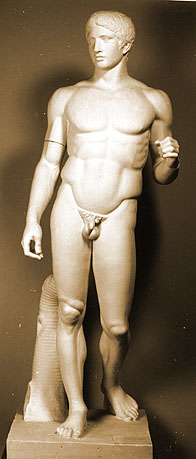
Copy of Polykleitos’ Doryphoros from Pompeii. Naples
Marble
Statue
2.12 m
From Pompeii. Allegedly found in the so-called "Palestra Sannitica" in Pompeii. It may not have been found there and the building is not a Palestra.
Italy, Naples, Museo Archeologico Nazionale, 6011
Preservation:The statue is put together from several pieces but is without important restorations. The rectangular plinth into which the ancient oval plinth has been inserted, and the block under the sole of the left foot are restorations. There are breaks from the bunion to the third toe of the left foot, on both ankles, under both knees and at the same level on the support, on the left forearm above the wrist, on the right wrist, and on the penis.
Description:The statue is that of a naked male. He stands with his weight on his right leg which is consequently straight and tensed. Along the outside of the right leg and attached to the back of the right thigh is a support. The bent and loose left leg trails behind the right leg and is intended to be seen in motion. Only the toes of the left foot touch the ground; the rest of the foot rests on a marble wedge. The left hip is lower than the right hip, yet the left shoulder is slightly higher than the right shoulder. The right arm rests loosely by the side. The relaxed hand is attached by a strut to the outer thigh. The left arm is also lowered but bends sharply at the elbow so that the forearm extends forward. The hand held a spear (no longer preserved) which extended from the shoulder to the ground. The head turns to the right and tilts slightly downwards.
The body is muscular. The line from the hip to the groin (illiac furrow), the bottom edge of the rib cage, and the veins in the arm are clearly articulated, especially on the right side. The trapezius muscles between the shoulders and the neck are plastically modelled and the lateral muscles are defined on the back.
The head has a flat cranium and a broad oval face. The brow is high and slightly convex; the cheeks are flat and end in a solid round chin. The eyes are wide and the nose is broad. The lips are full, open, and droop down at the corners. The puffy lower lip is better defined than the upper.
The hair, which leaves the ears and much of the brow uncovered, is short and rendered in locks whose strands are separated by parallel, cursorily engraved, grooves. The short locks are arranged in tiers which originate at the crown in a starfish pattern. Over the brow and the temples, the hair is symmetrically arranged in three partings. The largest of the partings is directly above the nose; the two other partings lie above the outer corners of the eye. The hair at the back of the head above the neck is not fully rendered.
Discussion:The statue is without doubt a Roman copy of the “Doryphoros” made by Polykleitos. Polykleitos’ “Doryphoros” has excited ancient and modern enthusiasm, chiefly because Polykleitos wrote a treatise about it. In this treatise, called the “Canon”, he allegedly explained how to create the perfect statue by using symmetry and numerical calculations. Thus, the “Doryphoros” is considered the canon of classical sculpture. It has been cited for centuries as the epitome of perfect balance in pose (between relaxed and working muscles) and in motion (between action and monumental inertia), a balance which best shows off the beauty of the human form. There is still some doubt as to the original subject of the statue. According to some (von Steuben, Zanker, Kreikenbom), the statue represents Achilles; according to others (Ridgway), it is an athlete. The argument for Achilles lies in the fact that Lysippos’ statue of Alexander was based on the “Doryphoros” and showed Alexander with a spear as Achilles.
It had been generally accepted that whether the statue was Achilles or an athlete, the placement of the statue in the athletic environment of a palestra in Pompeii was appropriate. Hartswick, however, has recently pointed out that the statue may indeed not come from this area in Pompeii, that the area in Pompeii was called a palestra only because this athletic statue was found there, and that the area has been most recently identified as a temple by L. Richardson.
The statue in Naples was considered the most complete and important copy of the “Doryphoros” until the appearance in 1986 of the copy in the Minneapolis Museum in Minnesota; it allowed us to evaluate the pose and proportions of the “Doryphoros”. The statue has, however, always been criticized for its uneven workmanship which is particularly visible in the cursory treatment of the hair. In the early 1970s Lorenz and Von Steuben attempted to defend the statue and assert that its softer modelling and lack of articulation were truer to the original than other copies, particularly the torsos in Berlin and Florence. Only shortly afterwards, Zanker maintained exactly the opposite. With the discovery of the Minnesota statue, the pose given by the Naples statue also came under question since it lacks the strength of the right turn of the Minnesota statue; right foot, hip, and head turn more sharply in the Minneapolis copy. Kreikenbom in 1990 assigned the differences in the various copies of the statue to the period in which they were erected. He saw the differences, for instance, between the more organic motion and agility of the Minneapolis copy and the plasticity and blocky relationship of space and movement of the Naples copy as the difference between a Hellenistic work and a early imperial classicizing work. Hallett argues convincingly that these slight differences between the copies were not intended to be noticed at all. He believes also that the softer articulation of the Naples statue is less in keeping with the fifth century aesthetic than the more defined copies in Berlin and Florence. To support this argument he shows that the Riace bronzes feature firmly defined anatomies.
The Naples statue has been dated by Zanker to the Tiberian period mainly because of the handling of the head which resembles portraits of Tiberius. This dating has been generally accepted even if Kreikenbom, considering it potentially early Claudian, has pushed it slightly forward.
Bibliography:T. Lorenz,
Polyklet (Wiesbaden 1972)
H. von Steuben,
Der Kanon des Polyklet: Doryphoros und Amazone (Tubingen 1973) pp.185-198
full discussion of measurements and symmetry, considers it to be AchillesP. Zanker,
Klassizistische Statuen (Mainz 1974) pp.7-8
considers it to be Tiberian on account of the handling of the head, original probably AchillesM. Robertson,
A History of Greek Art (Cambridge 1975) pp.328-331
general discussion of the canonB. S. Ridgway,
Fifth Century Styles in Greek Sculpture (Princeton 1981) pp.201-204
canon, chiastic structure, considers it an athlete and not Achilles,
Le Collezioni del Museo Nazionale di Napoli I,2 (Rome 1989) p.100 no.31
,
Polyklet: Der Bildhauer der griechischen Klassik (Mainz am Rhein 1990)
articles on various aspects of PolykleitosD. Kreikenbom,
Bildwerke nach Polyklet (Berlin 1990) pp.59-62, 163 no.III.2
compares Minnesota (Hellenistic copy) and Naples (early imperial classicizing copy) statue, dates Naples to the late Tiberian-early ClaudianC. Hallett,
"Kopienkritik and the Works of Polykleitos" in Polykleitos, the Doryphoros, and Tradition (Wisconsin 1995) pp.128-136
evaluates the Naples copyK. Stemmer (ed.),
Standorte: Kontext und Funktion antiken Skulptur (Berlin 1995) pp.396-397 C 37
summarizes the research and discusses the statue as belonging in a PalestraK. Hartswick,
"Head Types of the Doryphoros" in Polykleitos, the Doryphoros, and Tradition (Wisconsin 1995) pp.173-174 Appendix 2
questions the findspot of the statue which, even if it were correct, is not a palestraW. Moon (ed.),
Polykleitos, the Doryphoros, and Tradition (Wisconsin 1995)
articles on the various aspects of the Doryphoros