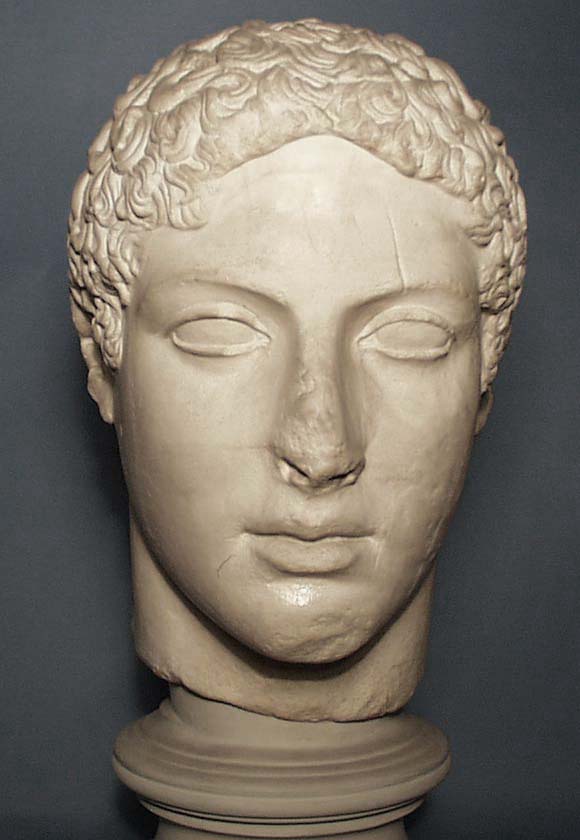
Head of an athlete.
Commentary Prepared by Dr. Julia Lenaghan, Ashmolean Museum
C 023
Head of Hermes? in the "Cyrene-Perinthos" Type. Dresden
Marble
Head
26.8 cm
From Perinthos. Found in 1855
Dresden, Staatliche Kunstsammlungen, Skulpturensammlung, 73
Preservation:The head is broken through the lower part of the neck. The end of the nose and the back part of the right ear are broken. The left ear and the chin are battered. The eyelids are chipped and worn. In addition, the hair originally framed the brow in a gentle arc; this arc has been altered either in antiquity or in the modern era. Two diagonal cuts through the brow hair begin above the center of each eye and intersect at a higher point at the center of the brow. The surface in the places, where the original brow has been removed along the diagonal cut, are set back and uneven.
Description:The head depicts a beardless young male with short hair. The hair, which covers the scalp naturally, is arranged in tiers of curls and consequently, has some volume. Each individual lock tends to curl back into itself. At the back of the head the hair reaches a few centimeters below the ears which are completely uncovered. In front of the ears a few locks drop downward below the temple. Between the temples, over the brow, the hair has been recut into a stiff triangular form which has its apex at the center of the brow.
The face has a long oval shape. The brow is tall and flat and the cheeks are long and full. The eyebrows arc and reach their highest point near the outside of the eyes. The eyes are long and small; the lower lids are horizontal and the upper lid has a low arch. The mouth has a wide groove between the lips which gives a semi-open aspect. Both the upper and lower lip are full and well defined; the upper lip has a neat bow shape and the lower lip is a regular downward arch in form. The chin is large and solid. The ears have a large unattached lobe and a quasi-cauliflower aspect.
The muscles in the neck, particularly on the right side, as well as the edge of the shoulders are preserved. The muscle on the back of the right side of the neck emerges in a position that is at odds with the rest of the neck. It is clear that the head turned to the right. In addition, the edge of the right shoulder is higher and comes further forward than that on the left. The right arm, therefore, seems to have been raised and to have been placed in front of the body.
Discussion:The head belongs to a type which called the “Cyrene-Perinthos” type, named after its two most important examples. In total, there are at least seven replicas preserved: 1) the head from Perinthos, 2) the J. Hirsch head, 3) the head in the Vatican Magazzino with the elongated ears of a satyr, 4) the head in the Hermitage which is bearded, 5) the head and statue in Cyrene, 6) the statue of Hermes in Side, and 7) a torso in Gortyn. The number of replicas, the associated body type, and the details of the head which has been compared to that of the Lapiths on the pediment of the Temple of Zeus at Olympia, the Diomedes, the Riccardi head, and Myron’s discobolus, show that the original model was a bronze statue of the mid to late fifth century BCE.
The subject of the statue was for some time open for discussion. Polacco, judging by the athletic frame, short hair, seemingly unidealized features, and the large bulbous ears, suggested that it was a boxer. Chamoux thought that it might well represent Hermes (popular in Cyrene) or Herakles since both had athletic associations. A statue from Side, published first by J. Inan in 1970, is clearly the same type as the Cyrene statue and has the kerykeion of Hermes cradled in the left arm. Moreover, struts on the left side of the Cyrene statue as well as an indentation on the left upper arm seem to indicate that the Cyrene statue also held a long object, very plausibly a kerykeion. Inan, developing Chamoux’s argument, points out that Hermes, whose image was often erected in gymnasia, was an athletic figure who might have the large ears of a wrestler or boxer. Finally, she notes that the posture of the statue is similar a bronze statuette of Hermes (Annecy),
The statue type has been associated primarily with two artists, Pythagoras (Polacco and Hermann) and Myron (Lippold, Langlotz, Chamoux). Most recently, however, Inan has rejected both these attributions and has reassumed Poulsen’s unpopular attribution to Kresilas. Her argument is basically that the Diomedes and the “Cyrene-Perinthos” Hermes are done by the same hand. The Diomedes has been shown without doubt by Furtwangler to be by Kresilas. Thus, the “Cyrene-Perinthos” Hermes is also by Kresilas.
In my opinion, the Perinthos head certainly copies a mid fifth century bronze original. Moreover, because the Side and Cyrene statues both seem to have represented Hermes, it is plausible that the original represented Hermes. Who the original artist was appears to be a subjective discussion without great relevance. Perhaps of greater interest are the two Roman copies in the Vatican and in the Hermitage which freely alter the subject of the original.
Bibliography:P. Herrmann,
"Athleten-Kopf aus Perinthos" AM 16 1891 pp.313-331
L. Polacco,
L'Atleta Cirene-Perinto (Rome 1955) especially pp.18-20
G. Kaschnitz-Weinberg,
Sculture del magazzino del Museo Vaticano (Vatican 1937) pp.36-37 no.45
F. Chamoux,
"A propos d'une statue de Cyrene" (RA 48 1956) pp.40-55
J. Inan,
"Three Statues from Side" (AntK 13 1970) pp.21-26
J. Inan,
Roman Sculpture in Side (Ankara 1975) pp.19-29 no.3