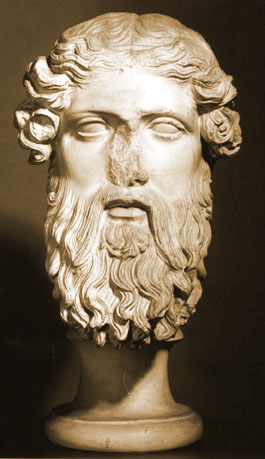
Cast Gallery catalogue number: C022
Head of Dionysos.
- Plaster cast: Height: 46cm.
- Copy of a marble head.
- The head:
- is of the type known as Sardanapallos.
- is a Roman version of a Greek bronze original of about 450 BC.
- was found at Piraeus, the port of Athens, in 1914.
- is now in Athens, National Museum, 3478.
Detailed Record
Commentary Prepared by Dr. Julia Lenaghan, Ashmolean Museum
C 022
Head of Dionysos in the"Athens-Kos" Type (related to the "Sardanapalus" Type). Athens
Marble
Head
34 cm
From Piraeus. Found in 1914
Preservation:The head, broken through the neck, is preserved in good condition. The nose and some ends of the beard locks are broken and the left eyebrow is abraded. There are no restorations.
Description:The head depicts a male with long hair and a long beard. The wavy hair has a central part and a small band, running around the head just above the ears, keeps the hair tightly against the skull. The band is visible only above the center of the brow and above the ears. Elsewhere it is hidden by the hair. The hair between the central part and the temple is long and pulled backwards. The hair, which is pulled back, has greater volume and stands further away from the skull. This hair is placed under the band in such a way that its ends reappear between the temple and the ear, hanging down in thick curly locks. At the back of the head the hair retains its division into left and right sections; both sections, falling over the band, are brought together near the nape. A few short locks of hair escape the general pattern and curling, rest on top of the more obedient locks.
The beard and moustache cover most of the lower face. The individual locks, consisting of raised strands, tend to turn in one direction or another at their ends. Below the lower lip is a distinct area of shorter locks. The beard reaches well below the chin and the lower section, hanging off the face, has great volume.
The face is marked by a low rectangular brow and high projecting cheekbones. The eyebrows are virtually horizontal and the eyes have a long horizontal shape which seems to slope downwards. The lips are slightly open and the lower lip is fuller than the upper lip.
Discussion:The head is known in one other replica which is in Kos (L.Laurenzi ClRhodos 9 1938 p.36 fig.20). For this reason it is said to belong to the “Athens-Kos” Type. This “Athens-Kos” Type is, however, related to a well-known Dionysos type, the “Sardanapalus” Type (see cat.no.117), which exists in eleven replicas.
The Athens’ head is certainly a Roman copy. What it actually copies is the focus of scholarly debate. Ashmole, followed by Pochmarski, first distinguished the “Athens-Kos” Type from the “Sardanapalus” type because of the different brow formation. He considered the “Athens-Kos” Type to be based on a bronze original which dated about fifty years before the original of the “Sardanapalus” Type. The former he thought to be a work of the mid fifth century from the circle of Phidias and the latter an Attic work of the fourth century from the circle of Praxiteles.
Whether his attributions and datings are correct, his separation of the two types has been generally accepted. Recently Gasparri (in LIMC II) has, however, challenged this. Reflecting on the inability to associate any body with the “Athens-Kos” Type and the possibility that the original of the “Sardanapalus” Type moved, he suggests that the “Athens-Kos” Type is just a variant of the better known “Sardanapalus” Type.
In my opinion, the Athens head is likely to be a variant of the “Sardanapalus” Type, particularly since this “Sardanapalus” Type is in no way assuredly fourth century. In fact, Pochmarski and Zanker have recently suggested that the “Sardanapalus” Type is a Hellenistic creation. It is likely that the Hellenistic creation was based on an older statue and that a Roman copy might be liable to more variation since it might draw on a combination of the Hellenistic creation and the older statue.
Bibliography:E. Pochmarski,
"Neue Beobachtungen zur Typus Sardanapal" OJh 50 1972/73 p.43 footnote 30
E. Pochmarski,
Das Bild des Dionysos in der Rundplastik der Klassischen Zeit Griechenlands (Vienna 1974, dissertation 1969) pp.61-62 and 64-66
B. Ashmole,
"The So-Called Sardanapalus" BSA 24 1919-1921 pp.85-86 pl.4
S. Karouzou,
National Archaeological Museum. Collection of Sculpture (Athens 1968) p.163
C. Gasparri,
"Dionysos", Lexicon Iconographicum Mythologiae Classicae III, I (Zurich 1986) p.443 no.187