Commentary Prepared by Dr. Julia Lenaghan, Ashmolean Museum
C 014
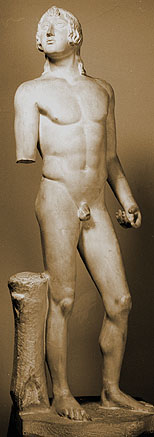
Statue of a boy in the "Eros Soranzo"Type. St.Petersburg
Marble
Statue
1.59 m
From Istanbul or from an island in the Aegean. According to Venetian stories either bought in the former locale by Enrico Dandolo or in the latter by Giovanni Soranzo in 1312. The statue was in Palazzo Soranzo in Venice until 1851
From Istanbul or from an island in the Aegean. According to Venetian stories either bought in the former locale by Enrico Dandolo or in the latter by Giovanni Soranzo in 1312. The statue was in Palazzo Soranzo in Venice until 1851
Russia, St. Petersburg, Hermitage, A 192, K 153, W 102
Preservation:The nose, left forearm until the wrist, the fingers of the left hand with the exception of the index finger, and the base in which the remainder of the ancient plinth is set, are restorations. The left hand and the round objects in it, according to Waldhauer, belong to the statue. The feet were broken but the break surfaces correspond. On the hips there are traces of struts. The tree trunk features a hole which was made during an earlier restoration. The right forearm, which was also an earlier restoration, has been removed.
Description:The statue depicts a naked male who stands frontally with the body weight over the right leg. The right foot points outward and the left foot at shoulder width apart points toward the left. The torso is fully developed, especially the abdominal and pectoral muscles, but lacks pubic hair. The left hand, which Waldhauer insists is not restoration, holds small round objects. The left forearm, however, is a restoration. Thus, the position of the left hand is not certain.
In contrast to the frontal torso the head turns upwards and over the right shoulder. The hair of the head, rendered by undulating engraved lines, is long in back; between the ears at the back of the head the hair falls from the crown down the nape of the neck and onto the shoulders. Apparently beginning above both ears and coming forward over the brow is a twist or a braid. Out from under the twist or braid in front of the ears is a short mass of hair thatm falling downwards, reaches the middle of the cheek bones. On the brow over the nose and inner eyes another short mass of hair escapes under the twist or braid. Behind the twist or braid the hair is combed backwards toward the crown. The face itself is difficult to assess because of its upward tilt. It has arched eyebrows, wide eyes, and an open mouth since the lips are separated by a broad groove.
Discussion:The body exists in two other replicas, one at Oxford and one in Sparta [M.N. Tod and A.J.B. Wace, A Catalogue of the Sparta Museum (Oxford 1906)]. Neither of these copies preserves the head. In addition, the Sparta copy has slots in the back for the insertion of wings.
Because the type exists in more than one replica, because the body resembles works of the Severe Style, and because the head has been compared to that of the Spinario and the head of Triptolemus on the Eleusinian Relief, the statue in the Hermitage was initially taken to be a copy of a famous original dated to the Early Classical Period. Waldhauer did, however, qualify this by stating that it was a “Hadrianic interpretation.” In regard to the subject depicted, Waldhauer, dismissing the wings on the Sparta statue has an alteration, believed that the original statue represented a youth beloved by the gods; he suggested Hyacinthus. Another more far-fetched suggestion has been offered by Hafner who calls it “Agon” and believes it held a cock in each hand.
More recent scholarship is less convinced that the statue represents a fifth century original. Ridgway finds the surprised expression, the upturned head which contrasts with the frontal torso, and the unusual hair over the forehead to be unlike any early fifth century statue. Robertson (Ridgway footnote p.132) suggested the statue to belong to a larger group, for instance it might be an Eros looking up toward an Aphrodite. He, furthermore, considered the statue “Pasitelean”, i.e. of the first century BCE. Ridgway accepts Robertson’s idea.
In my opinion, the fact that the torso exists in three replicas suggests that the original was well-known. The date of the original is, however, difficult to assess. The head of the Hermitage statue should certainly not be considered a representation of the original, not matter what the date of the original may be.
Bibliography:O. Waldhauer,
"Zur Kritik spatromischer Kopien" in Antike Plastik: Walther Amelung zum Sechzigsten Geburtstag (Berlin 1928)
compares Eros Soranzo head to that of the head often attached to the SpinarioB. Schweitzer,
"Eine Attische Tonpuppe" (RM 1929) p.19
dates the original between 460-450O. Waldhauer,
Die antiken Skulpturen der Ermitage II (Berlin 1931) pp.1-2 no.85 pls.1-2
considers the statue to be a Hadrianic copy of a Greek original of 475-450V. Poulsen,
"Der Strenge Stil: Studien zur Geschichte der Griechischen Plastik 480-450" (ActaA 7 1937) p.33
considers it to be an Argive creatin of 475-450B. S. Ridgway,
The Severe Style in Greek Sculpture (Princeton 1970) p.132
discusses statue amidst pastiches, considers it to be a first century creation