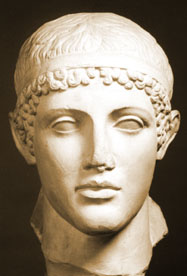
Head of an athlete.
Commentary Prepared by Dr. Julia Lenaghan, Ashmolean Museum
C 007
Erbach Athlete in "Anadumenos Capranesi" Type. Schloss Erbach
Marble
Head
30 cm (preserved original), 46.5 cm with modern herm
Provenance is unknown.
Germany, Erbach, Grafliche Sammlung
Preservation:The head is broken at the neck. The herm (which is not reproduced in the cast) and the end of the nose are modern restorations. Scratches in the chin, the edge of the left ear, the fillet on the left side, and flicks in the cheeks and throat have been restored in plaster.
Description:The head depicts a young man who wears a fillet. In the frontal view the head has an oval shape at approximately the center of which is the bridge of the nose. The hair clings to the head and is traversed by a a flat fillet which, located above the ears, encircles the head. The hair is rendered in long wavy locks which are combed from a central part to the sides. The ends of the hair, which appear mainly below the fillet, are rendered in small “snail” curls or spits. The line of the hair over the brow generally follows the arc of the top of the head. At the center of the brow is a triangular parting. Around the ears, the locks fall in layers which serve to conceal the protrusion of the ears that would have disrupted the oval contour of the head. The fillet is tied at the back of the head in a Herakles knot. The ends, however, do not fall straight down but are looped up and under the band of the fillet to the left and right of the knot. They then fall downward on the shoulders.
The brow is low and small. The cheeks are flat and smooth. The eyebrows, beginning at the bridge of the nose, follow a gentle arc. The eyes are almond-shaped. The upper eyelid, formed by two lines, is arched and heavy. The path of the lower lid is distinctly more horizontal than that of the upper lid. On the left eye the lower line of the upper lid intersects the lower lid. The nose and mouth are regular. The lower lip is fuller than the upper lip. The groove between the lips dips slightly at the center. The chin is rounded and solid. The part in the brow hair, the nose, and the center of the lip are slightly off axis. The preserved area of the throat shows that the head turned slightly to its right.
Discussion:There is a replica of the head in the British Museum in London which is known as the “Anadumenos Capranesi” (BM no.1780). Since they correspond in overall appearance and details, they are surely based on the same original. The fillet worn in the hair indicates that the original was probably a statue of a victorious athlete.
According to Fittschen, there are primarily three differences between the London and Erbach copies: That the outline of the lower face is smaller in the London copy, the upper lip is more arched in the London copy, and that the Erbach copy has longer locks, especially behind the right ear. Yet, Fittschen believes that the copies are so similar that they may even come from the same workshop which he, judging by the marble, locates in Athens. He dates both marble copies to the early imperial period, suggesting that the Erbach head is Augustan and the London head is a little later since it features point drilling in the curls over the brow.
The original, on which these two marble copies are based, he dates to the middle of the fifth century BCE. He cites the shape of the head (long with eyes in the center) which accentuates the lower part of the face and the crown, the almond eyes without intersecting lids, and the hair divided by the fillet into long strands and curly ends, as being typical of works made between 480 and 450 BCE. He compares the head to that of the Delphi charioteer which has the same head shape, hair pattern, fillet, and form of the lips and chin. He believes that the original of the London-Erbach heads would be slightly later than the charioteer since it features some short sickel locks which disrupt the unified form of the head and recall the Doryphoros; in addition, the head’s large eyes, more plastically rendered brow, and rounded chin suggest a later date. The head can also be compared to the Choiseul Gouffier-Omphalos Apollo, the Tiber Island Apollo, the Perinth-Cyrene athlete, the Riccardi-Ince Blundel athlete, and the Monteverde-Corinth athlete.
The head has been ascribed by various scholars to numerous artists (Myron, Amphion, Pison of Kalaureia, Pythagoras, and Sostades of the charioteer) and to numerous schools (Attic, Peloponnesian, and Sicilian). Fittschen, however, views the pursuit of the artist, the artistic school, and the location of the original as unfruitful, concluding that it is improbable the name of the artist and the statue are known from ancient literature.
Bibliography:K. Fittschen,
Katalog der antiken Skulpturen in Schloss Erbach (Berlin 1977) pp.9-11 no.1 pl.1