Commentary Prepared by Dr. Julia Lenaghan, Ashmolean Museum
B 218
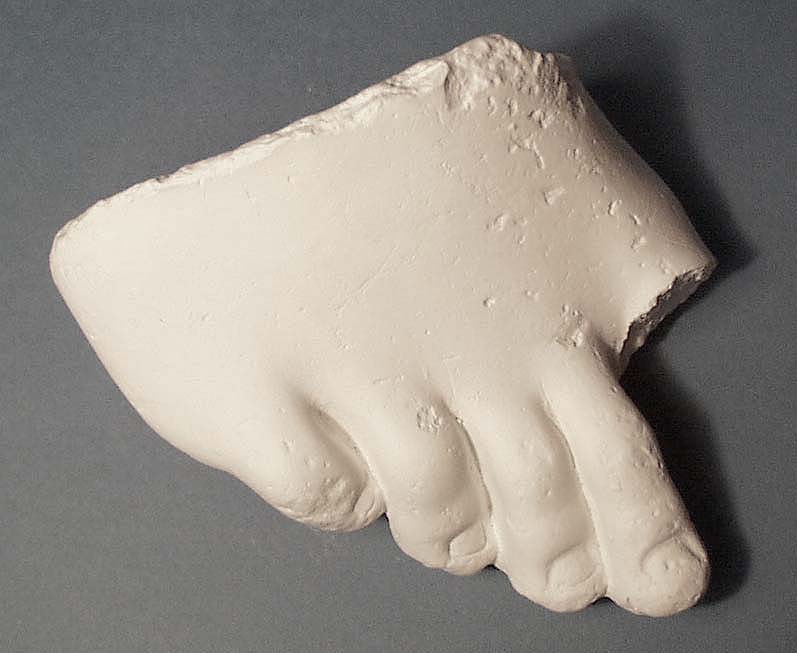
Cast Fragment of the Front Part of the Right Foot of a "Sosikles" or "Capitoline" Amazon Type Statue. Baia
Plaster
Statue Body Fragment
L 13 cm, W 12 cm, H 8 cm, L of second toe 6 cm
Found in 1954 in a cellar room in the Baths of Sosandra at Baiae (modern Baia). It was found among dirt fill and other casts.
Italy, Baia, Museo Archeologico dei Campi Flegrei, 174.534
Roman Period, Copy of a Classical Statue Dated ca.440 BC
Preservation:The foot fragment, made of fine plaster, depicts part of the right foot. The preserved area extends lengthwise from about the ball of the foot to the end of the toes. All but the beginning of the big toe is missing and, the four other toes are battered at their tips. The surface, however, is generally well preserved. On the underside of the foot. preceding the toes, there is a deep hollow. A portion of the plinth, visible below the outside of the foot, features a finger-like indentation under the end of the little toe.
Description:The fragment belongs to a non-weight bearing right foot. The foot rises markedly at the instep. Under the outer edge of the foot and the small toe a plinth, which is about one to two centimeters high, is visible. It, however, disappears at the tip of the fourth toe. The tips of the fourth, third, second, and presumably also of the big toe touch the ground.
In comparison with the broad and large foot, the toes are relatively small. The second and third toes are lean and unbent. They lie directly against each other. The fourth and small toe are shorter and rounder; they bend in opposite directions. The fourth toe bends so that the end presses closer to the ground and turns to its right. The small toe, which is significantly smaller and more bent than even the fourth toe, rises in the middle and its end turns to its left. The end touches the middle knuckle of the fourth toe. Because of the different directions of the fourth and little toe there is a gap between the toes at their base. At the outer base of the little toe the foot moves sharply outward and extends in breadth about three centimeters over the plinth.
The only delineated details of the foot are the toe nails. The second, third, and fourth toes feature flat broad clearly defined nails which are cut short; that of the little toe is appropriately much smaller. The rest of the foot appears broad, soft, and rounded.
Discussion:Christa Landwehr associated this fragmentary foot with the foot of a statue type known as the “Sosikles” or “Capitoline Amazon” (see cat. C 87). In statues of this type the right leg does not bear the weight and the toes of the foot press against the ground but the heel is raised. Moreover, other fragments from the various statues of Amazons were found at Baiae.
Landwehr compared the foot to the Amazon statue in the Capitoline Museum (Salone 33) (here cat. C 87) which gives its name to the statue type. She even made casts of the Baiae fragment and the foot of the Capitoline statue. She concluded that the width and length of the fragment and the foot as well as the height of the arch and the placement of the toes corresponded. These basic elements were also repeated in the right foot of another statue of the “Capitoline Amazon” type (Capitoline Museum Salone 19). Landwehr did note, however, that there were minor discrepancies in the details of the Baiae fragment and the namesake of the “Capitoline Amazon” type (Capitoline Museum Salone 33). The plaster fragment is slightly smaller than the marble foot but in the marble foot the fourth toe does not touch the ground, the small toe is thicker, the nail of the little toe is somewhat larger, and the other toe nails are more “prettily” rendered. Also the fourth toe of the marble statue does not bend as much. These details, however, are attributable to the sculptor of the marble copy; similar differences occur between the Baiae cast fragment of the foot of the “Athena Velletri” type statue and the feet of the marble copies of the “Athena Velletri”. In any case, the discrepancies do not shed serious doubt on the fact that the plaster cast represents the foot of a bronze statue of the “Capitoline” or “Sosikles” type.
In her discussion of the cast fragment, Landwehr points out that the wide and solid form of the foot and the short toes with a crimped baby toe have parallels in other sculpture of the high classical period. She notes the foot of Persephone from the Great Eleusinian Relief, the feet of the female figures of the Parthenon frieze- especially Athena and Aphrodite, and even the foot of the Nike of Paionios. Among the cast fragments at Baiae the “Capitoline” or “Sosikles” foot fragment most resembles that of the “Athena Velletri”. Furthermore, she points out that this wide soft fleshy foot with its curled little toe is quite different from that of the “Sciarra” or “Mattei” type amazons, neither of which does she compare
to any high classical sculpture. Landwehr correctly emphasizes that there is a significant difference in the rendering of the three best known amazon types.
R. Bol in her monograph on the various statues and statue types of the Amazons refuses to accept wholeheartedly Landwehr’s attribution of the foot fragment. She states that the foot is too wide and big for an amazon but then concurs that it does correspond in form and modelling to that of the “Capitoline Amazon”. At another point in a footnote, she discusses the round feminine character of the “Capitoline” type and concludes that if the Baiae foot did come from this statue it would add further strength to her point. It is unclear to me why she simply does not accept the Baiae foot as deriving from the type.
The plaster cast and the ensuing careful examination of the feet of the Amazon types forces one to reflect more seriously on the style of the actual rendering. Landwehr, who points out that this foot of the “Capitoline” type, corresponds to feet of the high classical period, inadvertently lends support to the argument put forward by Ridgway and modified by Harrison which assigns the three statues to different chronological periods. Particularly Harrison’s argument which would have the original statues of the Amazons all created within a less than hundred year period, 440-370 BC, deserves consideration.
Bibliography:C. Landwehr,
Die antiken Gypsabgüsse aus Baiae (Berlin 1985) pp.70-71 and 74-76 no.40 pls.41, 42, and 104 f
full description of the foot, identifies it as the foot of the "Sosikles Amazon"R. Bol,
Amazones Volneratae. Untersuchungen zu den Ephesischen Amazonenstatuen (Mainz am Rhein 1998) p.50 fn.273 and pp.87-88 II.1 pls.70 d-e
does not consider Landwehr’s attribution of the foot to the “Sosikles” Type secure, admits that the foot corresponds to the copy of the type in the Capitoline collection