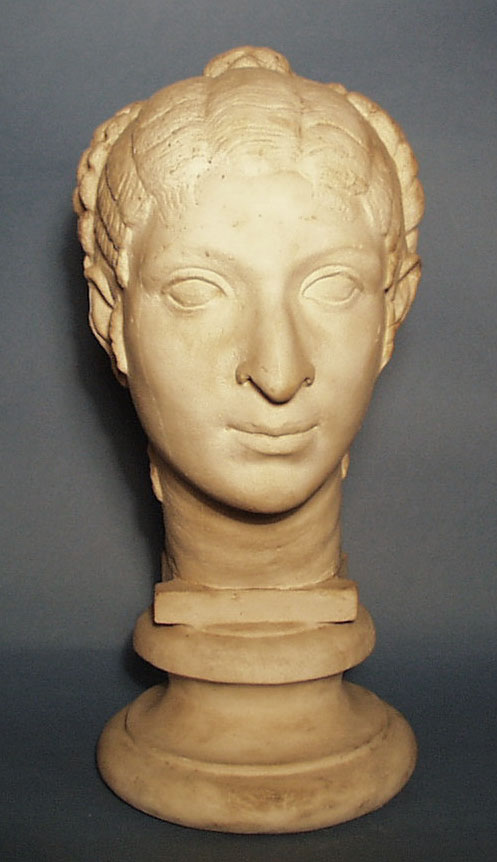
Portrait head of a woman (sometimes incorrectly referred to as 'Cleopatra').
Commentary Prepared by Dr. Julia Lenaghan, Ashmolean Museum
B 197
"Cleopatra". London
Limestone portrait head of a woman with an elaborate hairstyle worn in the late Republican period. Formerly misidentified as Cleopatra.
Limestone
Head
28 cm
United Kingdom, London, British Museum, 1873
Late Republican
Preservation:The head has broken off from its original element, probably a statue, at the base of the neck.
Description:The head and neck have broken off from a statue or bust at the base of the neck. The head, depicting an adult woman, turns to its left. It has irregular features and an ornate hairstyle
Due to the left turn of the head, the face is asymmetrical. The right side is fuller and projects further than the left side which slants more rapidly backwards. The shape of the face is a regular oval. The brow, framed by an essentially arching hairline, is of average height and the chin harmoniously connects the cheeks in a smooth U-shape. The eyebrows arch and are finely delineated. The eyes are wide set. The eyelids are sharply defined. The upper line of the upper lids is deeply engraved, and on the left side it continues well beyond the corner of the eye. The upper and lower borders of the eyeballs are crisply defined by distinct engraved lines. The nose has a broad flat bridge and then swells out in a hooked fashion. Between the septum of the nose and the center of the upper lip is a vertical indentation.
The mouth is small and has a convex shape; that is, the center pushes outward and the corners are tucked into the cheeks. The lips are thick and tightly pressed together. The center of the upper lip drops sharply downward.
The hair is tightly pulled back off the brow in a "melonfrisur"; that is, it is divided into sections by a series of parallel parts running from the front of the head to the back. The arrangement of these parts and the rest of the hair-do is off-line with the center of the face and nose. Two small tufts of hair escape the "melonfrisur" above the eyes and a further twisted spit escapes at each temple. In front of the ear is a long twisted corkscrew lock. The ears are uncovered and the lobes are pierced for the insertion of metal earrings. The melon hairstyle ends near the back of the head and the hair is gathered in several twisted braids. These braids are arranged in a big loop that extends from the neck up to the crown. At the crown knob-like ornamental object holds the braids together and in place. Wrapping from back to front around each side of the neck are two locks which, like those in front of the ear, are twisted into a tight corkscrew form; they look almost as if they are formed of different segments.
Discussion: This portrait head of an adult woman wears a hairstyle that was popular in the Late Republican period. The head was once even identified as Cleopatra VII.
The Cleopatra identification was based mainly on the portrait’s profile, especially the hooked nose. Yet, in point of fact, the portrait does not wear any regal attribute (neither crown nor fillet) and the portrait’s hairstyle does not correspond to the hairstyle shown in coin portraits of Cleopatra. Thus, already at the outset of the twentieth century, scholars ceased to identify the statue as Cleopatra.
The hairstyle is particular and fancy; it features a "melonfrisur" style with little locks on the forehead, tight small corkscrew locks in front of the ear, and large loop of braids at the back of the head. This hairstyle appears in a handful of portraits of the late first century BC as well as the slightly later portrait statue of Fundilia Rufa from Nemi, now in Copenhagen. The style was an elaborate and minority choice. It is thought to have been influenced by the styles of Hellenistic queens who wore the "melonfrisur" with a bun near or at the nape of the neck. Cleopatra’s presence in Rome, as the consort of Julius Caesar, between 46 and 44 BC, is furthermore given as the reason for the spread of the hairstyle of the Hellenistic queen in Rome.
The limestone head in the British Museum is without provenance. Limestone was, however, commonly used in grave monuments in Italy in the late Republican period and this portrait was purchased from the Italian dealer Castellani.
J. Lenaghan
Bibliography:A.H. Smith,
A Catalogue of Sculpture in the Department of Greek and Roman Antiquities, British Museum III (London 1904) 147, no. 1873, pl. 21
catalogue entryR.P. Hinks,
Greek and Roman Portrait Sculpture (London 1935) 15-16, fig. 18a
Levantine type head of a woman ca. 50 BCG.M.A. Richter,
Portraits of the Greeks III (London 1965) 269, fig. 1862
disassociates with Cleopatra because hairstyle does not conform to coin images and does not wear taeniaW. Trillmich,
Das Torlonia-Mädchen; zu Herkunft und Entstehung des kaiserzeitlichen Frauenporträts (Göttingen 1976) 60, n. 203
on hairstyle and lists related portraitsS. Walker,
Greek and Roman Portraits (London 1995) 74
S. Walker and P. Higgs,
Cleopatra of Egypt: from history to myth (London 2001) no. 210