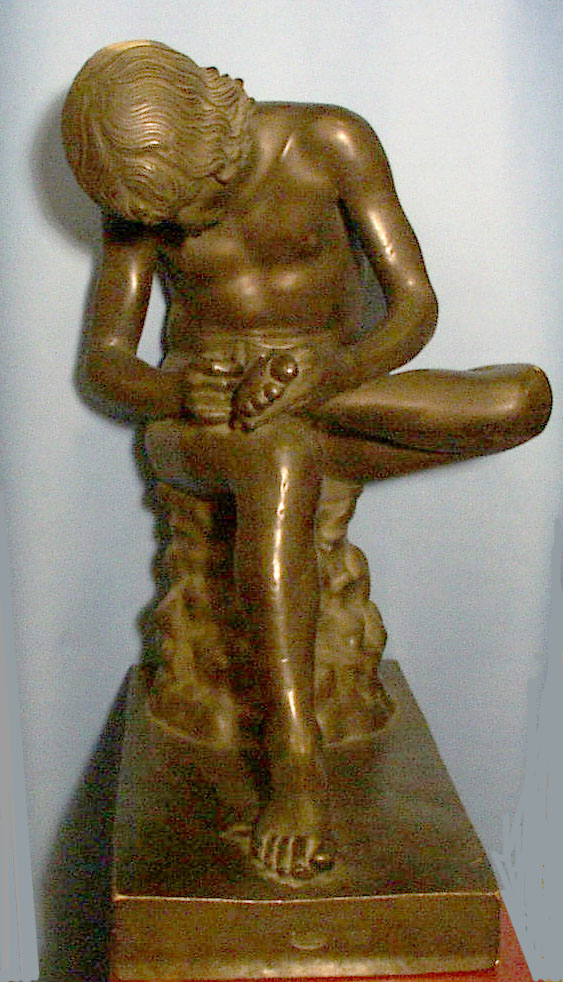
Boy drawing a thorn from his foot.
Commentary Prepared by Dr. Julia Lenaghan, Ashmolean Museum
B 190
Spinario. Rome, Conservatori
Bronze
Statue
73 cm
The statue, certainly from Italy and probably from Rome, is first mentioned by a 12th c. author (Magister Gregorius in De mirabilibus urbis Romae) and has apparently never under the earth.
Italy, Rome, Palazzo Conservatori, , Sala dei Trionfi inv. 1186
Late first century copy of a slightly earlier eclectic Hellenistic statue
Preservation:The statue was cast in four different pieces: The head, the legs, the right arm, and the torso of the body with its rocky seat. The four sections were integrated using “tongue and groove” seams. The eyes, now missing, were inserted from the inside and the lips have recessed surface for a thin covering in another material. There is ancient repair or simply structural strip at the back of the neck and a modern repair on the upper portion of the chest. Some scattered small areas on the body have been patched.
Description:The statue depicts a naked boy seated on a natural stool and pulling a thorn from his foot. The stool is wider at its than near the top and its surface is full of protrusions and crevices. The boy’s right leg, coming off the stool, rests at a 90 degree angle; that is, the upper leg projects forward from the stool horizontal to the ground and at the knee the lower leg drops vertically downwards. The foot rests fully on the ground. The left leg, bent at a 45 degree angle, rests on the right leg. The upper portion of the left leg moves forward from the body and the stool and to the left. The lower leg, beginning from the knee to the left and in front of the body, moves back to the right and remains parallel to the ground. The left foot with its bottom facing to the figure’s right rests on the right knee.
The upper body of the boy leans forward over the legs and twists to its right. The right arm is lowered and remains by the side. The upper arm drops vertically downwards and the forearm comes forward. The hand hovers near the sole of the foot and the index finger and the thumb come together as if they are holding a small object between them. The left shoulder appears raised and forward on account of the body’s lean and twist to the right. The upper arm is lowered and rests near the side of the body. The forearm, however, turns inwards towards the right and forms an approximately 90 degree angle with the upper arm. The left hand holds the foot between the thumb and the fingers.
The body is slender and without taut musculature. Engraved lines across the stomach where the torso folds over itself show a soft abdomen and the breasts hang loosely.
The head leans forward and looks downward toward the left foot that rests on the right knee. When the statue is viewed frontally from the same level, the face cannot be seen. The viewer instead sees the top of the head and the hair. The hair, which defies gravity, originates at crown in a whirl. It falls from the crown in thick wavy locks that end in corkscrew curls which move slightly away from the head. The locks, which cover the ears, get gradually longer towards the back of the head where they reach the nape. At the front of the head over the brow a section of hair has been separated from the rest of the hair. This section is parted down the center and pulled forward. Over the brow the hair on either side of the part is brought together and knotted. Where the front section separates from the side sections at the temples, there are about three small locks which appear in the parting. Given the forward and downward bend of the head one would expect the hair at least of the sides and back of the head to fall forward. It remarkably does not. In fact the hair at the sides of the head which reaches just below the ears actually moves slightly towards the back of the head.
The face, which is difficult to see, has a long oval shape with full smooth cheeks and a large but not projecting chin. The brow is flat and appears short since it is mainly covered by hair. The eyebrows are projecting strips that have only a slight arch. The upper eyelid also projects and it overlaps the lower lid which melds into the cheek. The nose is straight and from its septum to the center of the lip there is a marked vertical groove. The lips have a raised outline. The upper lip has a central overhang and below the center of the lower lip and above the projection of the chin there is an indentation.
Discussion:The bronze statue in the Conservatori, generally referred to as the “Spinario” or the thorn-puller in Italian, has been known since the twelfth century and has always been greatly admired. Because it is bronze, questions concerning whether it was a Greek original have always presented themselves.
The body type of the statue is known in a total of six good copies (the bronze in question here, the “Castellani” statue in the British Museum, and torso in Cherchel, the Louvre, Berlin, and the Uffizi) and perhaps two fragments in private collections. The head type of the statue is also well known and exists in a total of eleven copies [this, Basel, St.Petersburg, Louvre, Vatican, Capitoline (3 times), Conservatori (marble), Adolphseck, and a herm on the art market]. Two essential observations are now always made about the copies. First, only one of the copies of the body preserves a head. This is the “Castellani” statue, found on the Esquiline Hill in Rome in 1874 and currently in the British Museum. The head of this statue, however, is not the charming ephebic head of the Conservatori “Spinario” but depicts instead a realistic rustic looking lad with a grimace. Second, a marble copy of the Conservatori “Spinario” head type, now in the Capitoline storerooms, appears to have been joined to a statue posed in a completely different manner because the neck muscles are tensed in a completely different way.
The style of the Spinario head type has always seemed to belong to the second quarter of the fifth century BC. Scholars, such as Adolf Furtwängler, in fact, attributed the statue to famous sculptors of the fifth century on the basis of the head. Yet, the style of the body and its subject are distinctly Hellenistic. Moreover, it has been noted that the boy’s hair does not move in correspondence to the position of the head.
All of these observations taken together have led 20th century scholars to conclude that the Castellani statue in the British Museum represents an original work of the early Hellenistic period (third century BC). The Conservatori Spinario, they concluded, was an eclectic work which was designed to improve upon its Hellenistic model by combining the body type with a head type of the early fifth century.
Paul Zanker, who has most recently studied the “Thorn-Puller” type, modifies this conclusion. He notes that the motif of the seated male who pulls a thorn from his foot is common in the Hellenistic period and considers all related datable evidence for the “Thorn-Puller” type (the head of Castellani statue, a relief from Ince Blundell Hall which shows a young satyr pulling a thorn from his foot, and a terracotta from Priene which is a caricature of a country man in the “spinario” pose) to belong to the first century BC. Moreover, similarly structured compositions, for example some of the statues of Niobid group, some of the “Small Gauls”, figures on the “Archelaos” relief, and the seated maiden from the “Invitation to Dance” group, also date to the same period. Finally, he points out that eclectic compositions, such as that of the Conservatori Spinario, come into fashion at the end of the second century BC and continue in the first century BC. He, therefore, concludes that the “Castellani” type and the “Spinario” type derive from two different contemporary originals which used the same body type. He stresses that there is no way for us to know whether the master of original of the “Spinario” type was attempting to improve the appearance of the original of the “Castellani” type (as Ridgway has suggested) or whether the realistic original of the “Castellani” type was correcting the eclectic original of the “Spinario” type.
J. Lenaghan
Bibliography:H. Stuart-Jones,
A Catalogue of Ancient Sculptures Preserved in the Munipical Collections of Rome. The Sculptures of Palazzo dei Conservatori (Oxford 1926) pp.43-47 no.2 pl.60
full catalogue entryR. Carpenter,
"Observations on Familiar Statuary in Rome" (MAAR 18 1941) pp.31-45
points out that another marble head of the Spinario type was clearly joined to another statue type, thus the Spinario is an eclectic pasticheW. Helbig (W. Fuchs),
Führer durch die öffentlichen Sammlungen klassischer Altertumer in Rom II (4th edition) (Tübingen 1966) pp.266-268 no.1448
catalogue entry, concludes that the Spinario is an eclectic classicizing workB. S. Ridgway,
The Severe Style in Greek Sculpture (Princeton 1970) pp.132-133 fig.164
considers the Castellani statue to represent the original Spinario tradition which was revamped in the first century BCP. Zanker,
Klassizistische Statuen (Mainz 1974) pp.71-75, 81-83 pls.57.1, 57.3, 58.1, 60.3, 62.1, 63.2, 63.7
believes that there were two basically contemporary Spinario models and that it is impossible for us to judge which came firstB. S. Ridgway,
Hellenistic Sculpture I: The Styles of ca. 331-200 BC (Bristol 1990) pp.136-137
summary statement that motif is a Hellenistic genre motif which may have had more than one prototype