Commentary Prepared by Dr. Julia Lenaghan, Ashmolean Museum
B 185
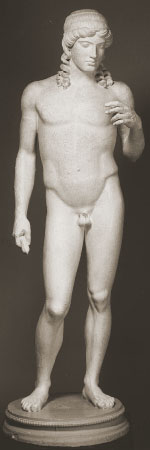
Citharist Apollo. Naples
Bronze statue, probably of the late first century BC, depicting a nude Apollo with plectron in his right hand and a now missing cithara in his left hand. Follows a well-known type, the "Citharist Apollo", which was designed to recall early fifth century BC models. From a private house in Pompeii.
Bronze
Statue
H 1.58 m with plinth, 1.49 without
From Pompeii. Found in 1853 at the House of the Citharist (I.4.25) which belonged to the gens Popidia. Two early Julio-Claudian busts of men (Marcellus type and an older man similar to Agrippa) and bronze busts of a Julio-Claudian couple were found in the same house (respectively Naples 6028, 6025, 4992, and 4990
Italy, Naples, Museo Archeologico Nazionale, 5630
Late Republican-Early Imperial copy of a late Hellenistic original
Preservation:The element held by the right hand is not preserved. In the hand is receiving element with a hole facing downwards into which the item would have been inserted. The eyes are filled with glass paste. The surface is covered with encrustation.
Description:The statue stands on a circular plinth that is decorated with elegant molding. It depicts a nude young man with a clean-shaven countenance and long hair that is mainly rolled under a head band which is circular in cross-section.
The figure stands with its weight on a straight left; the foot of which turns slight outwards. The right leg is bent and the lower leg extends back and to the side of the figure. The foot is flat on the ground with the inside of the foot pressed further into the ground. The left hip, above the weight bearing leg, is higher than the right hip and juts out. The position of the hip causes the linea alba to bend to the left as it rises. The shoulders, unlike the hips, are horizontal to the ground and thrown backward. This creates a pronounced indentation at the small of the back, between the broad pulled-back shoulders and the round bulge of the buttocks. The right arm is lowered but held slightly away from the body. There is plectron in the hand. The left arm is bent at a 45 degree angle; the upper arm falls naturally to the side and the forearm is raised in front of the body. The hand rests in front of the pectoral and holds in its palm an element into which a cithara would have been inserted. The head turns to the left and looks downward focusing on the action of the left hand.
The upper body is broad, stiff, and unusually flat and the legs are slight and lean. The anatomy is outlined and the shapes generally full. Yet the body tone is soft and unmuscular. This is visible both in the stomach area and in the thighs.
The head has long hair. It is brushed forward to all sides from the crown. It passes under a circlet that runs around the head just above the ears. The circlet is visible at the front of the brow and at the back of the head. After passing under the circlet the hair is divided into two sections. A part appears over the center of the brow. The parted hair is then is rolled back over and tucked under the circlet. Directly behind ear, two locks (four total) escape the roll and fall straight downwards. These locks take the form of loose corkscrews and fall forward on each side of the neck. Random wisps of hair lie at the hairline above the nape; these locks were too short to have been looped around the circlet. The main body of hair is rendered by thick engraved lines on a raised surface. The surface features two slight undulations above the circlet.
The face is long and rectangular. The brow is low with horizontal eyebrows that are denoted by a raised surface. The eyes are large and have a heavy upper eyelid. The nose is long and straight. The mouth is full with thick shapely lips. The upper lip has a central dip. The mouth is set well above the chin which is strong, broad, and projecting.
Discussion:The Pompeii statue depicts a nude Apollo who once held a cithara in his left hand. It was found in and probably made for a wealthy private home which destroyed in the eruption of Vesuvius in 79 AD.
The statue follows a type known after this statue as the ‘Citharist Apollo’. From other exemplars of the same type it is clear that the statue held a cithara in its left hand. The ten replicas of the type include 1) the statue in discussion here, 2) a fragmentary statue in Paris, 3) a statue in the Doria-Pamphili collection, 4-5) torsos in the Ny Carlsberg Glyptotek in Cophenhagen, 6) a torso at La Granja, 7) a torso in the Vatican, 8) a torso in the Barracco, 9) a torso in Sabratha, and 10) a head in the Palazzo Barberini. In addition, there are several closely related variants. According to Zanker, these are 1) a statue in Mantua, 2) a statue in the Palazzo Pitti, 3) a statuette in the Fogg collection, 4) a head in the Museo Nazionale Romano, and 5) a head mounted on a seated statue in the Vatican. The variations have caused some scholarly controversy. Simon, for instance, identifies the “Mantua Apollo” as second type, completely separate from the ‘Citharist Apollo’. Both types are very closely related in stance and hairstyle to the ‘Tiber Apollo’ (cat. no. C 20) which in its turn is similar to the ‘Kassel Apollo’ (cat.no. C 16-18). The basic format clearly belonged to ca. 460 BC and already in the fifth century the format had been revised and ‘improved’.
Although once the ‘Citharist’ type was also dated ca. 460 BC, most scholars now accept that it is a classicizing creation of the late Hellenistic period. The stance and body structure are sufficiently close to the ‘Tiber Apollo’ type that in themselves they might date to the early classical period. However, the softness of the flesh and the hairstyle, which does not actually make sense (for example, the appearance of the circlet at the back), are typical of Hellenistic and Roman works. Moreover, in the early classical period scholars do not believe that an Apollo playing the lyre would have been depicted nude; in early classical iconography Apollo Citharoedos wears a long garment.
The Citharist Apollo from Pompeii has been dated to the second half of the first century BC, mainly on the basis of comparisons with material found at the ‘Villa of the Papyri’ at Herculaneum. Zanker, therefore, places the original for the type shortly before the mid first century BC. The date of the Pompeii statue could also be later and one could argue that the type was an Augustan creation. In any case, it is clear that the type draws upon and adapts well-known models of the fifth century BC.
The original context of the Pompeii statue merits mention. It was a private house belonging to an important family. The statue may have been used as a private cult object. Interestingly wall paintings in a small room of the house featured on three walls scenes of and related to Apollo. On the main wall he sat with his cithara and muses and on the two shorter walls a musical contest and a consultation of an oracle were depicted.
J. Lenaghan
Bibliography:C. Saletti,
"L’Apollo citaredo di Pompeii" (Arte Antica e Moderna 1960) 248-262 figs. 71a-c, 72a
careful observations, point of which is to demonstrate the type is a classicizing creationB. S. Ridgway,
The Severe Style in Greek Sculpture (Princeton 1970) 136-138
again discussion of early fifth century or classicizing, focuses on the hairstyleE. Simon,
"Ungedeutete Wandbilder der Casa del Citarista zu Pompei" Melanges Mansel I (Ankara 1974) 31-43, especially 42
discussion of wall painting at the house of the Citharista where the statue was foundP. Zanker,
Klassizistische Statuen (Mainz 1974) 61-64, no. 1, pls. 54.1, 55.1, 56.9
discussion of type, replicas, variants, and reasons to consider original model a late Hellenistic classicizing creation(E. Simon),
"Apollon/Apollo" Lexicon Iconographicum Mythologiae Classicae II (Zurich 1984) 372-373 no.35
catalogue entry that disassociates statue from the Mantua Apollo,
Le Collezioni del Museo Nazionale di Napoli I,2 (Rome 1989) 146-147, no. 258
brief catalogue entry with bibliography and photograph