Commentary Prepared by Dr. Julia Lenaghan, Ashmolean Museum
B 134
Small-scale Alexander-like head. Budapest
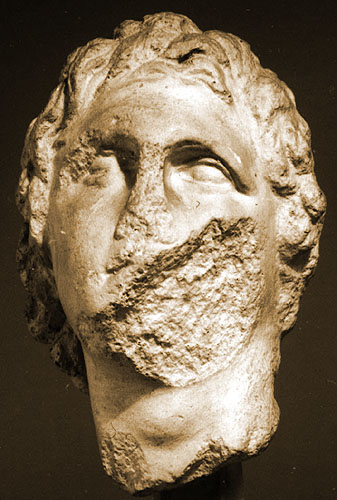
Small-sized head of a glorious hero or god in the style of Alexander the Great. Probably from a relief.
Marble
Head
14 cm
From Athens. Apparently purchased (or even found) with a virtually identical head (Budapest Museum no. 55).
Hungary, Budapest, Szepmuveszeti Muzeum, 56
Hellenistic or Roman in a Hellenistic style
Preservation:The head has broken from its body at the base of the neck. The break runs diagonally upwards from front to back. The back left side of the head has a regular, flat, vertical break. A significant portion of the face has broken off; this includes the left cheek, the chin, and half of the mouth. The nose has also broken off. The right eyebrow and the extant part of the mouth are badly chipped.
Description:The small-scale head, which turns to its left, depicts a young male with long hair and a fillet or wreath with a central metal decoration. The head was intended to be seen in three-quarter view from the right and may have come from a relief since the back left side of the head is a flat broken surface.
The hair of the head is long and wavy. The hair at the back and top of the head follows the shape of the skull and is loosely rendered in thick lumpy locks. A flattened band, especially visible over the right ear and temple as well as at the back of the right side of the head, runs around the head. At its central point there is a hole for the insertion of a metal decoration. The band separates the back and top portion of the hair from the locks around the face and on the right side of the neck. The locks around the face are long and completely conceal the ears. The locks, around the right side of the face until the center of the brow are the most carefully rendered of the entire head. There the individual locks are clearly separate and strands within the locks are delineated. Over the inner corner of the right eye, the locks seem to rise and then part.
The face has a long oval shape. The brow is tall, distinctly convex, and has a clear horizontal crease that divides its upper portion from a bulging lower section. The eyebrows droop and the orbitals (space between the eyebrow and upper lid) are heavy. The eyes are deep-set, long, and narrow. The bulge of the eye continues below the lower lid. The bridge of the nose continues the bulge of the lower brow without any indentation, thus making the eyes seem yet more deep-set. On the left side, the deep hollow of the eye socket is rendered. The cheeks are full. On the turned neck there is a horizontal fold line that runs below the bulging Adam’s apple.
Discussion:The Budapest head shows a young male with long hair, a fillet, and an attribute that was attached in metal above the center of the brow. It is one of two similarly styled, turned, and sized heads in Budapest that apparently come from Athens.
This head was intended to be seen in three-quarter view from the right side. The right side from the center of the back to almost the center of the face is far more carefully worked than the left side. This is especially true of the hair and fillet. Moreover, the face is slightly asymmetrical and the left eye is more deeply set. The vertical break or slice at the back of the left side seems to indicate that the head was placed against a vertical surface, probably the background of a relief. This would be appropriate given the size of the head. The other head in Budapest might then come from a different scene in the narrative of the same relief.
The general appearance of this Budapest head--long hair, clean-shaven, full oval facial structure, hooded eyes, bulging brow, and the cowlick over the brow--is characteristic of the portrait images of Alexander the Great. In fact, Richter identifies the other head in Budapest as Alexander. Yet, none of the images of Alexander made during his life-time show either a fillet or a decorative crowning element. Moreover, his image had an enormous influence on the visual construct of heroes and gods in the ensuing period. For instance, a frequently discussed painted tondo of two brothers from Antinopolis and now in Cairo shows a similar long-haired, clean-shaven, young male figure wearing the hmhm crown of Osiris and Horus. Bronze statuettes employing the same construct also often feature holes in the crown for the attachment of a divine attribute. It is thus impossible to determine whether the head represents a posthumous and divinized Alexander, another male hero, or a junior divinity. It is equally difficult to determine whether the head was made in the Hellenistic period itself or was a later Roman work in the same vein.
J. Lenaghan
Bibliography:A. Hekler,
Museum der bildenden Künste in Budapest. Die Sammlung antiker Skulpturen (Budapest 1929) 68-69, no. 56
catalogue entry on both this head and another virtually identical one, poor photograph and uninformative discussionG.M.A. Richter,
Portraits of the Greeks III (London 1965) 255, no. 5g, fig. 1736
brief entry on a virtually identical head also from Budapest--not this head!R. R. R. Smith,
Hellenistic Sculpture. A Handbook (London 1991) 22
brief comment on posthumous portraits of Alexander and their influence