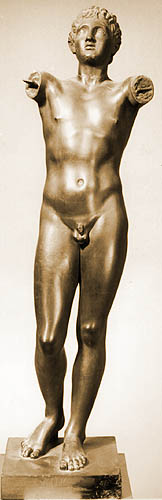
Boy.
Commentary Prepared by Dr. Julia Lenaghan, Ashmolean Museum
B 105
Praying Boy. Berlin
Late fourth century statue or Roman classicizing statue of an under life-size boy with arms outstretched as if in prayer. From Rhodes and generally ascribed to the school of Lysippus, sometimes associated with a statue made by Boedas.
Bronze
Statue
1.28 cm
From Rhodes. In 1501 brought from Rhodes to Venice by Cavaliere Andrea di Martini of the Order of St. John of Jerusalem (Knights of Malta). A letter of Lorenzo Pavia to Isabella D’Este in 1503 attests to this. Enea Vico (1558) claims that it was found near the medieval walls around the port at Rhodes. In 1576 sold to the Bevilacqua family in Verona, then inherited by special wish of Mario Bevilacqua by the Canossa family who sold it in 1604 to the Gonzaga of Mantua. The Gonzaga sold it in 1631 to Charles I of England who displayed it in Whitehall Palace in London. At Charles’ death under Cromwell the statue was sold to a Ralph Grinder who sold it to Foucquet (Finance minister of Louis XIV). He set it up at Vaux-le-Viconte. In 1717 Foucquet’s son sold it to Prince Eugene of Savoy in Vienna where it was set up at the Belvedere. Prince Wenzel of Liechtenstein inherited the statue and sold it to Frederick II in 1747 for Sanssouci at Potsdam. It was subsequently moved to Berlin. Napoleon’s forces took it to Paris. It stayed in the Louvre from 1806 to 1812 when it was returned to Berlin. In 1938 it was packed and taken to St. Petersburg for protection where it remained until its return in 1958.
Germany, Berlin, Staatliche Museen, Antikesammlung, Sk 2
ca. 300 BC or Roman statue
Preservation:The arms, the plinth, and part of the left foot are restorations. The left foot was restored in Padua. It may be ancient; renaissance sources say that Cardinal Bembo took it from his private collection and gave it to Andrea di Martini.
Description:The under life-size bronze stance depicts a nude boy with upturned head and outstretched arms. The body is soft and childish and the head proportionately too small.
The body weight rests on the straight left leg. The right leg is drawn back and bent. The right foot turns slightly outward; the heel is raised and the toes and ball of the foot touch the ground. The torso tilts almost imperceptibly backwards and both arms were raised to just above shoulder height and would have extended slightly outwards and upwards.
The body is rendered as flowing elastic forms without developed musculature. Most notably there is no muscle definition in the legs. The lower abdomen bulges gently outwards and the nipples appear to sag slightly. The full buttocks inexplicably do not sag.
The small head features medium length hair. The locks are tousled and pushed forward at the back and top of the head. The hair does not cover the ears; there is a short sideburn in front of the left ear but not in front of the right ear. The hair falls on the brow in various directions but the ends remain in a generally horizontal line. The brow hair has two distinctive motifs. Over the center of the brow is a clear parting of locks. And above the right eye is a pincer (or bracket) motif. It varies from standard pincer motifs in that the final spit of the lock of the left side of the pincer-bracket turns slightly back to the left.
The face is triangular in shape. The brow is horizontal and flat, and the eyebrows are horizontal and low. The eyes are large and open. The nose is straight. The small mouth has down-turned corners, and the upper lip has a central dip and the lower lip is pouting. The chin, far narrower than the upper portion of the face, juts forward.
Discussion:The just under life-size bronze statue of a boy is one of the rare surviving examples of an ancient bronze. Since its arrival in Venice from Rhodes in 1501, the statue has been received with great fanfare and has been owned and prominently displayed by numerous great men of European history in various famous aristocratic architectural settings. The original date, context, and meaning of the statue, however, are difficult to ascertain.
The statue, found on Rhodes, was brought to Renaissance Venice where its virtually complete state of preservation and that fact that it was a Greek statue authentically from the East rather than a Roman statue brought it enormous fame. Its original owner was much admired for his refusal to part with this singular object in the face of inordinately large sums of money offered by the Cardinal of Vicenza. Two further anecdotes about its first years in Venice merit mention. First, the statue was described in 1503 by Lorenzo Pavia in a letter to Isabella D’Este as missing its arms, left foot, and with hair that could have been nicer. The Renaissance sources claim that Cardinal Bembo of Padua noticed the lack of left foot and had in his collection an ancient bronze left foot which he gave to the statue since it fit perfectly. In fact the similarity of the feet has been more than once commented upon. According to Kabus-Preisshofen, it is possible that Bembo, who also served in Rhodes in the same order of knights, may have actually possessed the original left foot of the statue. According to Franzoni, the Renaissance sources veil or confuse the fact that statue was sent to Padua for full restoration. Second, when an heir of the original owner finally sold the statue to the Bevilacqua family in Verona (the source much of the Munich Glyptothek’s collection), a copy in bronze was made for the city of Venice in 1576. This is not to be confused with an ancient copy of the statue; there are no known ancient copies of the statue.
The subject and date of the statue have caused some controversy among scholars. The statue has been known as Ganymede, Antinoos, and even Apollo. When the piece was in Paris, Visconti labeled it the ‘praying’ boy and associated it with a passage in Pliny the Elder (NH 34.73) which describes a statue of an adorante made by Boedas, a follower of Lysippos. Its small size and the fact that there are no extant ancient copies of it, however, make it most unlikely that it was in any way famous in antiquity.
Stylistically the statue does demonstrate forms traditionally associated with Lysippos and his followers. The proportions are long and lean and the head small. The arms extend outward from the body not unlike the arms of the Apoxyomenos (cat. no. C 133). The tousled locks of medium length hair that sit atop one another and build in volume in places as well as the short triangular face are also similar to those of ‘Lysippan’ works. Yet it may be equally possibly that the statue was created long after the end of the fourth century BC in a style that copied that of the late fourth century BC. Zanker, for instance, calls the statue a classicizing work of the first century BC. The statue might even be Roman in date.
In regard to the original context and subject, Kabus-Preisshofen has recently suggested that the statue was a votive, representing a young athlete in a moment of adoration, made to Helios whose colossal statue on the island of Rhodes was one of the seven wonders of the world. Since both arms were raised at slightly different heights (the level of the shoulders varies), the statue’s gesture does seem to correspond to that of a worshipper. However, on the extant evidence-- found probably near a medieval wall and without attributes-- there is no way to determine securely either the function or meaning of the statue.
J. Lenaghan
Bibliography:L. Franzoni,
Per una storia del collezionismo. La Galleria Bevilacqua (Milan 1970) 111 ff
P. Zanker,
Klassizistische Statuen (Mainz 1974) 67
in text on statue in Vienna, delivers one line in which he notes that he believes the statue is a creation of the first century BCM. Perry,
"A Greek Bronze in Renaissance Venice" (BurlMag (117) 1975) 204-211
discussion of the statue’s reception in Renaissance Venice, influential in other scholars accountsR. Kabus-Preisshofen,
"Der ‘Betende Knabe’ in Berlin. Schicksal einer antiken Grossbronze und das Problem Ihrer Deutung" (AA 1988) 679-699, figs. 1-16
account of history of piece and interpretation—late fourth century BC votive to Helios on RhodesM. Zorzi,
Collezioni di Antichità a Venezia nei secoli della republica (Rome 1988) 45-46
information on first owner with some information not included in PerryStaatliche Museen zu Berlin,
Die Antikensammlung im Pergamonmuseum und in Charlotteburg (Berlin 1992) 162-164 no.66
latest museum catalogue entry with bibliography and colour photographN. Hackländer,
"L’Adorante da Rodi, odissea di un grande bronzo antico" I grandi bronzi antichi. Le fonderie e le tecniche di lavorazione dall’età arcaica al Rinascimento (Siena 1999) 365-384, figs. 1-19
fascinating fully documented story of scultpure’s history, recapitulating both Perry and Kabus-Preisshofen