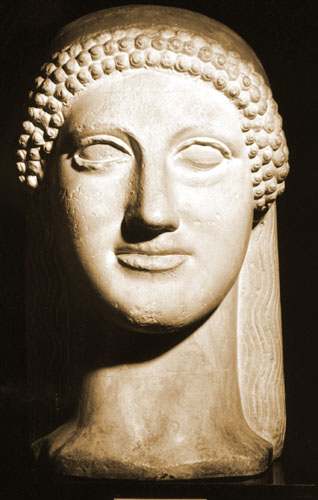
Head of a goddess made for insertion into a statue, perhaps the cult-statue of a Greek shrine in Sicily or south Italy.
Commentary Prepared by Dr. Julia Lenaghan, Ashmolean Museum
B 082
Ludovisi Acrolith. Rome
Colossal marble head of a goddess, perhaps Aphrodite, dated to the early fifth century BC. From an acrolithic cult statue.
Marble (probably Parian)
Head
83 cm
Found in Rome. First appearance in an inventory list is in 1733. Probably from the Horti Sallustiani and possibly originally from Magna Graecia
Italy, Rome, Museo Nazionale Romano, 8598
Preservation:The head, worked as a single unit, is completely preserved from the bottom of the neck to the top of the head. Most of the nose and the left lower eyelid (removed in the cast) have been restored. The lower portion of the face has been cleansed and smoothed so that no original surface remains there. The smooth white cheeks contrast blatantly with the corroded surface of the brow and the patinated surface of the neck. All the attachments are missing. Only the holes for these attachments remain. Their location is described below.
Description:The large head, which once featured numerous separately attached pieces, depicts a female with a short tightly curled fringe and long straight hair behind the ears. The hair at the top of the cranium, rendered in closely spaced engraved lines, is straight and held tightly in place by a broad flat band that is knotted at the back. Below this fillet behind the ears the hair falls down neck. These locks are rendered by engraved lines which are more widely spaced and wavier than the lines of the hair near the crown. Below the fillet and in front of the ears the hair is curled in four rows of snail curls.
Around the front of the broad fillet are small holes for the insertion of some object, perhaps a crown or stephane. Along the outer side (that is, toward the face) of the lock that falls directly behind the ear there are also drill holes. On the brow under the lowest row of snail curls, running from about the eye outer corner of one eye to the outer corner of the other, are another series of small holes. Both the holes behind the ear and across the brow would seem to have been for additional locks of hair. The earlobes and the neck, near the bottom, also have holes, presumably for the attachment of separately worked jewelry. There are also holes inside the ear itself that seem to be for the attachment of additional ear decoration.
The face has an even oval shape which is the result of the full cheeks and the uninterrupted curve of the snail curls on the brow. The eyebrows form high symmetrical arches and the eyes are long and almond shaped with thick projecting lids. The upper lid follows the regular path of an arc that is less than semi-circular. The lower lid rises from its inner corner- this forms the tearduct- and then begins a very slight downward arch. The nose is short and at the corners of the nostrils the skin is indented. This indentation, which continues toward the corner of the mouth, marks the bottom of the cheek. The groove dividing the lips dips at the corners and at the center. This makes the mouth slightly down-turned and gives the upper lip a central overhang. The lower lip is full and its outer edge has a smooth downward arch. Below the mouth the chin is long but not projecting. It is rounded and forms a harmonious U-shaped connection with the cheeks.
The neck is unusually long and flares out at the bottom. It was undoubtedly to have been inserted into a body.
Discussion:The head appears to have belonged to an acrolithic statue. The flared end of the neck was clearly for the insertion of the head into a core. The large scale makes it unlikely that the core would have been made of marble. In addition, the separately added locks of hair, jewelry, and crown, suggest the use of different media, a common characteristic of acrolithic statuary.
Stylistically the head appears to belong in the late Archaic or Early Classical period. The snail curls and the hair without a natural part as well as the roundness of the cheeks and the upturned mouth are all features of the end of the Archaic period. Furthermore, the heavy facial features and the linear hair appear to be typical of works from Magna Graecia during this period, for example the Agrigento Ephebe. The head is usually compared to the marble sculpture from Selinus and the choroplastic statuary from Locri and Medma. Most scholars generally accept that the head is related to the art of Magna Graecia and that it probably came from Magna Graecia, notwithstanding its findspot in the Horti Sallustiani. It is usually dated between 490 and 470 BC.
Ridgway, however, argues that the work belongs to a later period, perhaps the first century BC. Her argument hinges on the similarity of the head to the central figure of the “Charites” relief and her belief that the “Charites” relief does not derive from an original work of the early fifth century. Thus, any object, which resembles it, also must not date to the early fifth century. She believes that the Ludovisi head is conceptually different from true fifth century acroliths and to illustrate her point she compares it to the Apollo of Ciro, a head of disputed date.
The proposed identifications of the subject of the Ludovisi Acrolith are conditioned by both its alleged origin and its alleged findspot. Fuchs argues, for instance, that it represented Persephone because images of Persephone existed in every Sicilian precinct and that face is not appropriate for Aphrodite. The latest Museo Nazionale catalogue suggests Aphrodite as the more compelling identification because in Horti Sallustiani was a Temple of Venus Ericina. Thus it is possible that the cult statue of Venus was carried off by the Romans from Erice in Sicily. The most recent scholarship on the Horti Sallustiani inclines towards this suggestion.
E. Harrison supports the Aphrodite identification because of the head’s smile and M. Guarducci also considers it to be a cult statue of Venus. Yet Guarducci believes that it came from Locri and was a seated statue in the Temple of Marasà. She believes this because of the similarity of the Ludovisi acrolith to images that appear on terracotta pinakes from Locri. Both the pinakes and the Ludovisi acrolith feature unusual earrings.
Two details concerning the research of the statue should be mentioned briefly. Paribeni thinks that the bottom of the head, that is the neck, has been cut in the modern era. Other scholars appear to believe that this was the finished bottom end in antiquity; they, thus, assume that Paribeni is incorrect which he might well be. Yet one does wonder how the hair at the back of the head was originally finished since the break runs through it; although the head was of marble, the adjoining body was not. Also to be noted, the Museo Nazionale I,5 entry incorrectly states that W-H. Schuchhardt in an article on the acrolithic Ciro Apollo (AJA 66 1962 p.317) considers the Ludovisi Acrolith to be a Hadrianic creation. He simply does not say this.
Julia Lenaghan
Bibliography:E. Paribeni,
Sculture greche del V secolo (Rome 1953) p.11 no.1
compares it to the figures of Temple F in Selinus and the terracottas of Medma, dates it ca.490-480 BCW. Helbig (W. Fuchs),
Führer durch die öffentlichen Sammlungen klassicher Altertumer in Rom I(4th ed) (Tübingen 1963) pp.265-266 no.2342
considers it likely to be Persephone from a seated acrolith and to date to 480-470 BCB. S. Ridgway,
The Severe Style in Greek Sculpture (Princeton 1970) pp.121-122
considers the head to be later than the 480 BC date, possibly first century BCR. Holloway,
Influences and Styles in the Late Archaic and Early Classical Greek Sculpture of Sicily and Magna Grecia (Louvain 1975) pp.29-30
believes the head to be made in workshop of Agrigento,
Museo Nazionale Romano: Le sculture I, 5 (Rome 1983) pp.130-133 no.57
summarizes previous researchM. Guarducci,
"Due pezzi insigni del Museo Nazionale Romano: il trono Ludovisi e l'acrolito Ludovisi" (BdA 33-34 1985) 14-18 figs.15-16 pl.1
believes the statue to come from Locri on the basis of its similarity to images depicted on pinakes from there, considers it to be a seated Aphrodite, ca.490-480 BC, excellent color plateC. Marconi,
Selinunte: Le metope dell' Heraion (Modena 1994) p.219 fig.104
loosely related to the sculpture from SelinunteE. Häger-Weigel,
Griechische Akrolith-Statuen des 5. und 4. Jhs. v. Chr (Berlin 1997) 260-262 no.2 pls.32.1-34.2
E. Talamo,
"Gli Horti di Sallustio a Porta Collina" Horti Romani (Rome 1998) 138-139
puts the piece in the context