Commentary Prepared by Dr. Julia Lenaghan, Ashmolean Museum
B 070
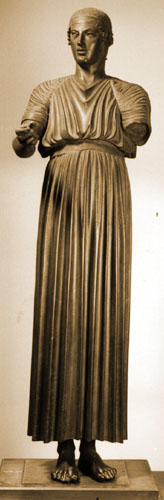
Delphi Charioteer. Delphi
Bronze
Statue
1.80 m
From Delphi. Found in the northwest area of the sanctuary of Apollo. It was excavated between 28 April and 9 May 1896 under a modern house built over an ancient terrace wall that was erected in the second half of the fourth century BC after an earthquake in 373 BC.
Greece, Delphi, Museum, inv. 3484 , 3520, and 3540
ca. 480-470 BC
Preservation:The statue was cast in seven major pieces and several smaller ones; these range from the skirt of the lower body to the small locks of hair near the ear. It was found, however, in three large segments; the lower body with the feet attached (inv.3484), the upper body and the head (inv.3520), and the right arm and hand with three reins still in place (inv.3540) (the reins are not included in the cast). Also preserved were fragments from the chariot, the horses, an arm of a stable boy, and an inscribed block of the base. Only the left forearm and hand are missing.
Polychromatic details of the facial features and hair band are still preserved. The eyeballs were made of a glass paste with pupils of a black stone and irises of brown onyx. The eyelashes were fringed with copper. Traces of lead solder in the mouth show that teeth of marble or silver were once separately attached and are now missing. The lips were inlaid with copper. The hair band was also decorated with inlaid copper and silver, only traces of which are preserved.
Description:The statue depicts a short-haired young male dressed in a long garment. The garment, seemingly of one piece of material, is sewn together along its upper border which runs from the length of the sleeves, that is, from the neck down to the elbow. To prevent the wide stretch of material from billowing about the arms and chest a cord is worn around the upper body. The cord basically follows the pattern of a horizontal figure 8 with the arms pulled through the two loops. Thus, at the front of the body only the cords running from the armpits to the side of the neck are visible. At the back of the body the cord crosses over itself in an X-like pattern. The band itself, not just the indentation of where it once was, is preserved only under the left armpit.
In addition, the garment is belted at the waist and some of the material of the chiton blouses over the broad belt. Below the broad belt the material of the chiton hangs as if it were a skirt with a bunched waist band. The material falls in vertical folds, no two of which, however, are alike. The material, maintaining its cylindrical section, hangs down until just above the ankles. This skirt has often been likened to a fluted ionic column. Yet, it should be stressed that the folds and the hollows between them are not regularly spaced.
Both feet remain flat on the ground and are closely spaced. The left foot turns slightly outwards The lower body rises in line with these feet. The upper body, that above the belt, turns almost imperceptibly to the left. Both arms stay close to the side of the body and, bent, form an angle just greater than 90 degree angles. The upper arms are lowered and come slightly forward. The forearms project directly forward and are parallel to the ground. In the right hand between the thumb and the index finger a band of three flat straps (reins) are held.
The head turns about 30 degrees from the central point of the body to the right. The head itself is an elongated oval. The upper portion of the head is covered by short locks with finely defined individual strands of hair. The locks are without volume and cling tightly to the head. Above the ears and crossing the top of the brow is a flat fillet which is looped around itself at the back of the head. The front of the fillet is decorated with a simple meander pattern which features small crosses in the areas above and below the horizontal sections of the meander. In addition, a horizontal lines frame the meander above and below. The meander, crosses, and horizontal bands were once inlaid with silver and bronze.
Below this fillet the hair contines between the temples and the ears, forming a roughly triangular area of hair on each side of the head in front of the ear. The ends of the flatly rendered hair in this triangular are, however, curl up and away from the face with springy volume. These curls border the entire triangular area. Below this area, extending down on the lower cheek are engraved curls of the yet flatter whiskers.
The face is long and has a horizontal brow which is mainly the result of the frame provided by the fillet. The lateral planes of the face intersect with the frontal plane at a line that drops down from the cheek bones. The features of the face are slightly asymmetrical. The right eyebrow and eye are higher and the right cheek is slimmer. The eyebrows are arched and the eyes are oval with a projecting upper lid. The upper lid does not overlap the lower lid. The nose is straight, has a broad ridge, and dips at the bridge. The mouth is slightly open and the lips are full. The outer line of the upper dips under the nose and the outer line of the lower lip is almost semi-circular. The chin is long and evenly rounded but recedes.
Discussion:The Delphi Charioteer is a truly significant monument. It is the only extant fifth century bronze for which we have full contextual information. We know whom the monument honored, when it was set up, and probably when it was destroyed.
The fragmentary inscription on the preserved block of the base gives two lines of hexameter. The original first line was erased and then rewritten. These lines are generally restored as follows:
Line 1) erased: ???????????????s?????????s ????????????????????????
Line ???rewritten: ???????s ?????????????????s ?’??????????
Line 2): [???s ??????????s ???????????????’?????????
Line 1) erased: Polyzalos, lord of Gela, set me up as a momento
Line 1) rewritten: Having been victorious with his horses, Polyzalos set me up
Line 2) Polyzalos was the son of Deinomenes, prosper him glorious
Apollo
The restoration of the inscription may not be perfect. The use of mnema in the first line has been criticized. Although the name Polyzalos has been completely restored in the first line of the original inscription, here is no reason to suppose that Polyzalos would have usurped the monument from either of his elder brothers. Thus, Rolley’s suggestion that the name Polyzalos should be subsituted with ??????????? (fraternal) does not necessarily make sense; why would Polyzalos claim credit for a monument that his brother erected for him?
Thus, it is better to consider the generally accepted restoration of the inscription. The Polyzalos of the rewritten inscription is a known historical figure. When his elder brother Gelon, the tyrant of Syracuse, died in 478 BC, Polyzalos was put in charge of his army and married to his widow. This created trouble with another older brother, Hieron, the new tyrant of Syracuse. The familial friction was, however, resolved by the new father-in-law in 476/475 BC. In 466 BC Hieron died and Gela was handed over to the youngest brother. This has been interpreted to mean that Polyzalos was already dead by 466 BC. In any case, the tyranny was overthrown in Gela in the same year. Thus, the charioteer monument must date between 478, when Gelon died, and 466 BC, when the youngest brother inherited rule of Gela.
Moreover, the lists of Pythian victors are preserved for all the games within that time frame except for those of 478 and 474 BC. Since Polyzalos’ name does not appear in any extant list, he, therefore, must have won in either 478 or 474 BC.
The first line of the inscription has been emended seemingly from “Polyzalos, lord of Gela” to simply “Polyzalos”. Thus, no grave dishonor befell man himself, only a loss of title. This emendation could have occurred after 466 BC when the tyranny was overthrown. It might also have occurred, as Stucchi has suggested, around 476 BC when Polyzalos and Hieron resolved their familial dispute and Polyzalos perhaps relinquished claims to an official title. This interpretation would mean that the Polyzalos original victory was in 478 BC. Polyzalos’ title of Gela might also be interpreted as only possible after his reconciliation with Hieron, in which case the original victory would have been 474 BC. Stylistically the Charioteer has a facial structure and features that are similar to those of the Tyrannicide Harmodios (ca.479 BC) and the Kritios and Blonde Boys (ca.480-470 BC). Either date is, therefore, plausible.
The monument was found in the fill layers of a terrace wall which was made to buttress the sanctuary of Apollo after a destructive earthquake in 373 BC. It is usually assumed that Polyzalos’ monument had been in the northwest area of the sanctuary and was irreparably destroyed in the earthquake. It has been pointed out, however, that it is odd that whereas the figure of the Charioteer is perfectly preserved, only fragments and hooves remain of the chariot and horses. Also there appear to be extra clamp holes on the one extant base block which suggest a repair. Stucchi, however, has pointed out that these clamps must date before the earthquake since it would be odd that the base would have been destroyed by the earthquake but not the statue. This is not a terribly convincing argument in itself since the statue is in a fine state of preservation but the chariot and horses are demolished. It does, however, seem unlikely that a large bronze with valuable metal inlays would have been deliberately dumped rather than reused. Thus, although precise moment in which the statue was dumped cannot be ascertained, it is most logical to assume that the statue was erected in the sanctuary of the Apollo and destroyed by the earthquake.
The reconstruction of the monument and the identity of the charioteer are also not entirely certain. The upper surface of the extant base block has been much destroyed by its modern use as a base for the statue of the charioteer. Nonetheless it clearly preserves three hoof prints. They appear in a vaguely diagonal line that runs from the right front corner to the back left corner; one is in the front right corner itself and the other two, more closely spaced, lie one to the right and in front of the other near the back left corner. Most scholars have interpreted these prints as the front hooves of a pair of horses that face front; one of the hooves found is even said to fit frontal into one of the cuttings. The hooves of the horse on the right side are ahead of the hooves on the left side. Therefore, the outer horse would be a pace ahead of the horse on the inside. The motif of two horses that are not in line with each other and with the outer horse a pace a head is commonly used in representations of quadrigae (a four horse chariot). Therefore, scholars have generally thought that monument must have had four horses.
Not all scholars (Hampe and Stucchi) are happy with this solution. Stucchi, for instance, believes that the block does not show the front hooves of two horses facing front but rather the hooves of horses in profile. He would interpret the hoof on the front right corner as the front outer hoof of the outer horse and one of the hooves in the back left corner as the back inner hoof of the same horse. This solution, however, has the serious flaw that the back outer hoof of this imagined outer horse is nowhere to be found. Stucchi’s conviction stems mainly from his belief that the turn of the charioteer means that he was not intended to be viewed frontally. As premise this is weak since such a large monument would be viewed from all angles.
Another problematic issue concerns the number of horses and stable boys or assistants. Of the horses only two legs with hooves, a tail, and one hoof, often said not to belong to the group but recently reinstated by Rolley, have been found. The two legs, which belong to different horses, and the base assure us that the monument featured at least two horses. The placement of the two adjacent horses, one in front of the other, suggests that there was a team of four; yet, this cannot be proven.
In addition, a bare bent left arm and hand holding a flat strap was found. This would appear to belong to a stable boy or groom who would have calmed the horses. Rolley notes that a team four horses would not simply have been led by a boy holding their bridles in his left hand. Moreover, a passage in Pausanias (6.12.1) describes a chariot monument set up Polyzalos’ brother, Hieron, to celebrate a chariot victory at Olympia. It reads, “Near by there is a bronze chariot with a man mounted in it, with race-horses standing beside the chariot one on either side, and boys, sitting on the horses. These are the memorials of the Olympic victories of Hieron son of Deinomenes, the dictator of Syracuse after his brother Gelon.” Rolley would, therefore, prefer to see either two stable boys flanking the chariot and leading additional horses or to see two stable boys/ jockeys riding next to the chariot group. Compositionally it is difficult to imagine only one who leads the team with a left arm. Yet there is no evidence that the monument should copy the Olympian monument of Hieron exactly and the invention of another two horses seems entirely unfounded.
A final point of interest is the identity of the charioteer and the moment depicted. It has been suggested that the charioteer is already victorious, the groom is calming the excited horses, and that the fillet worn by the charioteer commemorates the victory. Stucchi, who interprets the moment as pre-race, argues that the fillet is not that of the victor but rather an indicator of the rank of the man driving the chariot. He notes that it is a metal band applied only to the front of the fillet. He also argues that the charioteer has a groove or depression near the cord on the back of the shoulder in which the whip might have fit; thus, that the whip has not been used yet. Part of the argument is irrelevant since fundamentally a whip not in use and excited horses might occur both before and after the race. Of greater interest is the identity of the charioteer. If the fillet does express rank, are we then to interpret the driver as Polyzalos himself? If the fillet the commemorates the victory, then it is even more likely that the man in the chariot is to be understood as Polyzalos since the winner’s fillet went for certain to the owner. Pausanias (6.9.5) in his description of another charioteer group associates the man in the chariot with the dedicator. Yet the garment of the Delphi figure, tied back by the figure 8 cord to allow for motion, suggests that is the actual driver of the team. Moreover, a winner’s wreath was usually laurel. The identity of the driver, therefore, must remain a question.
Bibliography:F. Chamoux,
Fouilles de Delphes IV.5: L'Aurige de Delphes (Paris 1955)
volume dedicated to the charioteer monumentR. Hampe,
"Fouilles de Delphes IV.5: L'Aurige de Delphes (Paris 1955)" (Gnomon 32 1960) pp.60-73
critique of ChamouxB. S. Ridgway,
The Severe Style in Greek Sculpture (Princeton 1970) p.34
discusses as example of sculpture that pre-dates 470 BCM. Robertson,
A History of Greek Art (Cambridge 1975) pp.188-190
discusses the statue as example of early Classical statuary, compares it to the Kore of Euthydikos and the Kritios BoyC. Houser,
Greek Monumental Bronze Sculpture (New York 1983) pp.21-29
summary description with color photographsC. Houser,
Greek Monumental Bronze Sculpture of the Fifth and Fourth C. BC (New York 1987) pp.85-101
thorough discussion with summary of the argumentsS. Stucchi,
"Il monumento per la vittoria pitica del Gelas anasson Polizalo" (ArchClass 42 1990) pp.55-86
thoughts regarding destruction (373 BC), rewriting (between 478 and 476 BC), whip and fillet (moment before the race), and viewing angle (profile)C. Rolley,
"En regardant l'Aurige" (BCH 114 1990) pp.285-297
uses Pausanias' description of Hieron's dedication at Olympia to reconstruct group(F. Chamoux),
Guide de Delphes: Le Musee (Paris 1991) pp.180-186
full discussion of the statueW. Fuchs,
Die Skulptur der Griechen (Munich 1993) pp.343-344 no.380
brief mention, repeats known facts