Commentary Prepared by Dr. Julia Lenaghan, Ashmolean Museum
A 159
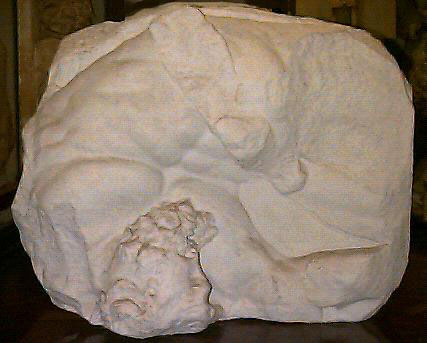
Fallen Giant ("Fawley Court Relief") from the Great Frieze of the Pergamon Altar. Robin Symes, London.
Marble
Frieze
Height: 86 cm; Width 107 cm
Rediscovered in 1967 by D. Haynes at Fawley Court, Hanley-on-Thames, where it had been built into a Gothic 'ruin'. Originally from Pergamon, where it was probably discovered by W. Petty in 1625 and brought to England for his patron, the second earl of Arundel (1585-1646). When the remaining Arundel sculptures were dispersed in 1691, this fragment was used as ornament in a pleasure garden at Lambeth owned by B. Cuper, a former servant of the Arundel family. From there it seems to have been acquired in about 1719 by John Freeman of Fawley Court.
United Kingdom, London, Art Market (Robin Symes)
High Hellenistic, after ca. 180/160
Preservation:The fragment is broken on all sides. The giant's left shoulder and arm, left leg from the hip, top of the head, and most of the right leg and arm have broken off. The face is battered, the nose broken off. Only traces are preserved of the leg of a second figure. The entire surface is worn.
Description:Depicted is a collapsed nude male figure, carved in high relief. The heavily muscled torso is bent over, resting on the shoulders and back of the head. The man has a thick beard and long, unkempt hair. The eyes under heavy brows and a furrowed forehead are closed, his lips slightly parted. His torso is crossed diagonally by the leg of a standing figure.
Discussion:The fragment belongs to the north side of the great frieze of the Pergamon Altar, between slabs 20.4 and 22.1. Depicted is a fallen giant, lying dead on the ground, his body violently contorted. His right arm, still caught in the arm handle of his shield, is preserved on a slab in Berlin (cf. the photo-montage in Haynes). The very high relief, heavy musculature, and pathos-filled face are hallmarks of the 'baroque' style of the great frieze and typical of the mid-hellenistic period.
For the Pergamon Altar in general cf. A 142.
Bibliography:D. E. L. Haynes,
"A Pergamon relief fragment from Henley-on-Thames" (Antiquity 46 0) 54-56
Description of the relief, its history and rediscovery.D. E. L. Haynes,
The Arundel Marbles (Oxford 1975) 21 pls. 14a-b
Detailed history of the Arundel collection and its later fate.,
Christie's (London). The Arundel Marbles and other Sculpture from Fawley Court and Hall Barn (10 December 1985) (London 1985) 22-23 no. 258
Auction catalogue with short description and full bibliography.,
Royal Portraits and the Hellenistic Kingdoms (Cat. Robin Symes Ltd, London 1999) (New York 1999) no. 26