Cast Gallery catalogue number: A141h
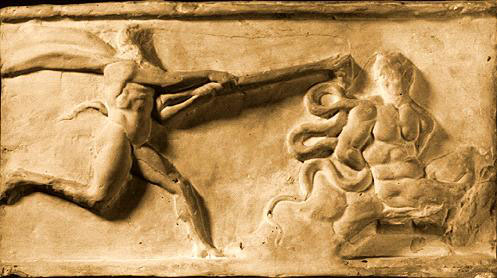
Satyr, wearing a panther skin, brandishing a torch and running towards a bound pirate who has been bitten by a snake on the right shoulder.
- Plaster cast: Height: 27cm.
- Copy of part of a marble frieze.
- The frieze:
- is from the Lysikrates Monument in Athens.
- was made about 330 BC.
- is still in situ.
Detailed Record
Commentary Prepared by Dr. Julia Lenaghan, Ashmolean Museum
A 141 H
Satyr and Pirate; Lysikrates Monument
Marble (Pentelic)
Frieze
H 25.4 cm
Greece, Athens, in situ
After 335/34 BC; Late Classical
Preservation:The surface of the relief is heavily worn. The satyr’s head has partly broken off; the pirate’s face is abraded. (The figures on the original monument were chiselled off after the cast was taken, and now are only visible in outline.)
Description:The scene depicts two figures facing to the right. On the left runs an elderly satyr with long beard; only his left leg touches the ground, the right is suspended in mid-air. He holds a long torch in front of him with both hands. A panther skin is draped around his shoulders and flows behind his back.
A heavily muscled human figure, depicted in three-quarter profile, the head turned slightly back, sits on a rock in front of the satyr. Both his arms are held behind his back; a large serpent is winding up the rock next to this figure.
Discussion:This section concludes the battle scenes depicted to the right of Dionysos. Another pirate has been overpowered and taken captive. Spatial depth is suggested in the terrain: The pirate’s legs are partly obscured by a huge rock; the satyr is charging forward between this rock and the pirate, his action directed at a figure further to the right.
For a full discussion of the monument see A 141a.
Bibliography:H. F. de Cou,
"The Frieze of the Choregic Monument of Lysicrates at Athens." (AJA 8 1893) 42-55
Discusses earlier studies and drawings of the monument and the composition of the frieze.W. Erhardt,
"Der Fries des Lysikratesmonuments" (Antike Plastik 22 1993) 29-30 figs. 44-45; 47 pl. 18b
The most thorough discussion of the frieze so far. Excellent photographs of the original frieze, as well as documentation of early drawings and casts documenting a much better state of preservation. Extensive bibliography.