Cast Gallery catalogue number: A141c
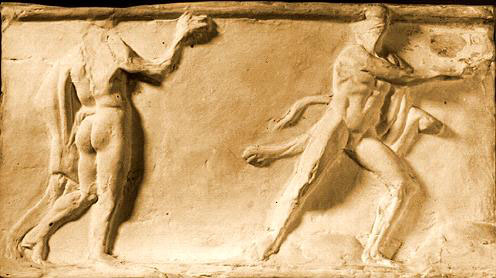
Satyrs; one gesticulating with a cup in his right hand, the other brandishing a pedum (sheperd's crook)
- Plaster cast: Height: 27cm.
- Copy of part of a marble frieze.
- The frieze:
- is from the Lysikrates Monument in Athens.
- was made about 330 BC.
- is still in situ.
Detailed Record
Commentary Prepared by Dr. Julia Lenaghan, Ashmolean Museum
A 141 C
Two Satyrs; Lysikrates Monument
Marble (Pentelic)
Frieze
H 25.4 cm
Greece, Athens, in situ
After 335/34 BC; Late Classical
Preservation:The surface of the relief is very worn, the head of the left figure with a large part of the right shoulder has broken off. The head and both lower arms of the right figure are heavily abraded.
Description:The scene shows two satyrs moving to the right. Their heads extended over the upper frame of the frieze. The first figure is seen in three-quarter profile from behind; his right arm is raised with a drinking vessel (?) in his hand. A panther skin is draped over the figure’s left shoulder, one paw reaching down to the ground. A second satyr is rushing off to the right over rocky terrain. He, too, wears a panther skin, draped over his left shoulder and arm. His right arm is thrust forward and seems to brandish a weapon; his head was turned back.
Discussion:The two satyrs depicted here form a transition between the calm scene in the centre of the frieze and the battle ensuing around. While the satyr on the left appears to be relatively calm, his companion on the right is about to join the fight. Rocks on the ground indicate a change of terrain.
For a full discussion of the monument see A 141a.
Bibliography:H. F. de Cou,
"The Frieze of the Choregic Monument of Lysicrates at Athens." (AJA 8 1893) 42-55
Discusses earlier studies and drawings of the monument and the composition of the frieze.W. Erhardt,
"Der Fries des Lysikratesmonuments" (Antike Plastik 22 1993) 24-25 figs. 32-34 pls. 14a-b
The most thorough discussion of the frieze so far. Excellent photographs of the original frieze, as well as documentation of early drawings and casts documenting a much better state of preservation. Extensive bibliography.