Commentary Prepared by Dr. Julia Lenaghan, Ashmolean Museum
A 138
Slab from the Amazonomachy Frieze of the Mausoleum at Halicarnassus
Marble
Frieze
H. c. 90 cm and c. 30 cm thick
This is one of three slabs found mounted on the sea wall of the crusader’s fortress (the Castle of St. Peter) at modern Bodrum (ancient Halicarnassus), and removed in 1846. Twelve slabs in total were found in the walls of the castle – the other nine decorated walls within the castle. Four other slabs and other fragments of the frieze were found on the site of the Mausoleum during Newton’s excavations and another was already in a collection in Genoa.
United Kingdom, London, British Museum, 1006
c. 350 BC
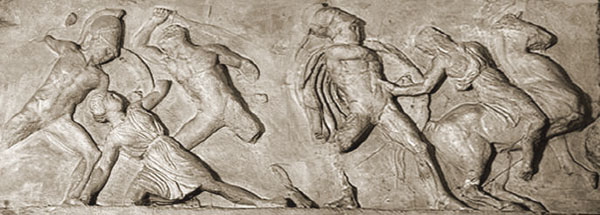
Preservation:This slab is relatively well preserved considering the fragmentary state of much of the sculpture from the Mausoleum. The mouldings along the top and the bottom have suffered damage. The bead and reel pattern decorating the moulding along the top of the slab, visible on other slabs of the amazonomachy frieze, has been totally obscured here. Of the relief figures, the warrior on the left hand side of the slab is missing his leg from mid-thigh down (part of it would have overlapped onto the next slab as well), and he is also missing his right forearm. Part of his right hand is preserved. The fallen amazon over which he stands, is missing her left forearm and hand, which reached up to the face of the second warrior. The chin and mouth of the amazon are also damaged. An object made separately and inserted into the hole running through her right fist is now missing. To the right, the second warrior is the most damaged of the relief figures. The top of his head is broken and much of his face is damaged. Most of his left forearm is broken away, as is much of his left leg. Part of the left hand and the left foot are preserved, though. At one time a fragment of a knee and shin were added to this figure, but this has since been shown to be inaccurate. The fragment is not included in the cast. Of the third warrior, the right forearm has broken off from the elbow. A large section of his right leg, from the middle of the thigh to about ankle height has also broken away. The edges of the shield he holds and the helmet he wears are slightly damaged. At the far left of the slab, the head of the amazon on horseback has been entirely obliterated through breakage. The tip of her right breast is damaged. Her right foot has broken off. The face of the horse she rides is severely damaged. The right foreleg has broken off entirely and there is a large crack or gouge through the rear right hock. The genitals of all the male figures have been broken off. The limbs which are missing broke off where they were carved in the round. Other fragments of the amazon frieze preserve traces of pigments from the original polychromy.
Description:This cast is taken from a slab belonging to a larger frieze, with figurative relief decoration depicting a battle between nude warriors – Greeks – and amazons. The slab depicts five figures, arranged into two combat groups. All the figures are posed in more or less frontal positions, with torsos turned toward the viewer. On the left side of the slab, the first combat group comprises two nude male warriors, who lean forward in lunging pose, attacking an amazon who has fallen to the ground below them. The composition of the group forms a neat, triangular unit. The first male from the left wears a Corinthian helmet, pushed back so that his face is exposed. He holds a round shield in his right hand, with the inside exposed to the viewer. His left arm is shown raised behind him, and although the instrument is now broken away, he surely held a sword with which he was about to strike the fallen amazon beneath him. The amazon herself leans to her right, resting on her right knee and arm, with her left leg stretched out behind her. Her head is shown turned back, so that she faces the second attacking warrior, and her left arm is raised in a defensive gesture. She wears a sleeveless, short chiton, belted at the waist. Her right hand is closed into a fist and there is a large hole through the fist of the insertion of a separately made object (perhaps an axe – the weapon of choice for amazons). The second warrior, shown bearing down upon her from her left, is shown in a lunging pose, similar to the first warrior. Like that warrior, he is also nude. The top of the head is broken, but there are no traces to indicate he wore a helmet. He is shown holding a sword in his raised right hand.
The second combat group comprises another warrior and an amazon on horseback. The warrior is shown in a somewhat awkward backward or reverse lunging position, stepping back and placing his weight on his right leg. His left leg is stretched out before him, the knee slightly bent. His upper torso is twisted, emphasising his powerful muscles. His right arm is extended forward, his hand (now missing) grabbing the hair of the amazon on the right hand side of the slab. His costume is slightly more elaborate than that of the other warriors so far described. He is shown with a crested Corinthian helmet pushed back off the face and holds a round shield, the inside of which is exposed. He also wears a short cape (chlamys), fastened at the neck, which is shown flying back behind his, emphasising the action of the battle. The horse of the amazon he opposes faces the left side of the slab, away from the action. The horse is rearing, and the amazon is shown leaning back, her head twisted over her right shoulder as her opponent drags her from the horse by her hair. Her left arm is held forward, her hand grasping the neck of the horse; her fingers can be seen at the top front of the horse’s neck. She extends her right arm back, her right hand grabbing her opponent at the waist. She wears only a short, sleeveless chiton, unfastened over one shoulder so that her right breast is exposed. There is a small dowel hole between the abdomen of the amazon and the horse’s mane, which would held a separately made object – possibly the reins of the horse.
There is a moulding along the bottom of the slab, which serves as the ground line for the figures. Along the bottom of the moulding, there are two rectangular cuttings. Pigments were preserved on some of the amazon frieze slabs; Newton noted blue background, reddish flesh and other colours detailing the armour and drapery on slabs he excavated on the site of the monument. As well, bridles and other weapons, as in the weapon of the first fallen amazon on this slab, were regularly made separately and inserted. The decorative moulding which ran across the top of this slab – bead and reel (astragalos)– has been obscured by damage.
Discussion:This cast is one of seventeen slabs which survive of frieze depicting an amazonomachy (battle between Greek and amazons), which once adorned the Mausoleum at Halicarnassus. The amazonomachy frieze is the best preserved of the Mausoleum’s sculptures and is the only sculptural element on which there is a consensus concerning its location on the monument. Architectural evidence recovered by the Danish excavators strongly suggests the frieze decorated the podium of the Mausoleum, and not the entablature, as Newton and Smith had argued. The combined length of the surviving parts of this frieze (26 m) make it longer than just one side, suggesting it could have run around all four sides of the podium top (making a total length of about 70m long).
In terms of theme, composition and quality, this frieze is in the tradition of the best Greek temple friezes. The ancient sources record four sculptors having worked on the Mausoleum: Skopas, Leochares, Bryxis and Timotheos or Praxiteles (although most scholars discount the latter). Although it is not clear which one if any of these sculptors carved the amazon frieze, the tradition which associated famous names with the building indicates one of Mausolus’ aims was to decorate his monument with the very best quality sculpture. One difference between the battle friezes of the late fifth century on Greek temples and this frieze that is sometimes pointed out in handbooks, is that in the Mausoleum frieze the combat groups are rather widely spaced (as noticeable in this slab) and the flying cloaks of the warriors are less florid than those of, for instance, the amazonomachy of the Temple of Apollo at Bassae. The figures of the Mausoleum frieze also overlap the slabs – notice in this slab how the right leg of the first warrior on the left hand side of the slab carried on to the adjoining slab.
The amazonomachy may have had special significance to Caria and Mausolus. Anatolia was in general the land of amazons, but more specifically, the Carians held that Herakles, who is certainly depicted in another slab of this frieze (BM 1008), stole the double-sided battle axe of the amazon queen Hippolyte, and this axe had later been transferred to the shrine of Zeus Stratios or Labrandos, at the Carian sanctuary at Labraunda (the theft of the axe is recorded by Plutarch, in quaestt. Gr.45). Mausolus also started building programmes at Labraunda during his reign.
On the Mausoleum in general, see B 97 (‘Mausolus’). For other statues from the Mausoleum, see A 139 (fragment of the amazonomachy frieze), A 140 (fragments of a chariot race frieze), B 98 (‘Apollo’), B 116 (‘colossal’ portrait of a woman) and B 229 (‘heroic’ portrait of a man).
CMD
Bibliography:C.J. Newton,
"On the Sculptures from the Mausoleum at Halicarnassus," Classical Museum 5 (1848) 170 - 210
(on the discovery of the amazon frieze in the Castle at Bodrum)C.J. Newton,
A History of Discoveries at Halicarnassus, Cnidus and Branchidae (London 1862) 234 - 44
(considers the frieze to be the frieze of the order and compares unfavourably the frieze to the same theme as rendered by ‘Phidias’ on the metopes of the Parthenon; lists earlier publications)A.H. Smith,
A Catalogue of Sculpture in the Department of Greek and Roman Antiquities, British Museum, vol. 2 (London 1900) 95 - 119, esp. 99 - 100, no. 1006
(follows Newton in considering this part of the frieze of the order; lists earlier publications)K. Jeppesen,
“Old and New Evidence of a Reconstruction of the Mausoleum at Halicarnassus,” Paradeigmata: Three Mid-fourth Century Main Works of Hellenic Architecture Reconsidered (Aarhus 1958) 1 - 68, esp. 21 - 26, figs. 10 and 11
(provides first new architectural evidence for the placement of the frieze, which should be situated along the top of the podium)B. Ashmole,
Architect and Sculptor in Ancient Greece (London 1972) 166 - 91
(general discussion; points out the work of different sculptors in the frieze; notes the relevance of Herakles axe later housed in a Carian shrine)B.F. Cook,
"The Mausoleum Frieze: Membra Disjectanda," BSA 71 (1976) 49 - 54, esp. 51 - 52, pls. 6 and 7
(argues a fragment of leg which was at one point added to the figure of the second Greek from the left of the slab does not belong to the figure)T. Linders and P. Hellström (eds.),
Architecture and Society in Hecatomnid Caria (Uppsala 1989)
(numerous essays covering more than just the Mausoleum; in particular: Jeppesen gives details of the mouldings running above the amazon frieze, Cook summarises arguments on attribution and Stampolidis argues the marble is from Cos)I. Jenkins and G. Waywell (eds.),
Sculpture and Sculptors of the Dodecanese and Caria (London 1997)
(various short reports on aspects of the Mausoleum, including appearance of the monument with placement of the sculpture, marble type [Proconnesian], polychrome decoration and sculptors)