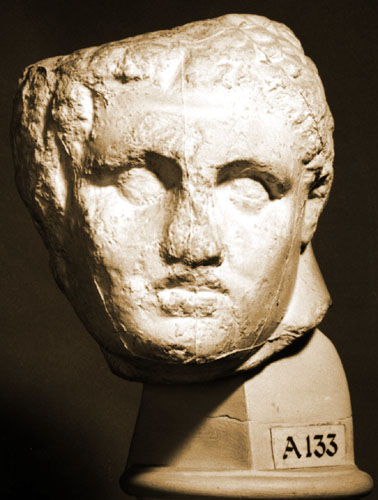
Head of a youth.
Commentary Prepared by Dr. Julia Lenaghan, Ashmolean Museum
A 133
Head of youth from Tegea. Athens
Head of youth turned to its left. From the scene of the Calydonian boar hunt that decorated the east pediment of the Temple of Athena Alea at Tegea. The temple was constructed by Scopas of Paros in ca. 350 BC.
Marble
Pedimental Figure
H 21.4 cm, W 20.4 cm, D 21.5 cm
From the Temple of Athena Alea at Tegea. Found in the later walls in front of the northwest angle of the temple with the head of the Calydonian boar (cat.no. A 132) and the head of Achilles (cat.no. A 137).
Greece, Athens, National Museum, 179
Ca. 350-340 BC
Preservation:The head has broken from its body through the neck. The top of the head ends in a roughly worked oblique surface. The nose is badly battered; only the outline of its right side remains. The left ear, the eyebrows, and the lips are also battered, but to a lesser extent. There are deep diagonal gouges in the hair above the inner and outer corners of the right eye and near the right ear.
Description:The head depicts a squat-faced, short-haired, clean-shaven young male. It turns powerfully to its left. The surviving portion of the neck is thick and extends diagonally away from the head toward the left.
The face is short from chin to crown and broad across the brow and between the cheekbones. The face tapers slightly to the small chin. The brow features a horizontal furrow, below which the forehead bulges. The base of the nose, continuing the swelling of the lower forehead, also bulges. It is thick from side to side. The eyebrows are arched and the eyes are small, wide-set, and extremely deep-set. The left eye is more fully finished than the right. Below the arch of the eyebrows and above the eye is a heavy fold of skin that covers the upper lid. The convex surface of the eyeball continues below the lower lid, and the entire area of the eye socket is indicated as an indented area in the massive thick cheeks. At the left corner of the nose is another pucker in the skin indicating the edge of the round cheek. The pucker would seem to be created by an upper movement of the mouth on the left side. The mouth is short from side to side with full shapely lips. Below the lower lip is a narrow groove below which begins the projection of the chin. The chin is rounded and protruding as well as short and narrow.
The hair grows in short tufts that spring off the brow. Twisting in all directions they are unruly but not fully worked.. The back of the head is flat; the point where the cranium meets the neck is almost a smooth vertical. The head’s extension from back to front is notably deep. The right ear was never rendered. The left ear is small and has a flattened lobe.
Discussion:The turned head of a powerful young male with a slight grimace was found in the area of the Temple of Athena Alea at Tegea. It is of the same technical workmanship and size as fragments that assuredly belong to the pedimental sculpture from the Temple.
Pausanias (8.45) visited the Temple of Athena Alea at Tegea and recorded it as a remarkable structure created by the architect Skopas of Paros. For more general information on the Temple, see cat.no. A 132 and for other fragments, see cat.no. A 132, 134-137.
According to Pausanias, the east pediment featured the Calydonian boar hunt and the west pediment the battle between Telephus and Achilles on the plain of Kaikos. Although this head cannot be securely ascribed to one or the other of the pediments, two details make it more likely to have belonged to the east (hunt) pediment. One, the Greeks and Mysians wore helmets in battle. Two, Stewart has noted that the proportions of the figures of the two pediments differ slightly; the figures of the battle scene are larger. This head corresponds to the slightly smaller group.
The head, which draws its lip up in pain, turns to its left. It is clear from the lack of fully worked details (for instance, the ear) on the right side that the right side was not visible. The viewer was to see the head in three-quarter view and turned to the viewer’s left. Moreover, the top of the head has been sliced so as to fit under the raking cornice of the pediment. This means that the figure was either standing near the center or seated near the corners of the pediment. Three possible locations for the head on the east pediment have been proposed: 1) the figure was seated, looking inward, at the right corner of the pediment; 2) the figure was seated, looking outward, at the left corner of the pediment; 3) the figure was standing, looking outward, to the left of center. Stewart finds the first option most appealing and tentatively identifies the figure with one of the last heroic participants of the battle mentioned by Pausanias, Amphiaraos or Hippothoos. The curling left corner of the mouth presumably indicates that the figure was wounded during the hunt.
The head is often cited in discussions of Skopas’ style. It is the most cubic and deepest of all the heads preserved at Tegea. In addition, the squat face, the divided brow with its lower bulge, the massive cheeks, the thick features, the heavy orbitals hanging over the outer corners of the eyes, and the pathos-filled expression have all become characteristic benchmarks for the style of Skopas. The head evokes power and gripping intensity, terms often applied to Skopas’ oeuvre.
J. Lenaghan
Bibliography:C. Dugas, J. Berchmans, and M. Clemmensen,
La sanctuaire d’Aléa Athèna à Tégée au IVe siècle (Paris 1924) 91-92, pl. 102b
first full catalogue entry, believes it impossible to determine assuredly to which pediment the head belongedA. Stewart,
Skopas of Paros (Park Ridge, NJ 1977) 7-8, 16-18, no. 9, 51-52, 73, pl. 7, 8a-b, 38c-d, 52b-c
full catalogue entry with bibliography, places it on east pedimentB. S. Ridgway,
Fourth-Century Styles in Greek Sculpture (London 1997) 48-52
recent discussion in English of the temple and its sculptureC. Rolley,
La sculpture grecque II. La période classique (Paris 1999) 268-272
most recent clear and logical presentation of material and bibliography