Commentary Prepared by Dr. Julia Lenaghan, Ashmolean Museum
A 132
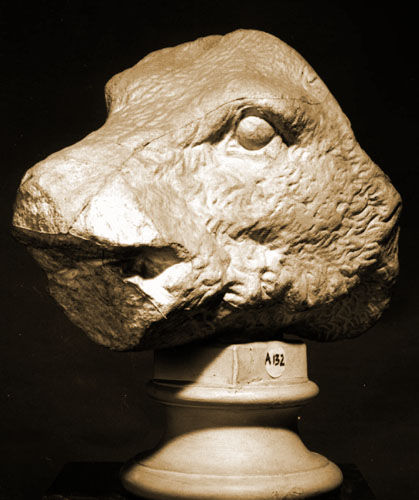
Head of Calydonian boar from Tegea. Athens
Fragment of the head of a boar. From the scene of the Calydonian boar hunt that decorated the east pediment of the Temple of Athena Alea at Tegea. The temple was constructed by Scopas of Paros ca. 350 BC.
Marble
Pedimental Figure
L 42 cm, H 29 cm, D 24.5 cm
From the Temple of Athena Alea at Tegea. Found in the later walls in front of the northwest angle of the temple with the head of a young man (cat.no. A 133) and the head of Achilles (cat.no. A 137).
Greece, Athens, National Museum, 178
Ca. 350-340 BC
Preservation:The head has broken from its body just before the ears. The break runs diagonally from the top of the head to the throat. The front portion of the snout has also broken off. The underside of the head as well as the right eyelid and eye are battered. The left side shows more signs of weathering than the right side which appears unfinished. On the right side are two small rectangular holes behind the mouth.
Discussion:This head of a boar was found in the area of the Temple of Athena Alea at Tegea. According to Pausanias a depiction of the Calydonian boar hunt decorated the front (east) pediment of the Temple of Athena Alea. The boar’s head provides crucial confirmation of Pausanias’ description.
In addition to providing the themes of the temple’s pedimental decoration, Pausanias (8.45.4-7) gives important information about the date and architect of the temple. The Temple of Athena Alea was an exceptional building that replaced an older temple which had been destroyed in a fire in 395 BC. The architect of the building was Skopas of Paros, ‘who made images in many places of ancient Greece, and some in Ionia and Caria’.
These two details have supplied scholars with material for endless discussion and debate. Although Skopas is the architect and was probably only involved in a general plan of the pedimental sculpture, many scholars ascribe it directly to him and use the pedimental sculptures to define a Skopan style that they then strive to trace in other statuary.
Scholarly debate focuses on the precise date of the temple and its sculpture. Vitruvius and Pliny the Elder both note that Skopas participated in the Mausoleum at Halicarnassus in ca. 360-350. A votive relief found at Tegea bears depiction, once labelled, Zeus Labranda (a Carian form of Zeus), Ada, and Idrieus (the successors of Mausolus and Artemisia). This confirms a connection between Halicarnassus and Tegea, and Idrieus’ death in 344 BC provides a terminus ante quem for the relief. It has been suggested that either this relief was a dedication by a worker who followed Skopas from Halicarnassus to Tegea or part of a decree thanking the Carian royalty for a hypothetical contribution to the Temple of Athena Alea. In any case, most scholars now accept that the Temple in Tegea post-dates Skopas’ involvement in Halicarnassus. Rolley, for example, notes that the architectural details of the temple are appropriate to date after 350 BC. A. Stewart in the latest full coverage of the temple, however, disagrees but arrives at the generally accepted date for the sculpture. He places its inception ca. 370, immediately following the Spartan defeat at Leuctra and the formation of the Arcadian League. He acknowledges that the temple structure could not have been finished before 355 BC and that the sculpture continued to be wrought into the 340s.
In regard to the east pediment, Pausanias writes that boar was at the center of the pediment. On one side of the boar, he then lists nine heros, first and apparently prominent among these is Atalante, the local Arcadian huntress with whom Meleager fell in love. On the other side of the boar Pausanias cites six heros. Because symmetry was typical for these decorations, it has been suggested that perhaps Pausanias has omitted three heros. The total number of figures was at least fifteen and possibly eighteen. Although only the head of the boar is preserved, it allows for two observations. Since the right side of the head is not worked, the left side was the only visible side. Thus, the body was probably also seen in left profile, advancing to the viewer’s left. Second, on the basis of the size of the head, the full figure was probably about 1.70 m long. The two holes behind the right side of the mouth remain a puzzle for scholars. Initially it was suggested that they were the holes into which wounding spears or arrows were inserted. Yet the angle and placement is unsatisfactory. Other suggestions include struts to attach the boar to the wall of the tympanum or supports to connect to a hunting dog which leapt at the throat of the boar (the muzzle and body of the dog are preserved). A stylistic detail of the boar that is repeatedly noted is the eye which is more human than animal.
The theme of the Calydonian Boar hunt has pan-hellenic and local motifs. The boar hunt was occasioned by King Oeneus’ neglect to sacrifice to Artemis who then sent a boar to destroy his territory. He and his son, Meleager, called together a hunting party of Greek heros from various cities. Atalante of Arcadia had a decisive role in the hunt and was awarded by Meleager the prize of the skin and head. The story has a direct association with the temple since the decaying skin of the boar were stored in the cella as a votive. The story’s connection to Athena Alea is a slightly vague. Although there need not have been a particular link, Stewart argues that the scene demonstrates the battle-like aspect of Athena.
J. Lenaghan
Bibliography:C. Dugas, J. Berchmans, and M. Clemmensen,
La sanctuaire d’Aléa Athèna à Tégée au IVe siècle (Paris 1924) 84-85, pl. 108a
full catalogue entryA. Stewart,
Skopas of Paros (Park Ridge, NJ 1977) 14-15, no. 5, 51, pl. 5a
first full catalogue entry with bibliography and discussion of placement and pose in pedimentB. S. Ridgway,
Fourth-Century Styles in Greek Sculpture (London 1997) 48-52
recent discussion in English of the Temple and its sculptureC. Rolley,
La sculpture grecque II. La période classique (Paris 1999) 268-272
most recent, clear, and logical presentation of material and bibliography