Commentary Prepared by Dr. Julia Lenaghan, Ashmolean Museum
A 125
Trojan woman with plaits from Epidauros. Athens
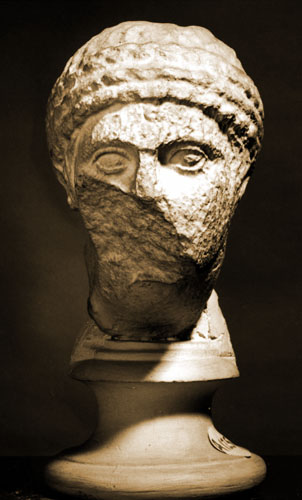
Under life-size head of a woman with plaits wound around her head. Belonging to a statue of a Trojan woman crouching in front of a standing Trojan woman. From the east pediment (depicting the Sack of Troy) of the Temple of Asklepios at Epidauros, ca. 375 BC.
Marble (Pentelic)
Pedimental Figure
H (of group) 30 cm, (of head) 11 cm
From the Temple of Asklepios at Epidauros. Found in the late walls between the the Tholos and west façade of the temple. The main body fragment of the figure was found built into the wall of a late house within the sanctuary.
Greece, Athens, National Museum, 153
Ca. 375-370 BC
Preservation:The head is broken through the neck. The nose is missing, and a large section of the lower face has split diagonally off, from under the right eye to the left side of the chin. The surface is very weathered. Both ears have small holes in the lobes into which metal earrings were inserted. The head belongs to a kneeling figure that is part of two-figured composition that shows a kneeling and a standing woman. The group, originally made from one block of marble, has now been recomposed of a total of eight fragments: this head; a large fragment of the kneeling woman with the lower portion of the standing figure behind it (Epidauros Museum 65); the upper body of the kneeling figure with the left chest and shoulder (Epidauros Museum 82)); the right leg of the kneeling figure (Epidauros Museum); the upper body of the standing woman (Epidauros Museum 94); two fragments from the right arm of the standing woman (Epidauros Museum). Two additional fragments, a portion of a head possibly of the standing figure and a left forearm possibly of the kneeling figure, might also belong to the group.
Description:The head depicts a woman with long plaits wrapped around her head. The neck cranes forward and the head leans to its right.
The hair is worn in two plaits that wrap horizontally twice around the head just over the brow. All the way around the head at a level just above the ears, a double row of plaits is visible. On the back right side, the plaits are only summarily defined and lose any sense of volume. The portion of the hair above the plaits is an evenly but roughly worked surface that is stepped back from the plaits. The spatial distinction between these two areas is lost on the back right where the plaits become flat. In front of both ears, below the plaits, a clump of hair falls on to the cheek; it has a triangular outline and some individual locks within the group are delineated. Both earlobes have small drills holes for the insertion of earrings, even though the right ear is only roughly defined.
The face is oval. The forehead, crossed evenly by the plaits, appears to be low and gently convex. The eyebrows are low-arching ridges. The eyelids are projecting rims around the eyeballs. The right eyeball is entirely flat whereas the center of the left eyeball retains a small rise.
Discussion:This female head with plaits belongs to an under life-size figure of a kneeling Trojan woman that formed part of the sculptural decoration of the east pediment of the Temple of Asklepios at Epidauros. The temple was constructed ca. 380-370 BC, and its sculpted pediments featured an amazonomachy (on the west side) and the sack of Troy (on the east side). The sack of Troy or Ilioupersis featured at least twenty-one figures that depicted Trojan women, Priam, one cult image, and attacking Greek warriors. For general information on the temple, see cat. no. A 121 and for other fragments from the pediments, see cat. nos. A 122, 123, 125, 126, 127, 168, and 169.
This figure to which this head belongs has recently been reconstructed from different fragments in the Athens and Epidauros museums. The head joins the body of a crouching woman who kneels on her left knee. The right leg was bent at a slightly greater than 90 degree angle and opened toward the right. The upper body bent forward over the legs, and the head craned further forward and leaned to the right. The body was visible to the viewer in three-quarter view whereas the head was visible primarily in profile. Its left side faced outward to the viewer. The woman wore a long inner garment and a mantle over it.
This figure of kneeling woman was part of two-figured group expertly carved from one block of marble. The second figure was again a woman dressed in a long inner garment and mantle. She stood behind the crouching woman and bent slightly down to her. Because of its size and shape as well as direction of the gaze of the crouching figure, the group has been placed on the right side of the pediment behind the figure of Priam (cat. no. A 121). The two women would have been watching and reacting to the scene of Neoptolemos grabbing Priam by the hair.
The group demonstrates characteristics typical of the East pediment; for example, the group does not rest on a plinth but was fastened directly to the pediment floor and the fold patterns are long and looping with sharp edges and feature a play of light and shadow. Even though the group is heavily weathered, it is a remarkable sculptural composition.
J. Lenaghan
Bibliography:J. Crome,
Die Skulpturen des Asklepiostempels von Epidauros (Berlin 1951) 51, no. 42, pl. 48
brief catalogue entry, ascribes to east pediment, suggests HecabeN. Yalouris,
"Die Skulpturen des Asklepiostempels von Epidauros" Archaische und klassische griechische Plastik II (Mainz 1986) 182, pl. 153.3
reconstruction of female group to which the head belongsN. Yalouris,
Die Skulpturen des Asklepiostempels in Epidauros (AntPl 21 1992) 28, no. 19, pls. 18c-d, 19
full new catalogue entry, discussion of newly reconstructed two-figure group to which head belongs