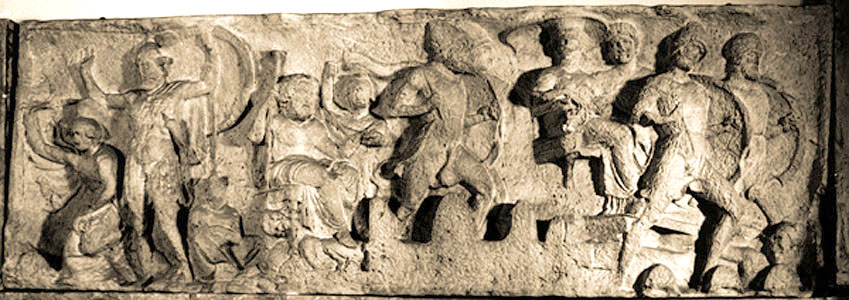
Warriors defending the walls of a besieged city.
Commentary Prepared by Dr. Julia Lenaghan, Ashmolean Museum
A 120 C
City Siege; Trysa Heroon West Wall
Limestone
Architectural Relief
W (total) 618 cm
First discovered in 1841 but soon forgotten, the Trysa heroon was rediscovered in 1881 by Otto Benndorf, then Professor of Classical Archaeology in Vienna. In 1882/83 the friezes of the heroon were transferred to Vienna.
Austria, Vienna, Kunsthistorisches Museum
Late Classical, ca. 370 BC
Preservation:The entire surface of the relief is heavily weathered, many figures are greatly worn and abraded.
Description:Depicted are a total of twelve figures on a fortification wall with a tower in the centre. To the left, shown in three-quarter profile from the left, are two men. One wears oriental dress and kneels next to a ram, which he holds down with his left hand, while his right is raised and holds a sword. The other man, bearded, a helmet on his head and wearing a cuirass and mantle draped over his back, stands upright. His left holds a spear, his right arm is raised. Next to him crouches another figure in oriental dress. Further to the right is a mature, bearded man on a throne, depicted in three-quarter profile from the right. A mantle is draped over the lower part of his body, his chest is exposed. With his right he holds a long sceptre. By his side is a smaller figure holding an object now lost, but by all accounts originally a parasol. On the tower, partly overlapping, follow two helmeted soldiers in short chitons and chlamydes, spears in their right and round shields in their left, rushing to the right. Next is a female figure on an ornate throne with a sphinx as armrest. She wears chiton and himation and is protected by a parasol held up by a female attendant. Further to the right are two more warriors advancing, much like the previous pair, and at their feet another figure in oriental dress hurling a stone with his right.
Discussion:Depicted here is the central scene of the city siege. To the left a ram is sacrificed by the city’s defenders. Several soldiers rush to the right to join their comrades in a counter attack. In the centre is the ruling couple with their entourage. The dynast and his wife sit on ornate thrones and are attended by servants with parasols. Most scholars believe that the local ruler, to whom the Trysa heroon was dedicated, is in fact represented here, successfully directing the defence against an outside enemy.
For the Trysa heroon in general see also A 119a and A 120a.
Bibliography:O. Benndorf and G. Niemann,
Das Heroon von Gjölbaschi-Trysa (Vienna 1889) esp. 51; 123-129 pls. 11; 112-113
The basic first publication of the monument.F. Eichler,
Die Reliefs des Heroon von Gjölbaschi-Trysa (Vienna 1950) esp. 61-63 pls. 18-21
Detailed guide with a description of the monument and the individual reliefs.R. Noll,
Das Heroon von Gjölbaschi-Trysa. Ein fürstlicher Grabbezikr griechischer Zeit in Kleinasien [= Führer durch das Kunsthistorische Museum Nr. 16] (Vienna 1971) esp. p. 5
A short guide with a detailed description of the various reliefs.W. A. P. Childs,
"Prolegomena to a Lycian Chronology, II: The Heroon from Trysa" (RA 2 1976) 281-316
Gives a detailed stylistic comparison between the reliefs from Trysa and sculptures from the Greek mainland and the rest of Lycia. The Heroon at Trysa is dated to ca. 370 BC.W. A. P. Childs,
The City-Reliefs of Lycia [= Princeton Monographs in Art and Archaeology XLII] (Princeton N. J. 1978) esp. 13-14; 31-36; 78 pls. 1.2; 13.2-17
Shows that the siege scene from Trysa forms part of the typical iconography of Lycian reliefs and ultimately derives from Near Eastern, particularly Assyrian sources that were slightly adapted under Greek influence.C. Bruns-Özgan,
Lykische Grabreliefs des 5. Und 4. Jahrhunderts v. Chr. [= IstMitt Beiheft 33] (Tübingen 1987) 56-81; 256-257 pls. 9-11.2; 12-13.2
Argues that the friezes from Trysa show an advanced style of ca. 370 BC and are influenced by the iconography of Greek paintings of the Classical period, probably through the use of established pattern books.B. S. Ridgway,
Fourth-Century Styles in Greek Sculpture (London 1997) esp. 88-94 pls. 24-25
Good summary and bibliography of previous research on the heroon.