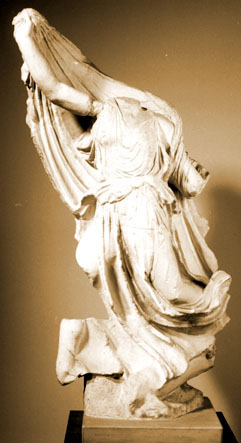
Commentary Prepared by Dr. Julia Lenaghan, Ashmolean Museum
A 117
Nereid 910, from the Nereid Monument at Xanthos. London
Under life-size statue of Lycian water nymph with a fish at her feet. From the intercolumniations on the north side of a grave monument of a Lycian dynast (probably Arbinas) at Xanthos. C. 390 BC
Marble
Statue
H 1.42 cm (to neck), 1.78 m (to right hand), L 1.10 m, W 39 cm
From Xanthos in Lycia. Part of a funerary monument on a hill within the city’s Hellenistic walls. Found in 1842 on the north side of the terrace.
United Kingdom, London, British Museum, 910
c. 390 - 380 BC
Preservation:The.head, the left arm from the elbow down, the right foot, and small parts of the overfold and himation. The statue is made of two large pieces of unequal size. The line of the break crosses the bottom of the statue horizontally, moving from just below the right knee to the left foot. Other fragments have been reattached and restored. The right arm is reattached and the right shoulder is a plaster restoration; the upper arm is recomposed of five fragments. The himation held by the right hand is recomposed of three fragments with some plaster filling. The right knee is also plaster and the lower right leg with a portion of drapery between the legs is made of two fragments; an adjacent piece of drapery has also been reattached. The end of the drapery that crosses the left leg and the left foot are also attached. The edge of the himation around the left arm near the shoulder is plaster but connects to an attached fragment at the back of the shoulder. At the back the edge of a fold below the horizontal break has also been reattached.
Description:The statue depicts an adult female dressed in a sleeveless and belted inner garment who holds a cloak around the back of her body. The figure, suspended in air, moves to its right and on the ground at its feet is a long fish, perhaps a dolphin.
The figure runs to its right. It is in the process of shifting its weight from one leg to another and is about to land its weight on its right leg. The right leg bends slightly; the upper leg extends to its right and the lower leg is almost perpendicular to the ground. The extant heel points to the right and shows that the rest of the foot extended slightly downward. The left leg trails far behind the right leg. Its upper portion extends down and to the left of the body. Its lower leg extends yet further to the left and slants diagonally toward the ground. In contrast to the legs, the upper body faces forward. The right arm and shoulder are raised. The arm extends to the right of the body and the forearm reaches well above the level of the head. The right hand holds up a corner of a heavy cloak that drapes behind the figure. The left upper arm is lowered and rests alongside the body. The forearm, however, extends behind the figure to the left. Wrapped around the upper arm from shoulder to elbow is the left edge of the cloak that runs behind the body.
The figure wears a sleeveless tube-like garment that reaches its feet. The upper edge of the garment has been folded down and reaches the level of the hips. The garment is buttoned together once at each shoulder along the crease of the fold. A flat cord is worn around the waist; it goes over the folded the section of the garment, the end of which appears below the belt. Wind or the figure’s movement push the end of the fold (overfall) in two different directions near the left side. A heavier cloak or mantle covers the back of the body. It is held up by the raised right hand and is wrapped around the left arm.
At certain points the body pushes through the garment; for instance, around the extended right leg, or at the bent left knee, and around the right breast. The drapery between the legs falls in thick calligraphic sweeping folds. These are broadly spaced, run parallel, and feature deep hollows between them. They are what Ridgway calls “Railroad track folds”. The back of the statue is fully finished but the folds are flatter than at the front of the figure.
On the ground between the figure’s feet is a long cylindrical fish. It slants upward and backward from a central point between the feet toward the left foot. Its head is not longer extant but a fin is visible near the where the head would have been.
Discussion:‘Nereid 910’ in the British Museum comes from the ‘Nereid monument’ at Xanthos. This monument is discussed more fully under cat. no. A 116 and also under cat. no. A 118. It was excavated in the nineteenth century and was a funerary monument for a local dynast, probably one Arbinas.
The monument, which took the form of a small temple, featured eleven statues of ‘Nereids’ in its intercolumniations on three sides, the east, west, and north sides. These figure give the monument its modern name. All of them are young females with aquatic animals at their feet. There are six almost complete statues of these ‘Nereids’ extant as well as five large fragments in the British museum, 19 small fragments in the British Museum, and 8 fragments at Xanthos.
Until recently the statues were deemed to be Nereids, the daugthers of the sea-god Nereus and the sisters of Thetis. In 1995, however, T. Robinson has proposed to identify them as similar divinities but divinities from the Lycian mythological repertoire. He has identified them as local water divinities, Eliyãna, who served Leto. Given the locale of the monument and the non-Greek iconography, this would be more suitable. Moreover, the dynast Arbinas had built a temple to Leto, who had been assimilated with an older Anatolian mother goddess. Thus, it would be understandable that Arbinas might be accompanied by Leto’s other devoted servants. Whether Eliyãna or Nereids, the main concept is similar—a divine escort for a heroic, more than mortal figure.
‘Nereid 910’ was found on the north side and appears to have been immediately to the viewer’s right of ‘Neried 909’ (cat. no. A 116), assuredly located at the center of the north. The stance of 910, which moves from left to right (i.e toward the center) and its plinth size seem suitable for such a position.
Just in the case ‘Nereid 909’, the figure has been identified as belonging to the sculpture of the monument created by the workshop now labelled M I. This is thought to have been a Greek workshop, working in a local stone, rather than a local workshop. It is this workshop that is considered responsible for most of the Nereids. Stylistically the folds and drapery of this Nereid have even closer parallels to contemporary Greek sculpture than the more individual details of Nereid 909. Comparisons include the some of the figures of the balustrade of the Temple of Athena Nike, the Dexileos monument, the Nike 312 from the Agora, and acroteria from the Asklepeion in Epidauros.
J. Lenaghan
Bibliography:A.H. Smith,
A Catalogue of Sculpture in the Department of Greek and Roman Antiquities, British Museum II (London 1900) 33-35, no. 910
catalogue entryW. A. P. Childs and P. Demargne,
Fouilles de Xanthos VIII : Le Monument des Néréides, Le décor sculpté (Paris 1989) 126-128, 270-277, pls. 94-96, 97.1-2,
catalogue entry, illustrations, discussion of meaning of NereidsL. Todisco,
Scultura greca del IV secolo (Milan 1993) 55-56, fig. 71
illustration, bibliography, and brief discussionT. Robinson,
"The Neried Monument at Xanthos or the Eliyãna monument at Arñna" (OxfJA 14 1995) 355-359
identifies the ‘Nereids’ as local Lycian divinities, the EliyãnaB. S. Ridgway,
Fourth-Century Styles in Greek Sculpture (London 1997) 78-79, 84-86, ill. 11
discussion of the ‘Nereid Monument’, summarizes research to date and provides bibliography